Viral News in the Civil War
ECW welcomes guest author Keith Altavilla.
On the morning of June 24, 1864, just a few months away from a presidential election, Republican readers of the Cleveland Morning Leader in Ohio were treated to a spicy jab at their political opponents. In a one-paragraph item, purporting to answer readers from New York how to define the term “copperhead,” the paper shared “the last definition we have seen [which] strikes us as the best: ‘A creature which has all the instincts of a rebel, without the pluck to be one openly.’”[1]
It was a devastating insult, or at least it must have been, as the piece reappeared three days later in Indiana’s Evansville Daily Leader, then ten days after that in the Lancaster Gazette in south-central Ohio. This is an example of what we today call viral content, stories almost too perfect to be true, or arguments carefully selected to “destroy” their targets, that spread quickly through media sources. A sampling of northern newspapers from 1863 reveals this space-filling content. In an era where newspapers eagerly shared stories and articles with one another, this pattern repeated itself across the northern states and was an important part of the fabric that created national political movements in an age of strong sectional identity.[2]
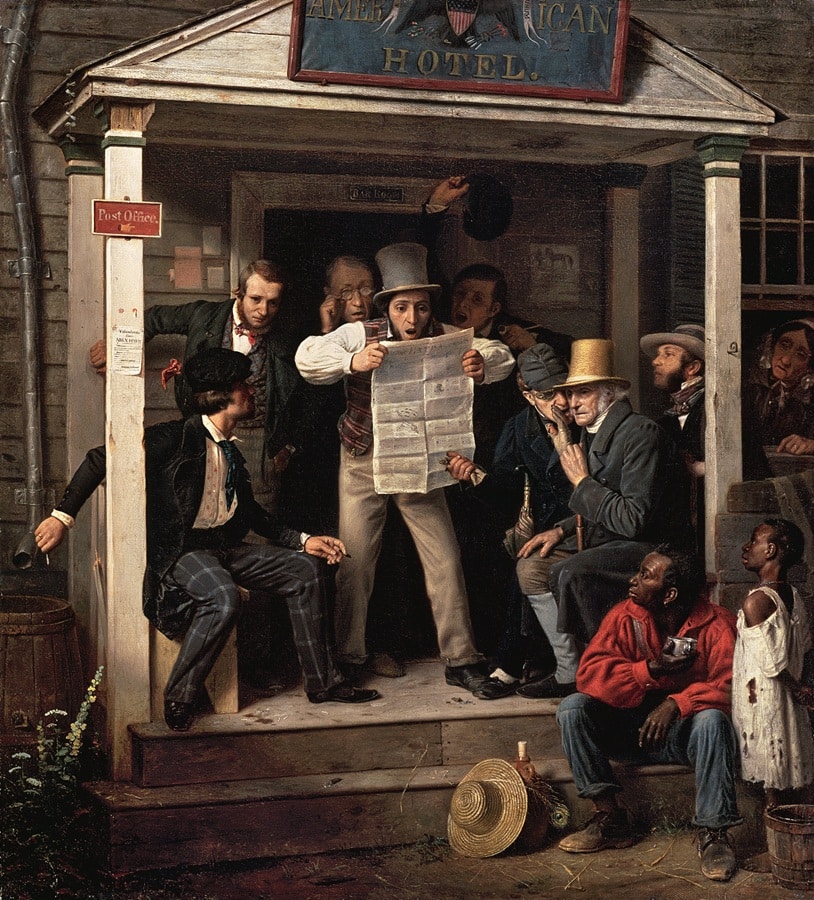
The spread of newspapers during the communication and transportation revolutions of earlier in the nineteenth century helped transform the United States from a varied mixture of regional cultures toward unified national culture. At the same time, these stories, both for Republicans and Democrats, reinforced the dogma of a political party, making clear what it meant to be a member, and what members believed. “Only a newspaper can come to deposit the same thought into a thousand minds at the same moment” wrote Alexis de Tocqueville in Democracy in America, and parties relished the opportunity to reach a thousand minds at once.[3]
A similar dialogue to the one we started with appeared in the Cleveland Morning Leader on August 19, 1863. Here Uncle Sam was asked by a “Secesh” to bend over because “I want to cut your throat!” The Copperhead then repeated the request, and when Uncle Sam worried that the Copperhead wanted to cut his throat as well, only responded “O no—never! I wouldn’t do such a thing for the world! I only want to hold your arms pinioned behind your back while Secesh cuts it. That’s very different, you see!” Uncle Sam would close the tableau with a simple “No, I don’t see it.” Not a riveting conversation, but one that clearly shows how Unionists interpreted the Copperheads’ role in political opposition. Simple, but effective enough to be reprinted in other Ohio papers like the Xenia Sentinel, Gallipolis Journal, and Lancaster Gazette, plus Wisconsin’s Dodgeville Chronicle, over the next few months.[4]
In early July 1863 the minds who received Wisconsin’s Wood County Reporter got the story of an “Unsophisticated Butternut,” who claimed he opposed the draft because “every Democrat who goes into the army and lives to get home, is sure to come back an Abolitionist.” What better reason to dodge the draft? The Reporter claimed to get the story from the Fort Wayne Gazette, as did the Wyandot [Ohio] Pioneer when it ran the same item the next day. The Gallipolis Journal reprinted the same story at the end of the month, right under another story where several “of the Butternut class” were victims of John Hunt Morgan’s raid. “Wonder how they like John’s style of war?” the paper teased, taking pleasure in their political opponents’ ironic pain.[5]
Partisan identity, recognizing “good” and “bad” guys in American politics, was an important part of personal identity, even beyond voting behavior. The rollicking democratic society found ways for people to contribute to national conversations, even those who could not legally vote. Young people were raised in a culture that prized political expression, and political activities created the social world of young adulthood. This was also reflected in what we now call “negative partisanship,” taking positions not because your party supported them, but because the opposition did not.[6]
This meant that sometimes stories were less about what the party should believe then mocking or dismissing the opposition. We don’t need to read a Democratic newspaper to guess that Robert Lincoln was criticized for allegedly making $500,000 as a government contractor, which would be impressive for a twenty-year old Harvard student. Or at least that something drove both the Belmont Chronicle in Ohio and Muscatine Weekly Journal in Iowa to publish the same story in defense of the president’s son in December 1863.[7]
This partisan identity is important to understanding ideas of loyalty. What it means to be “loyal” to the United States during the Civil War seems simpler to us now, especially knowing how the war ended. That idea, though, was consistently contested throughout the nineteenth century, and tested by the war itself.
Within northern society, Americans struggled with whether or not their loyalty to the nation (whatever that was) meant not just supporting the war effort, but every wartime policy enacted by Abraham Lincoln’s administration. Did that encompass conscription, forcing men to serve in the military, or emancipation, or worse (in the eyes of many Democrats, both (forcing some men to fight for the freedom of others)? Other policies, like confiscating the property of suspected rebels, arresting wartime dissenters, or shutting down critical newspapers, made Americans uneasy about the war.[8]
In this vein, the Fremont Journal, also in Ohio, reprinted the “Proclamation to the citizens and soldiers of the United States” issued by Benedict Arnold in October 1780. The freshly minted British general, and now arch-American traitor, exhorted Americans to turn against the revolutionary cause. Referring to him as “the Original Copperhead,” the Journal made the connection between Copperheadism and treason explicit. Similar references to Arnold and his proclamation followed through the summer across Ohio and Indiana. Democratic papers tried to respond in kind by highlighting the words of Ohio’s Radical Republican Benjamin Wade. Referring to the senator as “the Original Copperhead” and “Prince of the Copperheads,” the Daily Ohio Statesman and later Cadiz Democratic Sentinel hoped to turn the rhetorical tables.[9]
Technology and issues change, but the nature of partisan identity and the use of media to spread those ideas has been maintained in American society. Thirty years before the Civil War, Alexis de Tocqueville noted the preponderance of newspapers and their purpose, and while the technological structure is quite different, as long as there remains way to drop the same thought in a thousand (or more) minds in an instance, content will be there to fill the space.
————
Keith Altavilla is Professor and Chair of History at Lone Star College-CyFair.
Endnotes:
[1] “What is a Copperhead?” Cleveland Morning Leader, June 24, 1864, 1.
[2] “What is a Copperhead?” Evansville [IN] Daily Journal, Morning Edition, June 27, 1864, 3; The Lancaster [OH] Gazette, July 7, 1864, 2.
[3] Alexis de Tocqueville, Democracy in America, Harvey C. Mansfield and Delba Winthrop, ed. and trans., Part 2, Book 2, Chapter 6, (Chicago: University of Chicago Press, 2000), 493.
[4] “Dialogue: Uncle Sam; Secesh; Copperhead,” Cleveland Morning Leader, August 19, 1863, 2; Xenia [OH] Sentinel, September 8, 1863, 4; Gallipolis [OH] Journal, October 8, 1863, 1; Lancaster [OH] Gazette, October 22, 1863, 1; Dodgeville [WI] Chronicle, September 3, 1863, 3.
[5] “An Unsophisticated Butternut,” Wood County Reporter, Wisconsin Rapids, WI, July 9, 1863, 1; The Wyandot Pioneer, Upper Sandusky, OH, July 10, 1863, 1; Gallipolis [OH] Journal, July 30, 1863, 1.
[6] Jean Baker, Affairs of Party: The Political Culture of Northern Democrats in the Mid–Nineteenth Century (Fordham University Press, 1998); Jon Grinspan, The Virgin Vote: How Young Americans Made Democracy Social, Politics Personal, and Voting Popular in the Nineteenth Century (University of North Carolina Press, 2016).
[7] Belmont [OH] Chronicle, December 10, 1863, 2; Muscatine [OH] Weekly Journal, December 11, 1863, 2.
[8] Melinda Lawson, Patriot Fires: Forging a New American Nationalism in the Civil War North (University Press of Kansas, 2002); Mark E. Neely, Jr., The Union Divided: Party Conflict in the Civil War North (Harvard University Press, 2002); William A. Blair, With Malice Toward Some: Treason and Loyalty in the Civil War Era (University of North Carolina Press, 2014).
[9] “The Original Copperhead,” Fremont [OH] Journal, April 24, 1863, 1; The Daily Evansville [IN] Journal, May 2, 1863, 2; Ashtabula [OH] Weekly Telegraph, May 30, 1863, Image 2; The Jeffersonian Democrat [Chardon, OH], June 5, 1863, 1; Western Reserve Chronicle [Cleveland, OH], August 19, 1863, 2; “The Original Copperhead,” The Cadiz [OH] Democratic Sentinel, July 1, 1863, 1; Daily [Columbus] Ohio Statesman, June 25, 1863,1.


I love reading old newspapers. Even if their accuracy is questionable, they give such a great window into the minds of people from that time period. People who think our press is uniquely politically biased today need to read newspapers in the Civil War era. I really this article–thank you!
Great article! As someone who frequently uses era newspapers in his research projects, I’ve come to enjoy the often pedantic, frequently vitriolic, and almost always hyperbolic writing style that defined many of them.