Book Review: John Fremont’s 100 Days: Clashes and Convictions in Civil War Missouri

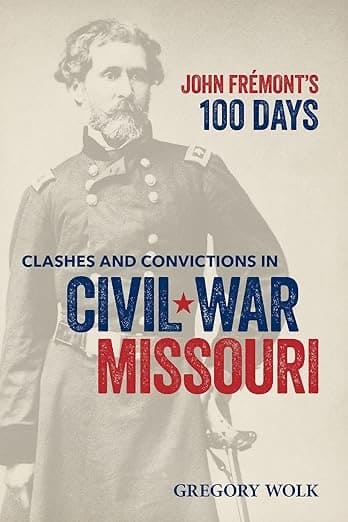
John Fremont’s 100 Days: Clashes and Convictions in Civil War Missouri. By Gregory Wolk. St. Louis: Missouri Historical Society 2025. Paperback, 216 pages, $22.
Reviewed by John Bicknell
John C. Fremont probably caused Abraham Abraham Lincoln more trouble than any of his generals, with the possible exception of George McClellan. Fremont’s adventures as a Western explorer are well documented. But his Civil War record has been largely skipped over by historians.
Gregory Wolk succeeds in remedying that oversight.
He begins with a prologue that puts Fremont and his politically savvy wife, Jessie Benton Fremont, in historical context, while tracing the situation in Missouri through the first half of 1861.
Major General Fremont arrived on the scene in late July. Wolk accuses Fremont of “dawdling in New York” (34) before heading to St. Louis, a charge also made at the time. But Fremont actually made good use of his time in the East. He organized his staff, a task made more difficult because he did not have the kind of West Point connections most officers of his rank possessed. And he spent time arranging for weapons and supplies to be sent west, on the correct assumption that the quartermaster would be preoccupied with supplying the armies in the East at the expense of the West.
Wolk asserts that Fremont took on a task that “few independent observers would have thought him fit to occupy.” (23) There was some doubt about Fremont’s ability to handle an assignment as important as the Department of the West, particularly among regular Army types. The West Point officer class had long been dubious of Fremont, although they hardly count as independent observers. William Tecumseh Sherman, who had known Fremont in California and was living in St. Louis at the time, voiced doubts, as did Treasury Secretary Salmon Chase. But many politicians and ordinary citizens were enthusiastic about Fremont’s appointment. He was compared to Andrew Jackson and George Washington, and even Joan of Arc. John Hay praised him. Broadly speaking, expectations for Fremont were high.
Fremont, the first Republican presidential candidate in 1856, had no long record of anti-slavery activism. As late as May 1861, he was still calling for the seceded states to return to the union, no questions asked.
But one month on the frontline in Missouri persuaded him that emancipation was crucial to winning the war.
Wolk provides a fast-moving account of Fremont’s emancipation proclamation issued on August 30, 1861, although he unfortunately misdates Lincoln’s first letter to Fremont asking the general to rescind his emancipation order as September 11, 1861. That letter, in which the president asks Fremont to modify his order to be in compliance with the Confiscation Act, was dated September 2, three days after Fremont issued the order. On September 8, Fremont responded that he would not reverse the emancipation unless ordered to do so. It was Lincoln’s September 11 letter in which the president “cheerfully” rescinded the emancipation. Other than providing a bit of confusion as the reader tries to keep track of the chronology, the misdating does not materially detract from what is a thoughtful version of the episode, particularly the role played by Lincoln’s ally–and Fremont’s nemesis–Missouri congressman Frank Blair.
Chapter introductions serve as mini profiles that effectively present interesting tidbits without clogging up the narrative. Among the best of these is the one in which he tells the rarely heard story of Hiram Reed and Frank Lewis, two men freed by Fremont’s emancipation proclamation before Lincoln rescinded it.
Given the book’s compact 216 pages, Wolk is thorough on the military action in Missouri during Fremont’s service. His analysis of the role played by the Blairs in Fremont’s downfall also is first-rate.
Like most good military history, the book provides a useful lesson in Missouri history, geography, and geology. Detailed description of the terrain and the roads used by soldiers add local color and serve as a guide for readers as they move with Fremont across the state. I do wish he had included more maps to help readers follow the action.
In the end, Wolk is a kinder critic of Fremont’s military skills than many other historians. “It’s possible that the elements simply conspired against Fremont to hinder his passage over the Osage,” where his army stalled in pursuit of rebel troops under Sterling Price and Ben McCulloch. “It’s also possible that Fremont determined he would slog on in pursuit of Price, no matter the odds against him.” (146)
Fremont had slogged on across the Sierra Nevada in the winter of 1844, and through the snows of Colorado in his disastrous expedition of 1848-49. Slogging on against the odds was in his nature. Wolk captures that essence.
John Bicknell is the author of The Pathfinder and the President: John C. Fremont, Abraham Lincoln, and the Battle for Emancipation; Lincoln’s Pathfinder: John C. Fremont and the Violent Election of 1856, and America 1844: Religious Fervor, Westward Expansion, and the Presidential Election That Transformed the Nation.


