2025 Year In Review: ECW Bookshelf
 This year brought three new titles to the Emerging Civil War Series, and Savas Beatie is gearing up to publish three more titles in that series in spring 2026. And with America’s 250th birthday approaching, the Emerging Revolutionary War Series will roll out two new titles in 2026.
We present a synopsis of the 2025 titles – and what’s coming off the Savas Beatie presses next year!
From the Emerging Civil War Series in 2025:
Unconditional Surrender: Ulysses S. Grant in the Civil War
by Curt Fields and Chris Mackowski
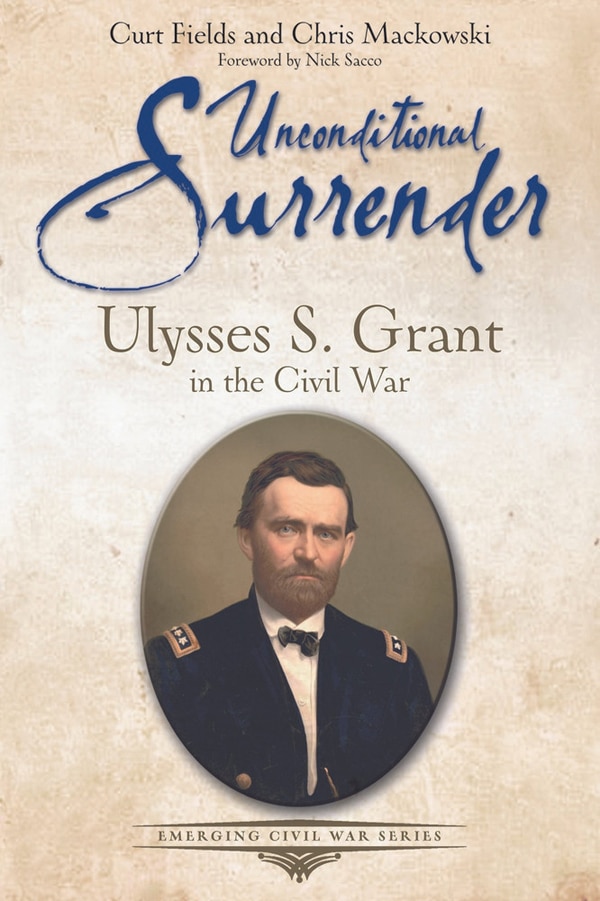 His friends called him “Sam.” His wife called him “Ulyss.” His initials inspired a nickname tied to one of his greatest battlefield triumphs: “‘Unconditional Surrender’ Grant.” Ulysses S. Grant never expected to play a role in the Civil War, yet by its end, he commanded every soldier in the United States Army. Along the way, he secured impressive victories, learned from critical mistakes, broke the Confederacy’s resolve, overcame the criticism of his immediate superior, and earned the steadfast support of the president. “Grant is my man and I am his the rest of the war!” exclaimed Abraham Lincoln after the pivotal victory at Vicksburg, Mississippi.
In under three years, the unassuming colonel of an Illinois volunteer regiment rose to become the army’s highest-ranking officer and the first permanent lieutenant general since George Washington. His ultimate victory paved the way for two terms in the White House. Ulysses S. Grant’s meteoric rise from obscurity made him a figure of profound irony: unassuming, unpretentious, yet resolute. “There will be no turning back,” he once famously declared.
Unconditional Surrender invites readers to follow Grant’s journey with Dr. Curt Fields, the nation’s foremost Ulysses S. Grant living historian. Since February 2010, Fields has portrayed Grant in first-person reenactments. Drawing on years of extensive research, this book offers an ideal introduction to the “dust-covered man” from the West who won the Civil War and preserved the United States.
Glorious Pelham: John Pelham in the Civil War
by Sarah Kay Bierle
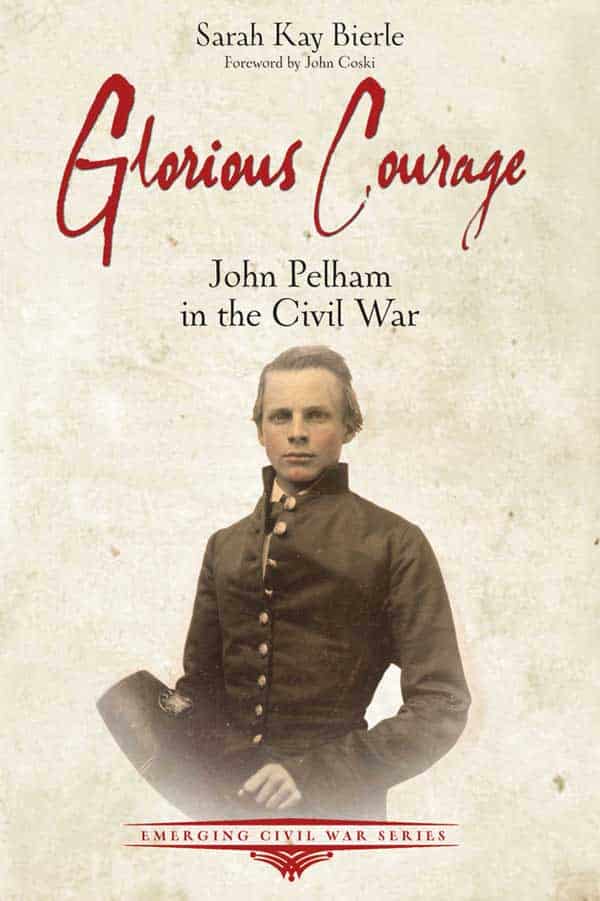 “It is glorious to see such courage in one so young!” So exclaimed Confederate General Robert E. Lee on December 13, 1862, during the battle of Fredericksburg as he watched Major John Pelham fight at least five Union batteries with just one lone gun. The dashing and handsome 24-year-old Alabama officer earned the compliments and admiration of his men, the war-gods of Virginia (Lee, Jackson, and Stuart), and Southern society—all while helping transform the concept of horse artillery on Civil War battlefields across Virginia and Maryland.
After Pelham’s sudden death in 1863, his place in Lost Cause memory soared and admirers firmly elevated him into the upper ranks of the Confederate pantheon. His status as a Lost Cause hero exacted a price—admirers transformed Pelham’s memory into “the beau ideal of Confederate arms,” sometimes altering and clouding the realities of his life. His memory has been trapped there ever since—until now.
In Glorious Courage, historian Sarah Kay Bierle reconsiders Pelham’s extraordinary, if short, life by drawing on primary and other sources and her extensive knowledge of the battlefields. Pelham’s zest for living carried him from Alabama to the military academy at West Point, while his zeal in command of the Stuart Horse Artillery earned him well-deserved plaudits. But like every other man who served the Confederate cause, the remarkable young officer was a human being with flaws. He deserves his place in history as he lived it, not varnished with the perspectives shoved upon him by later generations.
A Grand Opening Squandered: The Battle for Petersburg, June 15-18, 1864
by Sean Michael Chick
 May and June 1864 in Virginia witnessed some of the most brutal and bloody fighting of the Civil War. After the Wilderness, Spotsylvania Court House, North Anna, and Cold Harbor, combined losses for the two armies exceeded 80,000 men killed, wounded, and captured. And the result after all that carnage was a stalemate outside the gates of Richmond.
Federal Lt. Gen. Ulysses S. Grant remained undeterred and set his armies toward their next target: The logistical powerhouse of Petersburg. Grant’s surprising maneuver, which included the construction of a massive pontoon bridge across the broad James River and a surprise march against Petersburg, caught Confederate commander Robert E. Lee by surprise. Petersburg was but lightly guarded and seemed at the mercy of the aggressive Federal commander. Its fall would cut the lifelines into Richmond and force the evacuation of the Southern capital. Ther capture of the city would ensure President Abraham Lincoln’s reelection and eliminate whatever thin hopes the Confederacy still had for victory.
Petersburg was fortified, its garrison small but determined to hold the city. Department commander, Gen. P. G. T. Beauregard, realized the danger and shifted as many men as he could spare into the defenses and took the field himself. North of the river, meanwhile, Lee remained unconvinced that Grant had stolen a march on him. Three days of battle (June 15-17) followed. The Federals bungled the effort, and somehow the understrength Confederates managed to fight the Federals to a standstill. Reinforcements from Lee’s army finally arrived on June 18. Petersburg would hold—for now.
Sean Chick’s A Grand Opening Squandered: The Battle for Petersburg, June 15-18, 1864 provides fresh and renewed attention to one of the most important, fascinating, and yet oddly forgotten battles of the Civil War. Inside are original maps, new research, and dozens of images—many published here for the first time. A Grand Opening Squandered is the first in a series on the Petersburg Campaign, which will provide readers with a strong introduction to the war’s longest campaign.
Coming in spring 2026!
From the Emerging Civil War Series:
Unparalleled Horror: The Battles of Jerusalem Plank Road and the Crater, June 19-July 31, 1864
by Sean Michael Chick and John F. Schmutz
 After the first attempt to storm Petersburg failed on June 18, 1864, Ulysses S. Grant decided to try again. One day after June 18, he ordered George Meade to swing out to the west and cut off the railroads leading to Petersburg, while Grant unleashed his cavalry on Lee’s communications. The Federals suffered a stunning defeat at Jerusalem Plank Road, and Grant’s cavalry was ravaged. Grant settled for a siege while still looking for a chance to turn the tide.
Grant saw that chance in Ambrose Burnside’s mine. For weeks, IX Corps dug a mine under P.G.T. Beauregard’s front with the plan to blow a literal hole in the Confederate works. The mine was ready by July 30. It seemed Petersburg would fall. Instead, the attack failed. Warren Wilkinson of the 57th Massachusetts called the Crater “a scene of unparalleled horror. In places, the panic-stricken soldiers were so tightly packed together that they could not move or even raise their arms to defend themselves.”
Sean Michael Chick and John F. Schmutz portray the weeks after the June 18 attack in Unparalleled Horror: The Battles of Jerusalem Plank Road and the Crater, June 19-July 31, 1864. The narrative considers Grant and Lee’s evolving reaction to a situation neither man wanted. Lee saw Grant’s eventual victory as a “mere question of time,” while Grant was under tremendous pressure to deliver a victory that would secure Lincoln another term. The result was a series of Federal disasters, although Lee lacked the strength to pry Grant away from Petersburg, therefore leaving both sides in a stalemate as the summer of 1864 wore on and the presidential election loomed.
This Great Contest Afloat: The Civil War on the Seas, Coastline, Rivers, and Oceans
by Neil P. Chatelain
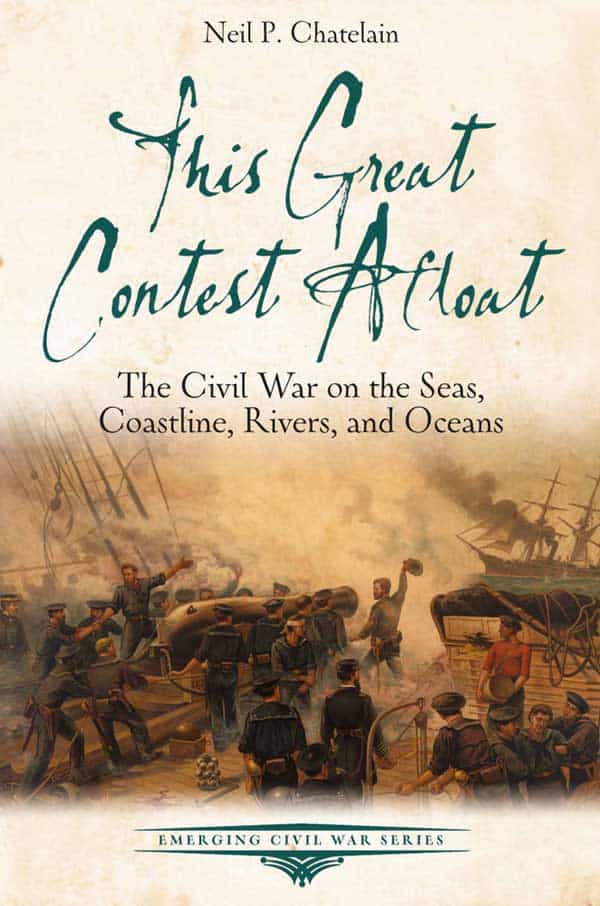 “History offers no example where so much was accomplished in so short a time, or where so many events were crowded into the space of four years, in which the Navy was employed subduing a coast over four thousand miles in length, and recapturing a river-coast of more than five thousand miles,” wrote Rear Admiral David Dixon Porter in his 1886 The Naval History of the Civil War.
His words demonstrate the true scale of the Civil War’s naval activity. Unlike the army dividing its efforts into the Eastern, Western, and Trans-Mississippi theaters, the Civil War’s naval forces fought in four distinct theaters of conflict. The offshore blockade was an economic and logistical campaign waged over whether Confederate armies would remain properly supplied. Sailors enacting that blockade simultaneously worked in tandem with armies to assault cities and coastal areas to deny the Confederacy its ports and coastal infrastructure, all while Confederate sailors fought to both break the blockade and keep control of its ports. Meanwhile, fleets on both sides battled for control over the Mississippi River valley, with a split Confederacy at stake. Finally, an economic and diplomatic war was waged across the oceans, where Confederate privateers and commerce raiders prowled for Federal merchants.
In This Great Contest Afloat: The Civil War on the Seas, Coastline, Rivers, and Oceans, award-winning historian and professor Neil P. Chatelain unpacks each of these naval theaters. Using prolific firsthand accounts merged with keen macro analysis, Chatelain takes readers to the decks of blockade-runners, beaches of coastal assaults, riverine ironclads, and targeted merchants, showing the extent and impact of Civil War naval activity.
Desert Empire: The 1862 New Mexico Campaign
by Patrick Kelly-Fischer and Phillip S. Greenwalt
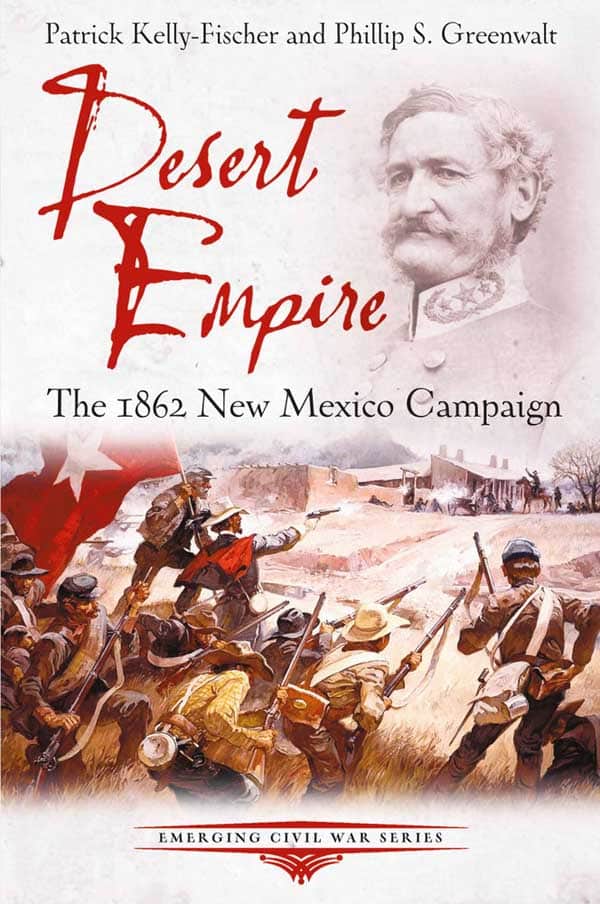 In late July of 1861, Lieutenant Colonel John Baylor and 258 Texas cavalry thundered into the small village of Mesilla, tucked along the Rio Grande River in the New Mexico Territory. They skirmished with U.S. regulars seeking to retake the town, and quickly forced them to retreat. It was a small victory that fueled visions of something much, much larger. These Texans were the vanguard of the newly-formed Confederacy, seeking to fulfill long-held Southern dreams of expanding their influence westward to the gold fields of the Rocky Mountains and the Pacific Ocean ports of Southern California: a Confederate version of Manifest Destiny from “sea to shining sea.”
The fighting at Mesilla was the opening act of one of the least-studied campaigns of the Civil War. For the next year, troops from Texas, New Mexico, Colorado, Arizona, and California would fight for control of the Southwest, its gold fields, and a route to the Pacific for the Confederacy. They marched across thousands of miles of scorching desert and over towering mountain passes, struggling with each other, hostile tribes, and the brutal elements, with the fate of the region hanging in the balance.
Emerging Civil War historians Patrick Kelly-Fischer and Phillip Greenwalt, longtime students of the Civil War, have spent countless hours researching and studying this too-long forgotten New Mexico Campaign of 1862. In Desert Empire, they explore the battles that shaped the course of the war in the Southwest, and shaped the future of the region.
From the Emerging Revolutionary War Series:
A Dear Bought Victory: The Battle of Bunker Hill and the Siege of Boston, 1775-1776
by Daniel T. Davis and Phillip S. Greenwalt
 Actually fought on Breed’s Hill outside Boston, Massachusetts, the battle of Bunker Hill proved a pyrrhic victory for British forces. Confident in their ability to overwhelm the New England militia that opposed them, long lines of neatly uniformed British infantry and marines swept uphill toward a quickly built earthen redoubt defended by a motley collection of farmers, shopkeepers, and tradesmen. “Don’t fire until you see the whites of their eyes!” the colonials urged each other—or did they?
By the end of the fight, the British gained the summit and Colonial forces scattered. One of the patriot leaders, Dr. Joseph Warren, lay dead—one of the first martyrs of the American Revolution. But for the British, the scene was far, far worse: it would be the greatest number of casualties they would ever suffer in any battle of the American Revolution. As British General Henry Clinton commented afterward, “A few more such victories would have surely put an end to British dominion in America.” The siege of Boston would continue, but the sobering lesson of Bunker Hill changed British strategy—as did the arrival soon thereafter of a new commander-in-chief of Continental forces: General George Washington.
In A Dear-Bought Victory: The Battle of Bunker Hill and the Siege of Boston, 1775–1776, historians Daniel T. Davis and Phillip S. Greenwalt separate the facts from the myths as they take readers to the slopes of Breed’s Hill and along the Boston siege lines as they explore a battle that continues to hold a place in popular memory unlike few others.
Atlas of Independence: John Adams and the American Revolution
by Chris Mackowski
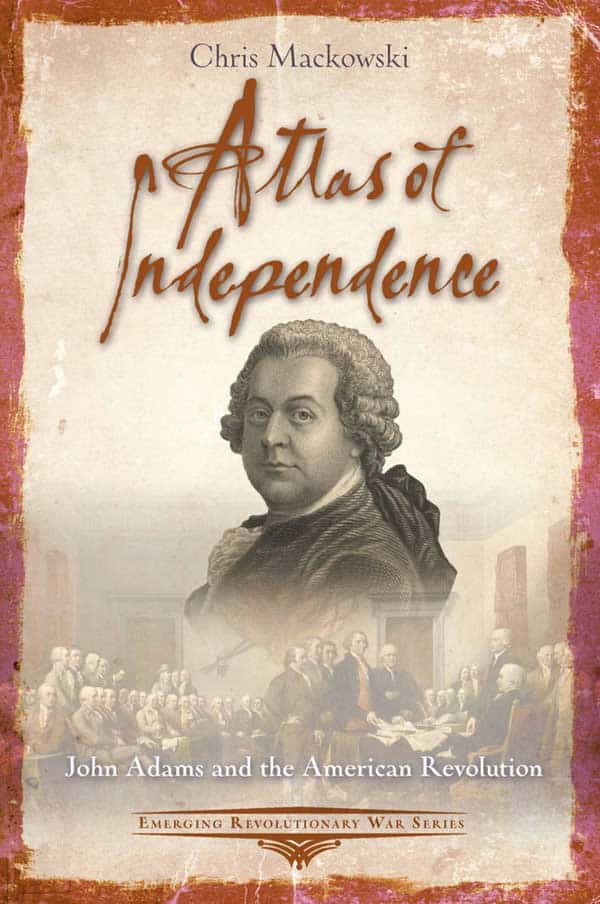 “The man to whom the country is most indebted for the great measure of independence is Mr. John Adams. . . . I call him the Atlas of American independence.” So attested one of the delegates to the Second Continental Congress, moved to support Independence after months of angst, indecision, dithering, and fear. Thomas Jefferson called Adams “our colossus on the floor,” arguing with power, passion, and persuasive force of reason why America needed to take the extraordinary step to break from the British Empire and set up an independent nation.
Born of humble means outside Boston, Massachusetts, Adams’s work ethic led him to become one of the colony’s most successful attorneys. Yet he burned with a powerful ambition and yearned for more. “I never shall shine, till some animating Occasion calls forth all my Powers,” he fretted.Festering tension in Boston with British soldiers and taxation and trade policies—tension that spread across all thirteen colonies—provided the occasion Adams longed for, and soon he found himself at the center of the storm, thrust onto the national stage where all his “Powers” transformed him into the intellectual architect of American independence.
But his efforts came at tremendous cost: long separations from his beloved children and “dearest friend” and wife, Abigail, who forged for herself a role as long-distance political counsellor even as she managed affairs on the family farm in a way nearly unprecedented for 18th Century America. “The times alone have destined me to fame,” Adams wrote. Atlas of Independence by Chris Mackowski offers a reader-friendly overview of Adams’s seminal role in that tumultuous Founding time.


All the 2026 books look great, John Adams is especially interesting.
Agreed, in particular the study of John Adams.
Adams was such good company while I was writing that book.
Wow! What a lineup! Would like to read and study every one of them. Congratulations!