ECW Podcast: Remembering John Adams (with Marianne Holdzkom)
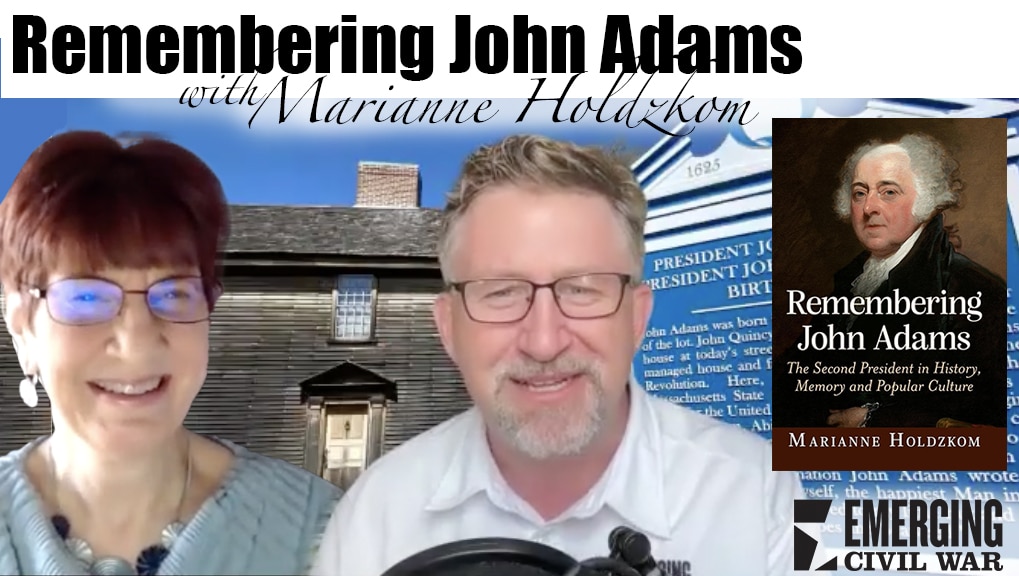
The Emerging Civil War Podcast is hosted by Chris Mackowski (a John Adams fanboy–ergo this week’s tangent!). This episode of the podcast is brought to you by Civil War Trails, the world’s largest open-air museum, offering more than 1,500 sites across six states. Request a brochure at civilwartrails.org to start planning your trip today.
Hosted by Chris Mackowski, The Emerging Civil War Podcast taps into ECW’s award-winning line-up of historians and great special guests—all of whom come from a wide variety of backgrounds with a wide variety of interests on a wide variety of topics.
You can listen on Spotify here:
You can listen on Apple Podcasts here:
You can also listen through the ECW Patreon page. A subscription to our Patreon page—which helps pay our podcast costs—also entitles you to exclusive free content. Sign up for as little as $1.99/month: https://www.patreon.com/emergingcivilwar.
Be sure to also catch the video version of each podcast on Emerging Civil War’s YouTube Channel!


Let’s not forget Abigail, who on the day the Constitution was ratified, predicted that, as wonderful a document as it was, it would also lead to civil war due to what would arise: an attempt to gather all power in the as-yet-to-be-named DC Swamp and destroy Federalism – that being what the Constitution was all about – with slavery having nothing to do with the conflict. Savvy lady.
But it was the balance of power as determined by the 3/5 compromise that cause Southerners to have disproportionate power in the first place, and as soon as it looked like they would lose that upper hand, they began talking about such nonsense as nullification. Lincoln publicly said that he opposed the expansion of slavery–which meant no new slaves states would come into the Union and, thus, permanently diminish the political power of slave-holding states–and so his election triggered secession. It was CLEARLY over slavery, and not just because of the issue of political power but because of the social order (as Jefferson Davis himself said when he left the U.S. Senate: “[Mississippi] has heard proclaimed the theory that all men are created free and equal, and this made the basis of an attack upon her social institutions; and the sacred Declaration of Independence has been invoked to maintain the position of the equality of the races.”). My thanks to my friend Eric Jacobson for that reference.
I’ve heard it all now. So, having less power is something for which someone should take blame? Your statement is rationalization in reverse. You’re forgetting how minor slavery was in 1789 – so small, and so unimportant, in fact, that the widespread prediction was that it would die out by the dawn of the 19th century. No one foresaw civil war over the issue. Rather, what Abigail Adams was talking about was, despite the wonders of the radical experiment of Federalism – which had never before been attempted – on top of the radical experiment of self-government, it was bound to be attacked by those who would take the inevitable step, which mankind had seen since the dawn of time, of attempting to consolidate power within a few individuals in a centralized government, which inevitably would be riven with corruption, and the republic would fall as a result. She also foresaw that existing regional differences combined with the imbalance in population numbers would aggravate those attacks on Federalism, much to the detriment of the South. That is precisely what happened, and war resulted. The Civil War has actually never ended in America, existing since 1861, in the perpetual struggle between those who follow the Constitution, which stipulates Federalism, and those who hate this experiment and want it to fail so they can wallow in runaway corruption with centralized power they control, just like Europe.
And so look where we are in 2026: $40 trillion in debt, which was just $6 trillion in January 2009 when Obama came to power. Whence came the $31 trillion in just 17 years? Well, the mind-boggling corruption of the Democrat Party in the State of Minnesota alone, stealing what will probably tally up to $100 billion in State and Federal funds, is a microcosm of where the money went – and how. And the investigators say that when they get to California, it will make Minnesota pale in comparison.
As well, look at Voter ID. 95% of Republicans want it. 73% of Democrats want it. 85% of Independents want it. 84% of Blacks – whom Democrats assure us are too stupid, too lazy, too poor, and too wrecked on heroin to obtain ID – want it. Overall, 85% of Americans want it. Why don’t we have it? Because a small group of corrupt politicians in the Swamp, who are not even the majority party in the House, or the Senate, or the White House, have said, “Fuck what Americans want – we’re not going to vote for this because it will wreck our corruption and our election-rigging.” There is no better support for my statement, and Abigail Adams’, that corrupt forces have been trying to destroy the foundation of Americans’ self-government, and that it started the Civil War, than this.
Bad typing correction: We have added $34 trillion, not $31 trillion, in debt in 17 years.
The war was “clearly about slavery”? Then why did five slave states remain in the Union throughout the war, without the Federal Government taking away their slaves? For that matter, why did Lincoln add a slave state five months after issuing the Emancipation Proclamation? For that matter, simply read that document. It does not free slaves or restrict slavery. Rather, it says Lincoln is declaring all slaves in states or territories in rebellion against the United States to be free…so, it says he is declaring that all slaves in states or territories not in rebellion against the United States to be consigned to remain in slavery. There is no better, clearer statement that the war was not about slavery, but about putting down a rebellion by secession – which was not illegal – and the government was going to try to end that rebellion through the use of military and economic warfare.