Book Review: Opening Manassas: The Iron Brigade, Stonewall Jackson, and the Battle on Brawner’s Farm, August 28, 1862

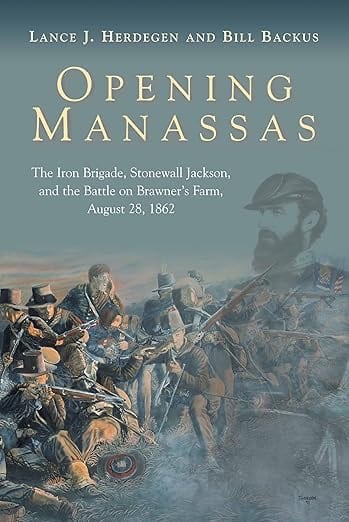
Opening Manassas: The Iron Brigade, Stonewall Jackson, and the Battle on Brawner’s Farm, August 28, 1862. By Lance J. Herdegen and Bill Backus. El Dorado Hills, CA: Savas Beatie, 2025. Hardcover, 264 pp. $32.95.
Reviewed by Kevin C. Donovan
The August 28, 1862 fighting on Brawner’s Farm, part of the Second Manassas (or Bull Run) Campaign, typically is remembered as the famous Iron Brigade’s baptism of fire. The battle otherwise has been treated merely as a prelude to the “main event,” the August 29-30 fighting that saw the rout of Maj. Gen. John Pope’s Army of Virginia.
In Opening Manassas: The Iron Brigade, Stonewall Jackson, and the Battle on Brawner’s Farm, August 28, 1862, authors Lance J. Herdegen and Bill Backus finally give this sanguinary episode its due, doing so through an interesting format. Throughout the book’s thirty-one chapters, Herdegen recounts events strictly from the U.S. perspective, while Backus provides the Confederate point of view. Both authors utilize a “fog of war” approach, describing how the participants experienced the battle and made decisions based only on the information they would have had in their possession at the time.
The dual author/strict focus on only one side at a time approach can be somewhat jarring, since the story does not follow a straight chronology. For example, Herdegen closes his Chapter 22 by describing the fighting of U.S. troops amid “the gathering darkness” of August 28. (190) Backus then opens his Chapter 23 with “August 28 dawned” in describing Confederate actions. (191) Yet the authors accomplish well their stated goal of presenting each side’s perspective as limited by what only it knew during its place within the same chronology of events.
The subtitle of Opening Manassas reflects three themes of the book. One theme is describing the pre-battle history of what would become known as the Iron Brigade. As befits an author who already has written extensively about the brigade,[1] Herdegen includes a thorough background of its constituent regiments, with interesting vignettes about each, its leadership, distinct character, and even intra-brigade rivalries. A second theme is examining Maj. Gen. Thomas “Stonewall” Jackson’s performance leading up to the battle. Backus shows how Jackson’s well-known penchant for secrecy adversely impacted his effectiveness in bringing his force together for the battle. He also criticizes Jackson’s misuse of cavalry and other errors that placed his isolated command at risk. Indeed, the third part of the book, the battle itself, does not make its appearance until well into the second half of the work.
The writing of both authors is very good. They make extensive use of soldier quotes and other primary sources to offer vivid descriptions of events, particularly the battle itself and specific tactical moves made by each adversary. The maps provided are useful.
There are, however, two areas in which readers—especially serious students of history—might take issue with Opening Manassas. First, there are occasions in which the authors do not provide obvious cites to their sources, including for quotations. The reader thus is deprived of the opportunity to delve deeper into the subject at issue. This is not to suggest that the authors do not know their subject; clearly, they do. But, for example, in Chapter 31 the author recounts how Pope harshly criticized Brig. Gen. Rufus King for his decision to withdraw his division (which included the Iron Brigade) from the field after the battle, Pope claiming that he told King to “hold his ground at all costs.” (261). The author then notes that Pope’s claim was “refuted in print by King’s son.” (261-262). Pope’s claim, and the younger King’s rebuttal, each undoubtedly are drawn from their dueling articles in Century Magazine’s Battles & Leaders.[2] Yet the reader is left without that source information for further study.
In addition, while the arguments supporting the criticism of Jackson’s performance appear sound, the reader may be hard-pressed to find support for the praise given Maj. Gen Richard Ewell’s performance at Brawner’s Farm, deemed “the high-water mark of Ewell’s career.” (223) Moreover, the conclusion that King’s decision to withdraw his battered division in the face of Jackson’s whole force (with Maj. Gen. James Longstreet’s wing known to be on the way) “of course…was a mistake and played a large role in the defeat of Pope’s Army of Virginia in the next two days” (263) is not explained in the text. Indeed, the condemnation of King’s decision runs counter to the analysis of John J. Hennessy in his own highly regarded work on Second Manassas.[3]
Despite these issues, Opening Manassas presents an excellent in-depth portrayal of a previously understudied battle and is a work well worth reading.
[1] Herdegen is the author of Those Damned Black Hats: The Iron Brigade in the Gettysburg Campaign (El Dorado Hills, CA: Savas Beatie, 2008) and The Iron Brigade in Civil War and Memory: The Black Hats from Bull Run to Appomattox and Thereafter (El Dorado Hills, CA: Savas Beatie, 2012).
[2] Robert U. Johnson and Clarence C. Buel, Editors, Battles and Leaders of the Civil War, 2:449, 470 & 495 (Century Publishing Co., NY, 1884-1889) (Pope’s article and King’s rebuttal, respectively).
[3] John J. Hennessy, Return to Bull Run (New York, Simon & Shuster, 1994), 192-193.


Kevin: An intriguing review of an intriguing narrative approach by co-authors. Thank you for this review. The late Eric Wittenberg carried off the co-author role extremely well in his books with Scott Mingus and Dave Powell. As a curmudgeon, I have already been lamenting the absence of full bibliographies in some military history works. Now, like your review, I have also been noticing a scarcity of footnotes in some works that leave me wondering what support the author has for certain statements. Publishers have a multitude of financial pressures to keep costs down, which I understand. Hard core readers, I suppose, may have to adjust our expectations – though not without some gnashing of teeth.
Thank you for the review! It was definitely a unique and fun project that helps challenge some preconceived notions.
Thank you for the review. When I started my section of the book, it quickly became obvious that I knew too much about the brigade and had to step back. It certainly changed the way I look at sources.