Book Review: Richmond Views the West: Politics and Perceptions in the Confederate Capital

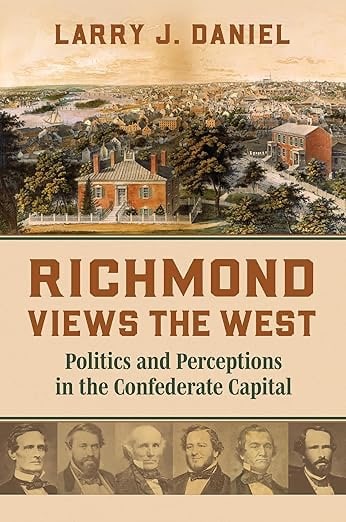
Richmond Views the West: Politics and Perceptions in the Confederate Capital. By Larry J. Daniel. Lawrence, KS. University Press of Kansas, 2025. Hardcover, 359 pp. $49.99.
Reviewed by Thomas M. Grace
Since making his authorial debut forty years ago, Larry Daniel has provided readers with a stream of heralded books on the Civil War’s Western Theater. Daniel’s latest, Richmond Views the West, expands his scholarly range of the sanguinary conflict. In its pages Daniel, the author of a number of battle studies, successfully answers a challenge issued by historian Earl Hess, who called on scholars to think anew about the war and, in Hess’s words, to be mindful that “There are…many kinds of military history…and all have important perspectives.”[1]
Daniel examines how President Jefferson Davis, his Cabinet, the Confederate Congress, and Richmond newspapers, all beheld the war west of the Appalachian Mountains. The area comprised three-fourths of the Confederacy’s land mass, while those representing the same expanse numerically dominated the Confederate Congress. Such a huge amount of territory, thought initially to be an advantage to the secessionist cause, also became difficult to defend. After the Confederacy added the rump governments of Kentucky and Missouri to the emergent nation in late 1861, western governors and representatives, including those of the two Border States, all demanded military protection or, in the case of the Bluegrass State, recovery of lost territory. There were too few troops to adequately guard two saltwater coasts and the river valleys, and Davis chose to deploy them using what Daniel critically terms a “static defense.” (xvi)
Published by a university press, the study is not an argument about why the Confederacy lost. Rather than add to academic dialogue, this is largely, though not exclusively, a narrative account, consisting of an explicatory preface and fifteen brisk chronological chapters. Daniel begins with the bungled handling of Kentucky neutrality in September 1861 by Episcopalian bishop, turned general, Leonidas Polk, and ends in December 1864 on the icy hills south of Nashville, where John Bell Hood nearly destroyed his Army of Tennessee. Still, the author does not shrink from scholarly judgement and contends that the strategic choices that shortened the life of the Confederacy “were grounded in politics.” (267)
Many representatives in the Confederate Congress were no better than the generals that they insisted hold commands, John Floyd, Gideon Pillow, and Missourian Sterling Price among them. In describing some of the reprobates in the legislative branch, Daniel pulls no punches. More than a few, he writes, “were often hypersensitive, drunk, quick-tempered, and violent.” (xi) Several, like Tennessee’s John Foote and Georgia’s Thomas Cobb, were rank antisemites, as was Missouri Senator John Clark, who defamed the Confederate secretary of war as “a cut-prick Jew.” (244) Denied Senate reappointment, Clark won a House seat in 1864.
And while the rogue’s gallery of congressional representatives were hardly an asset to the Confederate cause in the West, Daniel suggests that Davis should have, at times, heeded the advice of several officeholders. The governors of Tennessee and Kentucky demanded that he order Polk to withdraw the troops he had sent into the Bluegrass State, whose neutral status the Bishop endangered by the occupation of Columbus. After briefly considering the governors’ pleas, Davis reversed course and allowed Polk to remain. Kentucky, in turn, quickly aligned with the United States. With the buffer Border State gone, the Richmond government lacked the troops to defend a position 120 miles south of the Ohio River near the Kentucky-Tennessee line. Daniel recounts this and many other challenges Davis had to contend with, including those fought with members of congress, but in permitting Polk to remain in Columbus, the president received the support of many of his usual critics in the legislature as well as naysayers in the Richmond press. The misery of losing Kentucky to federal control created a lot of company.
In researching this well-crafted study, the author visited a dozen archives where he combed through twice that number of collections and read years-worth of newspapers, chief among them the largest circulating of the Richmond’s sheets, the old Whig Dispatch as well as Democratic ones, the Examiner and Thomas Ritchie’s Enquirer, which the famous editor’s family inherited. Because the city avoided capture until the very end, its press continued to publish, providing Daniel and historians ample sources to mine. His longtime familiarity with the Official Records and the Jefferson Davis Papers, coupled with Daniel’s intimate knowledge of contemporary sources and modern studies serves to enhance this studious and always readable tome.
The author and the University Press of Kansas have given readers an edifying volume and a study that enriches our understanding of how Richmond both understood and misunderstood the war in the western theatre.
Thomas M. Grace earned a BA in History from Kent State University and a PhD in History (2003) from the State University of New York (SUNY) at Buffalo. His principal area of interest is the American Civil War. He has lectured widely, has taught at Cornell University ILR program (Buffalo), D’Youville University, and SUNY/Erie and authored Kent State: Death and Dissent in the Long Sixties (UMass Press, 2016). He is editing a nearly completed manuscript on the 98th Ohio, tentatively titled, Citizens and Soldiers of the Upper River Valley. His articles and reviews have appeared in The Nation Magazine, America’s Civil War, The Register of the Kentucky Historical Society, Ohio Valley History, the Civil War Monitor, Civil War News, and the Journal of American History.
[1] Earl J. Hess, “Revitalizing Traditional Military History in the Current Age of Civil War Studies,” in Andrew S. Bledsoe and Andrew F. Lang, eds., Upon the Fields of Battle: Essays on the Military History of America’s Civil War(Baton Rouge: Louisiana State University Press, 2018), 21.


Sounds like an impressively researched work and due to the frequent confederate losses in the west, well the analysis.