Pistol-Packing Mama
Assistant Secretary of War Charles A. Dana was exhausted. He hadn’t slept in two days when he rode into the headquarters of Maj. Gen. William Rosecrans in Dyer’s Field behind the Union battle line at Chickamauga. He dismounted and laid down on the grass and went instantly to sleep.
“I was awakened by the most infernal noise I ever heard. Never in any battle I had witnessed was there such a discharge of cannon and musketry. I sat up on the grass, and the first thing I saw was General Rosecrans crossing himself . . . . ‘Hello,’ I said to myself, ‘If the general is crossing himself, we are in desperate situation.’”[1]
Looking toward the source of the sound, Dana said, “I saw our lines break and melt away like leaves before the wind.”[2] Five columns of Confederate soldiers under Maj. Gen. James Longstreet plunged through a gap in the Union line near the Brotherton Farm along the LaFayette Road. Not all who witnessed the breakthrough were men.
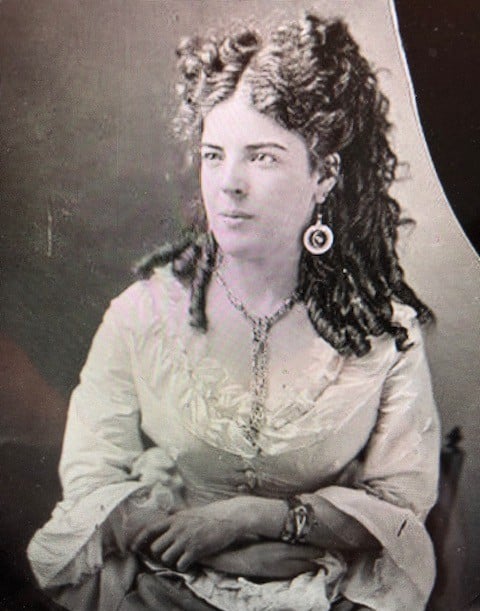
Married to Brig. Gen. John B. Turchin, Nadine A. Turchin was born in Russia on November 26, 1826, the daughter of an officer in the Russian army. The two Russians fell in love, married, and moved to America in 1856. At the outbreak of the Civil War, Turchin became colonel of the 19th Illinois Infantry. Despite army regulations, Nadine accompanied him into the field. She acted as a nurse for the men in her husband’s regiment, and when John was ill, besides nursing him, Nadine acted as de facto commander to the regiment. His soldiers referred to her as Madam Turchin. Despite her limited English, Nadine’s view was that in the absence of her husband, she was in charge, even leading them in a skirmish with the enemy. Now her husband was commanding a brigade fighting in Kelly Field.
A sizable portion of the XIV Corps supply and ammunition trains were aligned just west of Rosecrans’ headquarters along the Dry Valley Road. Nadine Turchin nervously stood with the 20-wagon ammunition train of her husband’s brigade. The train was guarded by companies C and H of the 105th Ohio Volunteer Infantry, under the command of company C’s Lt. John C. Hartzell.
All morning Nadine could hear the sound of cannons and musketry, but was only able to see the bluish smoke from the woods to the east and north. At one point she even climbed a tree to try to get a better look.
Nadine saw what Dana saw: the right of the Army of the Cumberland dissolving in defeat, the screaming Confederates bursting out of the woods in pursuit of the Federals, and all streaming in her direction across Dyer Field. The brigade quartermaster in charge of the wagon train ordered the wagons to move down the Dry Valley Road and to turn north to escape the oncoming rebels. As the wagons pulled into the road, they were overwhelmed by the stampede of hundreds of men in blue fleeing from the onslaught. Nadine angrily admonished the deserters as shells began to fly overhead and explode around them. The quartermaster lost his nerve and in the panic, ordered his men to abandon the wagons, set them on fire, and flee.
Apparently Madam Turchin understood English far better than she sometimes let on. As the quartermaster was giving his orders, she pulled from her bag a large loaded pistol and pointed it squarely at the quartermaster’s head. Suddenly able to speak perfect English, she fearlessly ordered the quartermaster to stay with her husband’s wagons and drive them north to safety – or else. Wisely the quartermaster acquiesced.
Nadine mounted her horse and rode at the head of the train. She brought “confidence out of disorder, moving on the wagons that had stopped . . . shamed [stragglers] to order, and not a few induced to return to the front,” recalled Sergeant John T. Booth of the 36th Ohio’s Company G. Mrs. Turchin had made up her mind to take the train to a place of safety, and she did. The result of her pluck and good common sense . . . was that not a pound of ammunition was lost.”[3] If not for the presence of Nadine Turchin, the XIV Corps trains might well have been entirely lost.
As she was riding towards Rossville in the dark, she wondered whether her “husband at least gets out of the confusion safe and sound.” She had heard rumors that he had been captured along with his brigade.[4]
Nadine and Gen. Turchin were reunited at 8:00 p.m. that evening. As Turchin’s men slowly marched through McFarland’s Gap to Rossville, he was startled by the sudden cheering of his men. He was astonished and relieved to see Nadine leading the ammunition wagons to safety. The two would make it safely to Chattanooga.
John and Nadine settled in Radom, Illinois after the war. They had no children. So technically she was never a mama except to all the boys in 19th Illinois Volunteer Infantry. John died in 1901, and Nadine applied for and received a $30.00 per month pension as a military widow. Nadine died in 1904 and was buried next to her husband in the Mound City National Cemetery.[5]
On April 25, 1961, Nadine was memorialized in the House of Representatives. Fred Schwengel, Congressman from Iowa said:
“Have you ever heard of Madam Turchin, the immigrant from Russia, symbol of foreign aid, who went with her husband, a colonel in the Union Army, and served as nurse and mother confessor to the regiment? And, once when her husband was ill, she took over and led the regiment into battle with confidence and poise and won the skirmish.”[6]
————
[1] Dana, Charles A., Recollections of the Civil War, New York, Collier Books, 1963. Pp. 115-117.
[2] Ibid. P. 115.
[3] McElligot, Mary A., A Monotony Full of Sadness: The Diary of Nadine Turchin, May 1863-April 1864. Journal of the Illinois State Historical Society, 70, No. 1 (Feb 1977) P. 68. Powell, David A., The Chickamauga Campaign: Glory or the Grave: The Breakthrough, the Union Collapse, and the Defense of Horseshoe Ridge, September 20, 1863, El Dorado, California, Savas Beatie LLC, 2015. P.404. Booth, John T., “Chickamauga: A Campaign Unrivaled in the Annals of War, Part III, National Tribune, October 16, 1890.
[4] McElligot, Diary of Madam Turchin. P. 69.
[5] Find-a-Grave. Nadine A. Lvov Turchin (1826-1904) – Find a Grave Memorial
[6] Schwengel, Fred, “Commemoration, Scholarly Effort, and Women of the Civil War,” Washington D.C., United States Congressional Record, April 25, 1961, p. 6701. GPO-CRECB-1961-pt5-11-2.pdf


I love stories like this. Too bad they never had any kids–They would’ve done great things
Bravo! I have always admired Madame Turchin. Thank you for this article remembering her courage!
What a great moment. It’s seems like women and former slaves were key to the North’s victory.
What an interesting story. I read about the exploits of John B. Turchin before, but never knew that his wife was such a perfect match for him.
Wow, great story … as my grandmother would say “she must have been a pistol” thanks Brian*.
Well-told story!
Let me point out that the tale of Mrs. Turchin pointing a gun at an officer is not contained in any of the references provided.
Her diary entry for 30th September recalls McCook leading the wagons back, and her disgust with him. She did not interfere with events at all. “I let this bunch of scoundrels follow their road; and moving to the opposite side, I was going to sit at the edge of the road to see what would happen next.” She waits until the wagons have passed by, and then followed them down the road, and spent several hours searching for her husband before meeting the divisional quartermaster who assured her that her husband was still alive. She then found her husband and then later went to find a tent from the trains.
Powell simply quotes the National Tribune article, and so is redundant. The National Tribune article has a little sketch entitled “Mrs. Turchin saving the ammunition train,” with her waving at one of the drivers. The author claims Mrs. Turchin took control of the trains and led them to the rear. No pistol involved.
The NT account is completely contradicted by Mrs. Turchin’s own diary entry, and probably never happened. Either way, in neither version does she fetch a gun and threaten anyone.
PS: Her diary states she waited 2-3 hours after the train passed before deciding to follow it.