Hub Wafers: A Yankee Delight
During World War II, G.I.s were issued candy rations to increase stamina, enhance performance, and boost morale. Hershey’s chocolate bars and Wrigley’s chewing gum were two of the soldier favorites.
Civil War Union soldiers also looked forward to sweet treats. Whether they received these in care packages from home or acquired them from local stores or sutlers, candy was a small reminder of home and a powerful tool for maintaining morale.

Union Soldiers Sharing Rations. Alred Waud. (LOC)
The 1800’s saw the rise of mass-produced candies. In 1847, Oliver R. Chase, an English immigrant living in Boston, Massachusetts, invented and patented a lozenge cutting machine. Originally used to manufacture medicinal lozenges for apothecaries, he discovered another use – making candy. Oliver and his two brothers, Silas and Daniel, formed the candy manufacturing company apply named Chase and Company. They began manufacturing and selling rolls of variously flavored thin disks that they named “Chase Lozenges.” Then in 1850, Oliver invented and patented a machine for pulverizing sugar making the process easier and quicker.
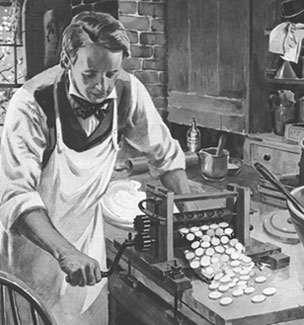
Oliver Chase and his candy making machine. Candy Hall of Fame
With the outbreak of the Civil War, “Chase Lozenges” became a sought-after staple for the Union soldiers. The soldiers referred to them as “Hub Wafers” – supposedly from the city of Boston where the lozenges originated. In the 19th century, Boston was known as the “Hub of the Universe,” and subsequently shortened to “Hub.” They came in rolls containing eight flavors: lemon (yellow), lime (green), orange (orange), clove (purple), cinnamon (white), wintergreen (pink), licorice (black) and chocolate (brown). They were small, had a long shelf-life, and were resistant to heat and damage – the ideal snack to carry in haversacks on long marches.
The iconic, mass-produced “Hub Wafers” were popular, so much so that in 1864, Daniel Chase moved to Chicago, Illinois and opened a second factory to satisfy the Western armies and territories. Around 1865, Daniel began printing sayings on the candy disks. He experimented first with hand tools, and then devised a machine in which a felt roller pad, moistened with vegetable coloring, usually red, pressed against a die with the saying engraved. Much like a printing press, the die stamped the words onto the lozenge. Later, the disk was cut in a heart-shape and Sweethearts candies, a staple of Valentine’s Day, was born.
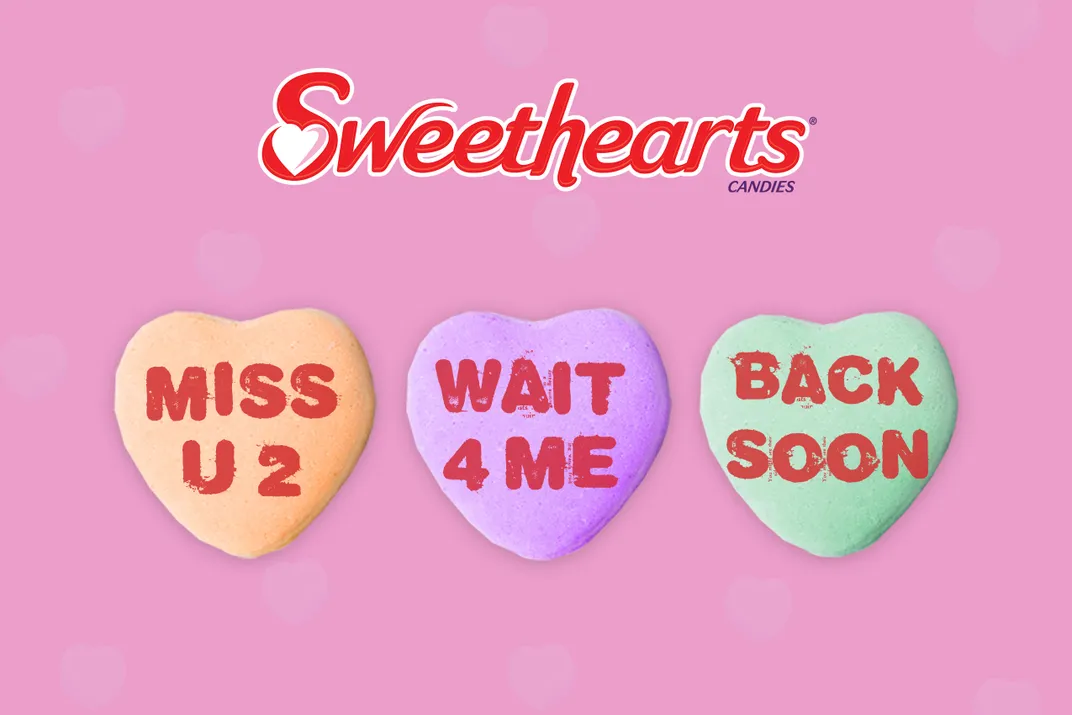
Sweethearts. Smithsonian Magazine.
In 1871, the Chicago Fire wiped out Daniel Chase’s western factory, forcing him to return to Boston. Unfortunately, a year later a Boston fire destroyed Oliver’s factory. The brothers slowly rebuilt the business. Olive retired in 1888, and three years later Chase and Company merged with two other candy firms, Forbes, Haywood & Company and Wright & Moody Company, and was incorporated into the New England Confectionary Company (NECCO). By 1912, the wafers were being advertised as “Necco Wafers,” a name they have carried since. NECCO became home to such treats as the Clark Bar, Mary Janes, Sky Bar, Candy House Candy Buttons, Canada Mints, Mighty Malts Malted Milk Balls along with Sweethearts and Necco Wafers.

Necco Wafers
The company went through a number of acquisitions between 1963 and 2018. Today, Sweethearts, Canada Mints and Necco Wafers are made and sold by the Spangler Candy Company of Bryan, Ohio. For between $1.25 – $2.99 you can buy a roll and taste what the soldiers enjoyed in the Civil War.
Sources:
Oliver R. Chase – Candy Hall of Fame
“Necco History: About the Company: Year by Year”, NECCO® – About
“Sweet History of Civil War Candies: 1800s Treats That Boosted Soldier Morale” article by True Treats Candy, https://truetreatscandy.com/blogs/article/sweet-history-of-civil-war-candies-1800s-treats-that-boosted-soldier-morale-3?srsltid=AfmBOooAe8qgEeHxKfuqa5zDHFHMghr6V_WRpWATE
Beckett, Jesse, “How the American Civil War Helped Shape the Modern Candy Industry,” November 4, 2012, How the American Civil War helped shape the modern candy industry
Galarza, Daniela, “A Brief History of Necco: America’s Original Candy Company,” October, 30, 2015, A Brief History of Necco: America’s Original Candy Company | Eater


When my husband was a student at MIT, many years ago, the Necco Factory would give free sample to students.
Brian, sweet story. Can’t wait to try a clove flavored wafer.
Hub Wafers were not only a Yankee delight, but this story for current day Civil War travelers is also a delight. It’s a true pleasure after absorbing a half century of Civil War history to be treated to this small nugget of information that was such a treat for the soldiers. The only comparison might be the reflections of the Rebel soldiers discovery of the ripening fruit on cherry trees during their advance into Pennsylvania.
Ha! when we were naive youths, we Catholic kids would practice saying Mass and use Necco wafers as communion hosts and Welch’s grape juice as wine. LOL. I’m sure someone would consider this as sacrilege. Whoa! Is that thunder I hear on a sunny day. The lightning must be coming!
Fun story, thanks Brian. I’m part of the Lincoln Group of DC, and legend has it that the wafers were Abe’s favorite candy. When a new statue of Lincoln (signing the Emancipation Proclamation), was dedicated last September at the African American Civil War Museum in Washington, DC, the Spangler Candy Company in Ohio donated dozens of rolls of Necco Wafers that we passed out at the ceremony – the legend lives on!