Civil War Themes in Modern Mardi Gras Celebrations
I have previously written about:
The Persistence of the Mardi Gras Spirit in Civil War New Orleans
Tensions in Reconstruction Mardi Gras Celebrations
and Civil War Era Themes in Mardi Gras Celebrations, 1880-1940.
Now I will conclude this multi-year exploration of the Carnival Season, how it impacted the Civil War, and how the Civil War impacted it by exploring these themes from World War II to today.
Unsurprisingly, World War II’s massive mobilization affected Mardi Gras celebrations. After the United States enacted conscription and joined hostilities in 1941, many adult men left New Orleans in uniform. Rationing increased scarcity of available goods, and Mardi Gras was limited from 1942-1945.
Just as during the Civil War however, modified festivities occurred. As in 1861, masquerade balls were held in 1942 with proceeds from ticket sales going toward soldier relief funds.[1] Every year of United Sates involvement in World War II also saw significant war bond drives each Mardi Gras Day, including a Million Dollar Bond Drive in 1943 that raised $1.192 million in bonds.[2] On Mardi Gras Day 1945, “there were a score of costumed persons on Canal Street, but they were attending strictly to wartime Mardi Gras business – selling bonds.”[3]
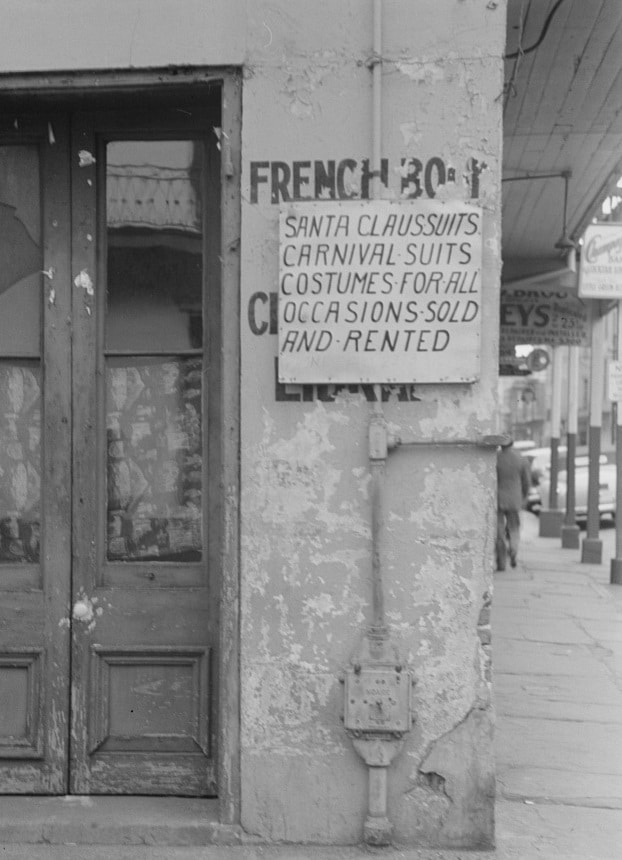
War could not stop celebrations by soldiers overseas. World War II GIs assigned to the 24th General Hospital, largely composed of members of the Tulane University School of Medicine, held impromptu Mardi Gras celebrations in Florence, Italy in 1944 just as the Washington Artillery of New Orleans did in 1862 in Virginia.[4]
Just as festivities were partially halted in World War II, some parades were cancelled in 1951 because of the Korean War, though many others still marched on, and the New Orleans streets were once again packed with revelers and the other years of the conflict saw continued celebrations.[5] During the 1979 police strike, which forced the cancellation of several major city krewes, Carnival did not completely halt, as many parades shifted to outside the city’s limits and maskers took to the streets regardless of any cancelled parades and official celebrations.[6] War and municipal issues continued impacting how Carnival celebrations could be celebrated, a trend started in the Civil War.
The Civil War’s centennial renewed Confederate memory’s influence on Mardi Gras, especially in the form of doubloons. The Krewe of Mid-City issued a golden doubloon in 1965 that featured a rectangular print of the Confederacy’s battle flag. Four years later, both the Krewe of Crescent City and the St. Bernard Sheriff’s Posse each issued a golden doubloon honoring the city’s now-removed statue of Pierre G.T. Beauregard. Adorned on the Crescent City doubloon was the statue surrounded on either side by two Confederate battle flags–banners Beauregard himself designed–and text describing Gen. P.G.T. Beauregard as “Napoleon in Grey,” “Le Beaux,” and “The Creole General.”
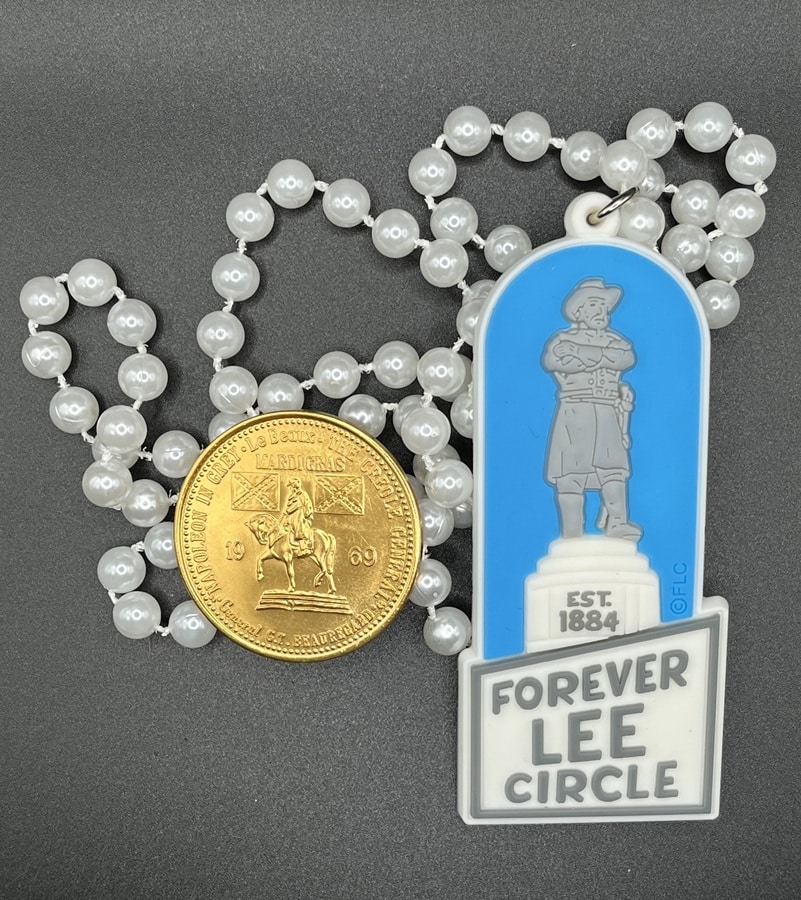
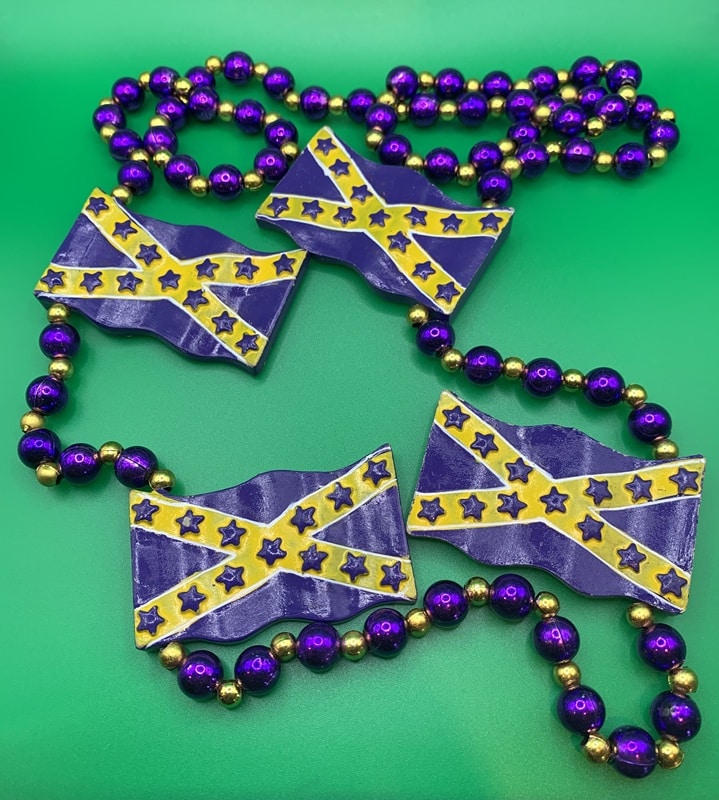
Twenty-first century parading has also been influenced by the Civil War era and memory of the Confederacy. In 2017, the Robert E. Lee statue on what was called Lee Circle on St. Charles Avenue was removed. With this prominent parade-route landmark gone, Mardi Gras beads bearing the statue’s likeness began appearing at parades in protest.[7] Though not officially issued by parading krewes, and in fact prohibited as throws by many along the St. Charles Avenue parade route, beads bearing the Beauregard-designed Confederate battle flag were caught by spectators along routes in 2016, 2019, and 2022.[8] Confederate flags were observed along the parade route in Mobile, Alabama, in 2017. In 2025, a Confederate battle flag, colored in purple and gold was thrown by members of the Krewe of Thoth; those members identified as throwing them were ejected from the organization.[9] Elements of the Louisiana Division of the Sons of Confederate veterans, attired in Confederate uniforms and marching with Confederate flags, paraded in the February 2026 Krewe of Janus, in Monroe, Louisiana.
Recent events are not merely elements of Confederate memory influencing Mardi Gras. The reverse also occurred in 2021. As parades were cancelled that year because of the Covid-19 pandemic, Demond Melancon placed his Mardi Gras Indian Suit titled Jah Defender on the site of the recently removed statue of Jefferson Davis.[10] Just as the Civil War era and its memory have influenced Mardi Gras celebrations, Mardi Gras spirit has influenced ongoing conversations about that conflict’s memory.
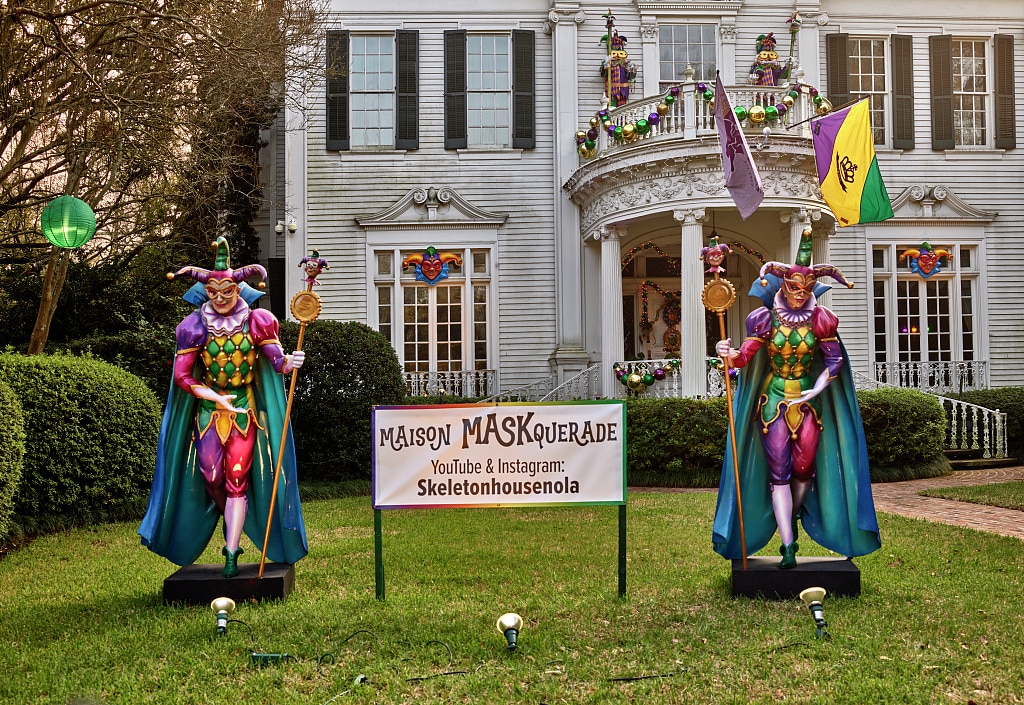
Other Covid-19 evolutions were in the spirit of Civil War New Orleans. In 2021, despite cancelled parades, Mardi Gras endured via the Krewe of House Floats, where residents decorated their own homes to celebrate when parading could not continue. Driving tours through City Park, styled Floats in the Oaks, also sprang up, allowing tours of displayed floats These new additions, added out of necessity in the eyes of many to celebrate Carnival in some form, have already become modern traditions newly incorporated into annual festivities.
Mardi Gras faced its first real challenge in the Civil War, and despite war, occupation, and cancellations, the citizens of New Orleans maintained Carnival’s essence through improvised parading, costuming, and masked balls, albeit via an abbreviated format filled with commentary about the Civil War itself. This challenge helped reinvigorate the Mardi Gras spirit postwar, impacting the celebration’s evolution and providing a precedent on how future cancellations can be recovered from by forging cultural additions to the Carnival season. When Mardi Gras is forced to limit activities and cancel parades, the people of New Orleans persist in expanding just what Carnival is and how it is celebrated, just as they first did during the Civil War. Despite war, pandemics, and protests, the spirit of Mardi Gras has persisted on, and the memory of the Civil War has persisted within that celebration, both by impacting celebratory traditions and how the Civil War is viewed.
Endnotes:
[1] “Masked Ball on Mardi Gras Night to Benefit Army,” Alexandria Daily Town Talk, Alexandria, LA, February 5, 1942.
[2] Advertisement for the Million Dollar bond Drive, 1943, 0000.053.001, The National World War Two Museum, New Orleans, Louisiana; “Mardi Gras Turns Into Bond Rally,” The Monroe News-Star, Monroe, LA, March 10, 1943.
[3] “No revelry at N.O. on Mardi Gras Day,” The Shreveport Journal, Shreveport, LA, February 13, 1945.
[4] Doctors of the 24th General Hospital at a Mardi Gras Party in Florence, Italy Circa February 1944, 2007.243.193, The National World War Two Museum, New Orleans, Louisiana.
[5] King of Zulu 52, William Boykins, 1979.333, The Historic New Orleans Collection, New Orleans, LA; Rex 1953 invitation, 1993.138.35, The Historic New Orleans Collection, New Orleans, Louisiana.
[6] 1979 Carnival ball and parade schedule, 2000.34.277, The Historic New Orleans Collection, New Orleans, Louisiana.
[7] Frederick Staidum Jr., “Robert E. Lee Beads Bring Mardi Gras’ Historic Racism Full Circle,” The Root, February 17, 2018, https://www.theroot.com/robert-e-lee-beads-bring-mardi-gras-historic-racism-f-1823080728.
[8] Doug MacCash, “Child catches Confederate flag Mardi Gras beads at Sunday parade,” Times Picayune (online), New Orleans, LA, February 1, 2016, https://www.mardigras.com/new_orleans_parades/article_5537f7ca-3a6f-5d1b-8164-848a189c6c30.html, accesses December 16, 2022; Della Hasselle, “Confederate flag beads caught at Nyx parade by New Orleans chef who says, ‘No need for hate,’” The Advocate (online), New Orleans, LA, February 28, 2019, https://www.nola.com/entertainment_life/mardi_gras/article_fdb17d74-8294-54a2-b85a-e1ba5011d774.html, accessed December 16, 2022; Doug MacCash, “Confederate flag beads tossed during Cleopatra parade land in Gallier Hall stands,” The Advocate (online), New Orleans, LA, February 19, 2022, https://www.nola.com/entertainment_life/mardi_gras/confederate-flag-beads-tossed-during-cleopatra-parade-land-in-gallier-hall-stands/article_7bf2e5cc-91b4-11ec-ba8d-dfbd31943f45.html, Accessed December 16, 2022.
[9] Joni Hess, “Krewe of Thoth kicks out 2 members after Confederate beads thrown at Mardi Gras parade,” nola.com, March 3, 2025, accessed March 3, 2025.
[10] Doug MacCash, “Mardi Gras Indian Suit Appears at Site of Former Jefferson Davis Statue in New Orleans,” Times Picayune (online), New Orleans, LA, February 16, 2021, https://arthurrogergallery.com/2021/02/mardi-gras-indian-suit-appears-at-site-of-former-jefferson-davis-statue-in-new-orleans/, Accessed December 16, 2022


Neat article, well researched and interesting. But I still am biased towards Philly’s Mummers.