America250, Anti-Slavery and the Lincoln Douglas Debates: Opportunity for CWRTs
 Emerging Civil War welcomes guest writer David Hamon
I have written in the pages of the Civil War Round Table Congress (CWRTC) about how our sister Civil War Round Tables (CWRTs) should contribute to Semiquincentennial commemorations in their local communities. Jumping on the celebration bandwagon seemed to me like an innovative idea.
Surprisingly (at least to me), readers yawned and moved on.
On the face of it, boldly promoting CWRTs as part of America250 may stretch credulity. After all, the design of the anniversary seems limited to remembering our nation’s founding in 1776 and the history therein.
Over the holidays I was searching for fresh inspiration to create connective fiber between our Founding Fathers and the preservation of the Union. Coursing through the Second Great Awakening, the rise of the abolitionist and anti-slavery movement provided inspiration.
The Methodist and Baptist churches in the United States during the early part of the 19th century advocated for abolition of slavery. In the decisive years preceding the founding of the New England Anti-Slavery Society in Boston, William Lloyd Garrison emerged as the most prolific and prominent abolitionist of his generation. Garrison began publishing “The Liberator,” which became known as the most uncompromising of American antislavery journals. Garrison penned in the first issue of 1831: “I do not wish to think, or speak, or write, with moderation.… I am in earnest—I will not equivocate—I will not excuse—I will not retreat a single inch—AND I WILL BE HEARD.”
Fascinated, I enrolled in an online course offered by Hillsdale College titled “American Heritage: Colonial Settlement to Present Day.” In lesson six, “The Crisis of the Union,” the content centered on Abraham Lincoln.
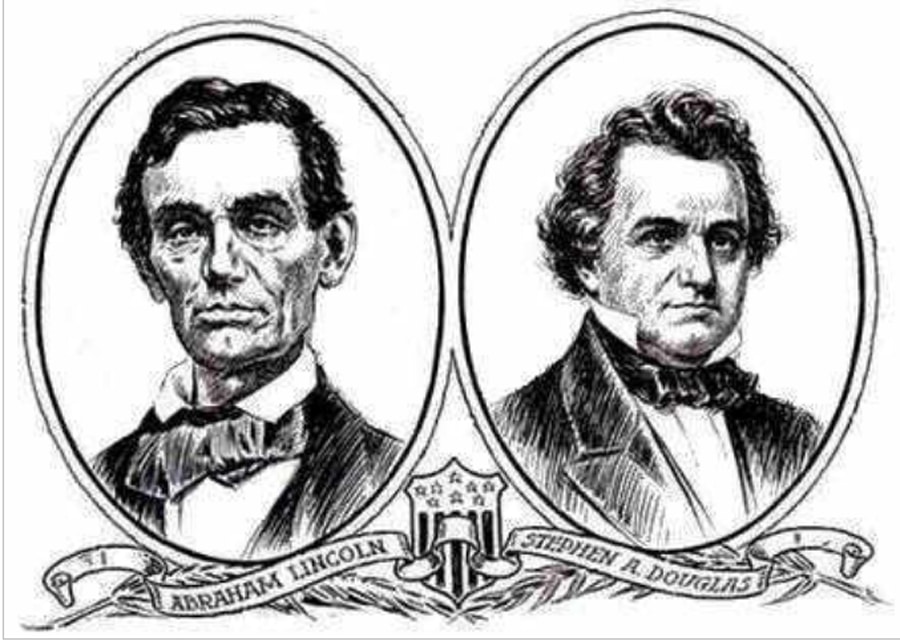 Lincoln believed deeply that American society and the country had strayed from the founding and the United States needed to return to both the Constitution and the intent of the Founding Fathers, particularly to resolve the issue of slavery. In both his writings and public appearances, he argued convincingly that the present-day slavery problem was a misinterpretation of the Constitution when it came to “inalienable rights” and the result of generations of misguided governance. Lincoln’s ideas were most clearly articulated during the famous Lincoln-Douglas debates of 1858.
Having given little thought to the meaning of these debates since college, I proceeded to descend into the proverbial “rabbit hole” and read the excerpts on the slavery question of this treasured American History discourse.
The Republican Party, created to repeal the Missouri Compromise and oppose opening the territories to slavery, nominated Abraham as its candidate for Senate from Illinois in 1858. The incumbent Illinois Senator Stephen Douglas advocated the principle of “popular sovereignty,” that each territory/state could make their own decision on the question of slavery.
Lincoln, during the seven debates, argued that the Supreme Court’s Dred Scott decision prohibited the people of a territory from exercising such a right. Lincoln suggested that the decision was part of a campaign to nationalize slavery, and that a “second Dred Scott decision” would declare that no state could prohibit slavery. Claiming that Douglas was a party to this conspiracy, Lincoln argued that Douglas’s popular sovereignty was an unreliable doctrine to prevent the spread of slavery into the territories. Lincoln went further in his rhetoric suggesting that Douglas himself was not credible because of his moral indifference to slavery.
Lincoln, in addressing the question whether blacks were excluded from the intent of the Constitution and the will of the Founding Fathers, had this critical response in the October 15 debate in Alton: “I think the authors of that notable instrument intended to include all men, but they did not mean to declare all men equal in all respects. They did not mean to say all men were equal in color, size, intellect, moral development, or social capacity. They defined with tolerable distinctness in what they did consider all men created equal—equal in certain inalienable rights, among which are life, liberty, and the pursuit of happiness. This they said, and this they meant. They did not mean to assert the obvious untruth that all were then actually enjoying that equality, or yet, that they were about to confer it immediately upon them. In fact, they had no power to confer such a boon. They meant simply to declare the right, so that the enforcement of it might follow as fast as circumstances should permit. They meant to set up a standard maxim for free society which should be familiar to all: constantly looked to, constantly labored for, and even, though never perfectly attained, constantly approximated, and thereby constantly spreading and deepening its influence and augmenting the happiness and value of life to all people, of all colors, everywhere….”1
The intense and historical epoch from Dred Scott to the 1860 election, the political philosophy of Abraham Lincoln, and the delicate effort to advance the anti-slavery agenda, is a capital topic for Civil War Round Tables as a seminal commemoration activity.
Take on this topic and reenergize your Round Table! Stand tall and be noticed!
Round Tables (and history clubs in general) everywhere share the common challenge of sustaining the viability of their membership whilst offering stimulating historical programs. Using the year-long 250th commemoration, a golden and rare opportunity exists to recruit and retain new members across many communities by shining a bright light on Lincoln, the savior of the nation.
David Hamon is a Director on the Board of the CWRT Congress.


Good ideas here for thinking about the 250th anniversary.