Book Review: Lincoln’s Road to War: A Day-By-Day Account of the First 60 Days of Abraham Lincoln’s Presidency

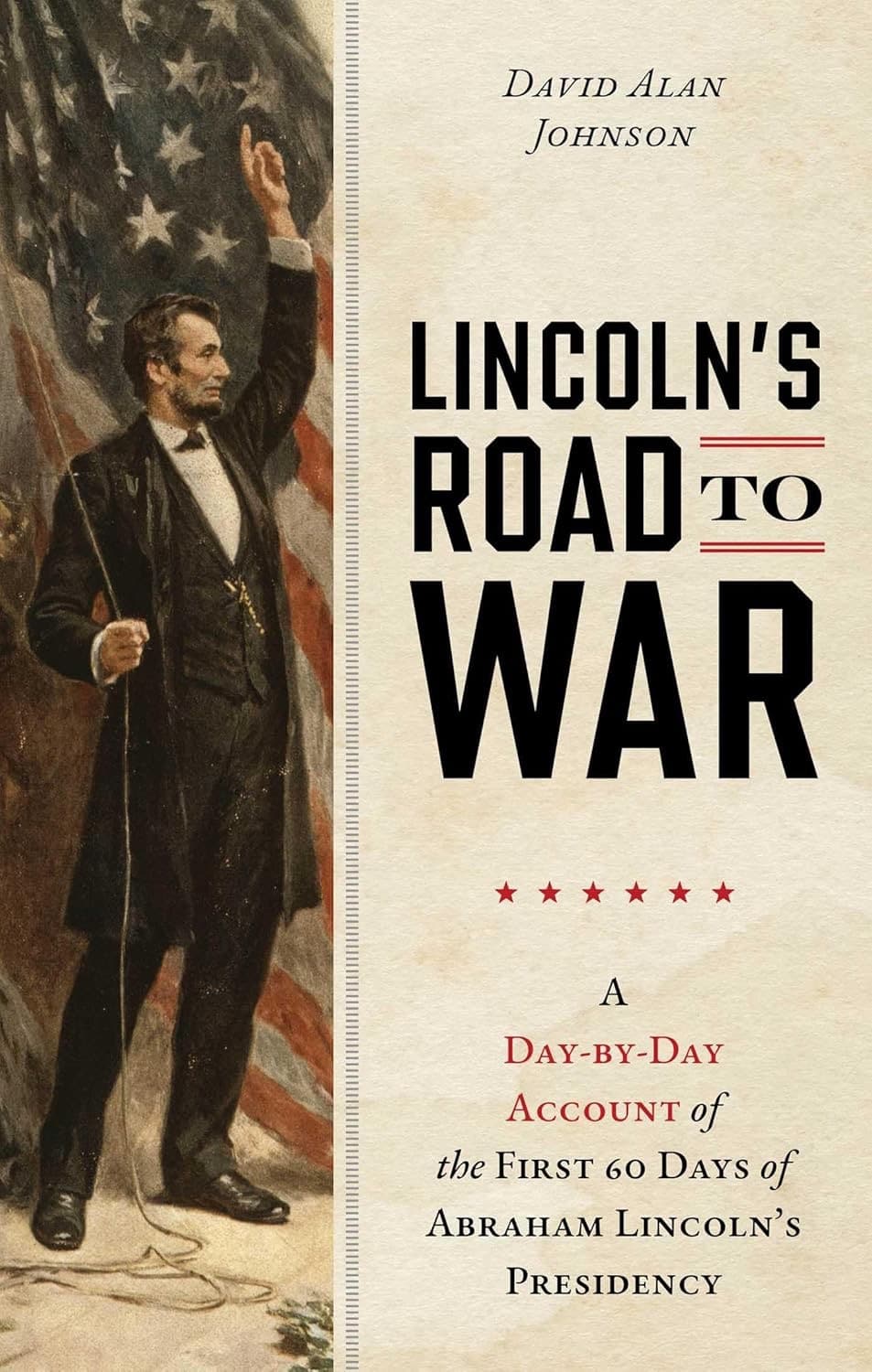
Lincoln’s Road to War: A Day-By-Day Account of the First 60 Days of Abraham Lincoln’s Presidency. By David Alan Johnson. Essex, Connecticut: Lyons Press, 2025. Hardback, 274 pp. $29.95.
Reviewed by Kevin C. Donovan
The reviewer approached this book with some skepticism. Would David Alan Johnson’s Lincoln’s Road to War: A Day-By-Day Account of the First 60 Days of Abraham Lincoln’s Presidency offer anything more than a bland “this happened on this day, then this happened the next day”? Granted, the daily chronological approach is not unheard of in Civil War literature. There is Every Day of the Civil War: A Chronological Encyclopedia, by Bud Hannings (McFarland 2010) and The Civil War Day By Day: An Almanac, 1861-1865, by E.B. Long and Barbara Long (Da Capo Press 1985). The question was would a reader learn from Mr. Johnson’s work anything beyond a recitation of dates and events that Civil War aficionados probably already knew?
The answer is yes, in several different ways. Lincoln’s Road to War does cover ground familiar to most experienced Civil War readers. The crisis created by secession and how Lincoln struggled to respond to such, the specific crisis presented by the deteriorating situation at Fort Sumter, the effort to keep Virginia in the Union, and the perceived threat to a virtually defenseless Washington are well-known stories that each figure prominently in the book, albeit told from Lincoln’s perspective. (The Collected Works of Abraham Lincoln is extensively used by the author.)[1]
Yet Johnson provides many interesting tidbits that provide a fresh flavor to these familiar themes. For example, in the March 12 entry the author recounts a suspected assassination attempt against the Lincoln family—from a Maryland fish dinner that “had been deliberately poisoned.” (60) The clever suggestion that Lincoln notify South Carolina that supply-only ships would approach Fort Sumter originally came from a visiting newspaper editor. Evidence that Lincoln was being physically worn down by the crisis is illustrated by a March 20 note that the president signed “Your tired friend…” (83). In the midst of all his troubles, Lincoln caught the fact that his first presidential paycheck overpaid him by four days and personally corrected the voucher. The defection to the Confederacy of U.S. Captain John B. (“Prince John”) Magruder, charged with an artillery unit defending the capital, hit Lincoln “particularly hard” because just three days before, Magruder had come to the White House to offer Lincoln “over and over again his …protestations of loyalty and fidelity.” (205) Other illuminating anecdotes abound.
On a broader level, Johnson’s day-by-day, Lincon-centric, approach permits the reader to accompany Lincoln as he faces daily doses of stress and frustration. Sources of such include military officials who repeatedly assure him Sumter’s plight is hopeless, unhelpful Cabinet members, and swarms of office seekers whose demands severely try Lincoln’s patience. These events are presented in rapid-fire fashion; chapters often only run two or three pages.
The toll the chosen period takes on Lincoln both physically and mentally is one theme of the work. Thus, while Johnson’s Lincoln is constrained from making bellicose threats against the insurgents by a hope of avoiding war, he lashes out at others. Johnson recounts an incident in which Lincoln raged against certain politicians complaining about patronage distribution, to the point of physically tearing up a document they gave him and consigning it to the fireplace. Another supplicant wrote that he hoped “never again to feel the humiliation” to which Lincoln had subjected him simply for requesting a job for a friend. (128) Lincoln’s plaintive response: “Is it really in his heart to add to my perplexities now?” (128).
Another theme is Lincoln’s growth amidst crisis. While this theme is hardly new among historians, Johnson’s examples highlight Lincoln’s pivot from attempted conciliator to a man with iron spine. For example, Lincoln’s pithy comment in response to a demand that Union reinforcements not travel through Maryland—“Our men are not moles, and can’t dig under the earth…”—is well known.[2] But Johnson adds the rest of Lincoln’s response: “Go home and tell your people that if they do not attack us, we will not attack them; but if they do attack us, we will return it, and that severely.” (202) Three days later, Lincoln authorized Gen. Winfield Scott to undertake “bombardment of their cities” if Maryland’s legislature moved against the Union. (209).
The reader sometimes is left wishing to know more about persons mentioned as interacting with Lincoln. Yet with the book’s focus on Lincoln himself and the impact of events upon that troubled soul, it really is not necessary to know others. At times, though, statements in the book are not supported by historical cites (the fish dinner assassination effort being one), which would have been useful.
Despite this, Lincoln’s Road to War succeeds in bringing to life a Lincoln traveling a fraught road, rising to the challenge during an unprecedented period of American history.
[1] Abraham Lincoln, The Collected Works of Abraham Lincoln, ed. Roy P. Basler (Rutgers University Press, New Brunswick, NJ 1953).
[2] E.g., Shelby Foote, The Civil War: A Narrative, Fort Sumter to Perryville (Vol. I), p. 53 (Vintage Books, New York, NY 1986).


