Daniel Foster: A Militant Pastor’s Heart
ECW welcomes back guest author Nancy Jill Hale.
“I am convinced that our cause must receive a baptism of blood before it can be victorious. I expect to serve in Capt. John Brown’s company in the next Kansas war, which I hope is inevitable & near at hand.”[1]
These were extraordinary words from a pastor who once advocated for non-violent means to end slavery. But through his experiences, Rev. Daniel Foster’s abolitionism evolved into a more militant perspective that ultimately cost him his life.
Foster was born in Hanover, New Hampshire, on December 10, 1816. Seven of the eight brothers in the family attended Dartmouth College, and six became Congregational pastors. Daniel spent two years teaching in Kentucky, where he was exposed to slavery and “became an abolitionist from a settled conviction of the inherent sinfulness of Slavery, a conviction forced upon me by what I saw of the evil-workings of the system.”[2] Foster returned to New Hampshire, was ordained, and served several churches in New Hampshire and Massachusetts.
However, his nascent abolitionism was growing fiercer, and he was dismissed from his churches by angry parishioners. William Lloyd Garrison of the Massachusetts Anti-Slavery Society offered Foster a position to lecture and raise funds for the society and to write for Garrison’s paper, The Liberator. But as Foster’s anti-slavery convictions led him from simply speaking out to action, he found himself at odds with the society. “It is true,” Foster wrote, “that Mr. Garrison and the leading men and women in the Massachusetts Society are non voters for conscience sake. I differ with them here. I think we must have political action.”[3] He ceased working for the society and began to lecture on his own.
While in Boston, Foster witnessed the effects of the Fugitive Slave Act, which he abhorred. When a fugitive slave was arrested and sentenced to be returned to his owner, Foster joined other demonstrators and was asked to lead them in a prayer that was widely circulated. His words in this prayer cemented his credentials as a passionate abolitionist. He implored, “Almighty God, Thou seest this poor man, one of Thy children, borne away by oppressors. In mercy, Heavenly Father, do Thou destroy the wicked power which rules over us. Hasten the day when all men shall be FREE.”[4]
Foster’s attention turned to Kansas in the mid-1850s when the question of whether that territory would be admitted to the Union as a free or slave state led to violence between the “Free-soilers” and the “Border Ruffians” (the region was known as “Bleeding Kansas”). Yet he still believed that non-violence was the proper response. He wrote, “The freedom of Kansas after all depends upon the presence and power of the Christian Spirit in the hearts of her people. I am sure that the effort to establish in Kansas the true, untrummelled progressive Christian Church would be attended with marked success.”[5]
By 1857, Foster had rejected his traditional Congregational doctrine and joined the Universalists. Through his connections in that denomination, he was invited to serve as chaplain of the Massachusetts House of Representatives. It was there that he heard a speech by John Brown about the trouble in Kansas, which led to Foster’s turn to a militant stance in which he agreed with Brown that blood must be shed to rid the country of slavery.
He moved his family to Kansas, and for the next couple of years he traveled back and forth to Massachusetts, where he lectured to raise money for Free Soil settlers in Kansas. Foster was involved in Brown’s planning to take armed men into Kansas, and he even signed Brown’s will as a witness, but there is no evidence that he took part in any of Brown’s violent activities in the territory.
When the Civil War began, Foster moved his family back to Massachusetts, and on August 13, 1862, he enlisted as chaplain in the 33rd Massachusetts Volunteer Infantry. He was with the regiment through their battles from Antietam to Gettysburg. Then, in August 1863, he wrote a letter to The Liberator in which he reflected on President Lincoln’s Emancipation Proclamation, issued on January 1, 1863, writing:
“Another result of this new policy, and the greatest blessing of all yet vouchsafed to us, is the recognition of the manhood and citizenship of the Negro. Thirty thousand of our colored fellow-citizens are now armed and equipped as soldiers in the American army, an integral and important part of the grand host battling for the dear old Fatherland. The number is constantly and rapidly increasing. Nor have we braver soldiers in the field than they have shown themselves at Port Hudson and Fort Wagner, and, indeed, on every field where they have been called to face the infuriated foe. As I read with a thrilling heart of their noble daring and heroic achievements, I deeply regret that I am not associated with them in their grand work.”[6]
His regret was short-lived because he resigned as chaplain of the 33rd on November 16, 1863, to accept a position as captain of Company B in the 3rd North Carolina Colored Infantry, soon renamed as the 37th Regiment of U. S. Colored Troops.
In February 1864, in a letter to his wife, he reported, “After the inspection this [Sunday] morning I held a religious service with my men.” When his men were encouraged to join in the plundering of a passing market cart, “they replied, no our captain tells us we must not steal or do anything else to offend God, but in all things act like true Christian men, and so they all refused. A wonderful work can be done with these colored men if their officers will only be patient and faithful with them. When treated kindly by their officers they exercise unbounded faith in them and yield implicit obedience, not only to actual commands, but to any expressed wish.”[7]
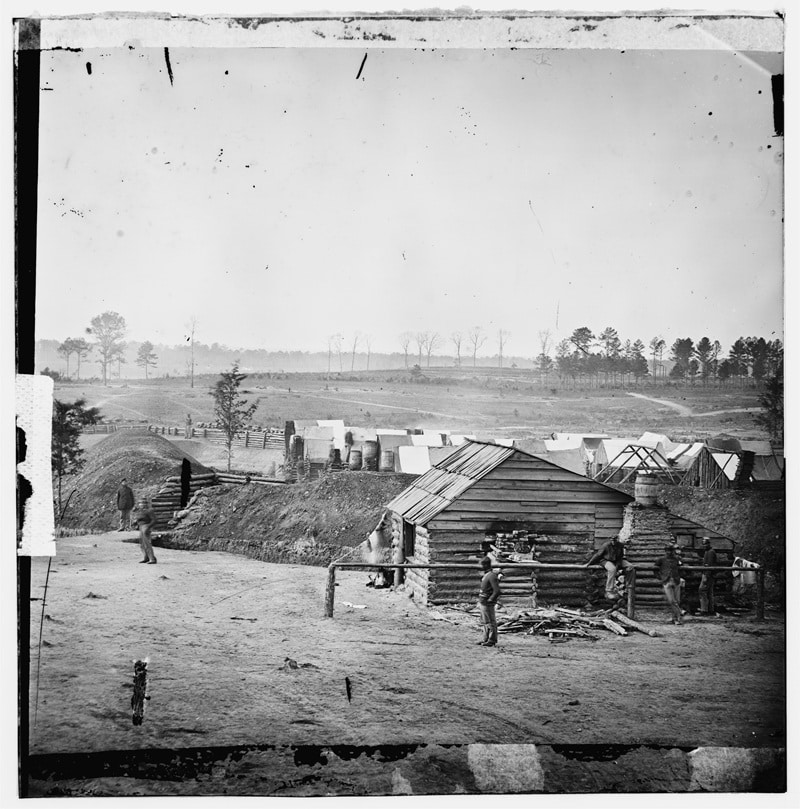
In the fall of 1864, at the age of 47, Foster’s passion for the rights of the Black men to be free and to serve their country cost him his life when his regiment, as part of the Union XVII Corps, was stationed at Fort Harrison, Virginia. One source writes:
“On September 30, his company was sent forward to test the enemy lines but when the retreat was sounded some of his men were too far forward to hear it. Foster jumped on his horse and rode forward to bring his men back. As he approached the enemy lines he was shot in his left side, just above the hip. He managed to stay on his horse and return to the Union lines, where his men took him down and laid him on the ground. He asked them to turn him around, as he had vowed that he would die facing the enemy. He died a few moments later. His men and fellow officers raised enough money to have his body sent back to his wife Dora.”[8]
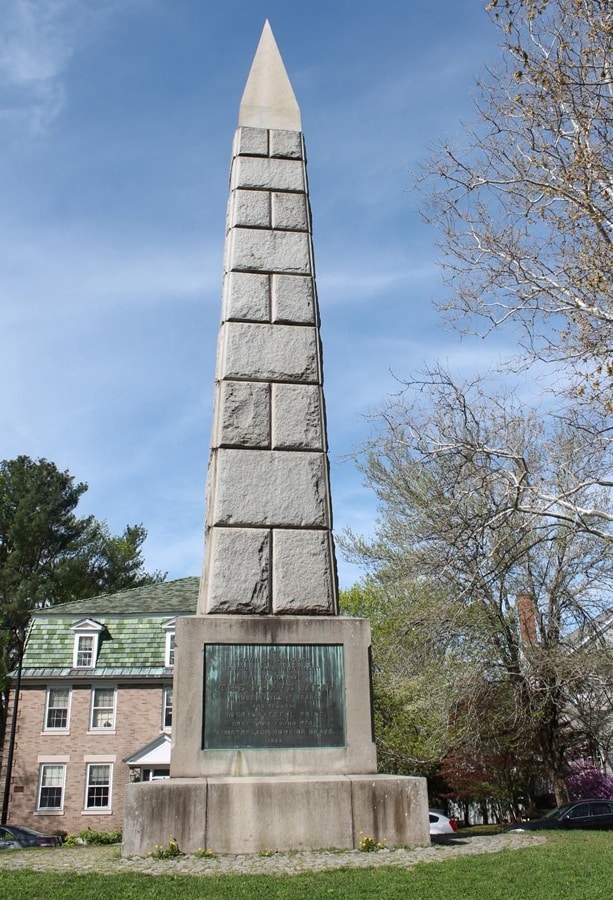
Photo by James R. Murray, www.HMdb.org.
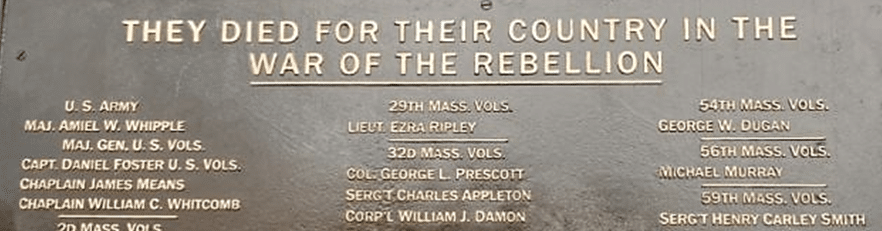
Foster’s sacrifice and devotion to his men and to his cause were memorialized on the Concord, Massachusetts Civil War Memorial. His tombstone, in Merrimack Cemetery in West Newbury, reads in part,
Greatly beloved and respected
by the Officers of the Reg.
and by his own men.
Friend of the poor and needy.
“Inasmuch as ye have done it unto
one of the least of these my brethren,
ye have done it unto me.”
The Rev. Dr. Nancy Jill Hale is a United Methodist pastor and Licensed Battlefield Guide at Gettysburg. She is the author of the book A Sight Never to Be Forgotten: Eyewitness Accounts of Union Chaplains at Gettysburg.
Endnotes:
[1] “Daniel Foster – Class of 1836,” Kimball Union Academy, https://www.kua.org/news-detail?pk=632428.
[2] “Daniel Foster – Class of 1836,” Kimball Union Academy, https://www.kua.org/news-detail?pk=632428.
[3] Letter, Daniel Foster to Frederick Douglass. PLSr: Frederick Douglass’ Paper, 31 December 1852. https://frederickdouglasspapersproject.com/item/7882. Emphasis in original.
[4] “Daily Morning Commonwealth,” April 14, 1851.
[5] Undated sermon, “The Mission of Christianity and The Field for Christian Effort in Kansas” (Massachusetts Historical Society, MsN1238_F04).
[6] “Letter from Rev. Daniel Foster,” The Liberator, August 21, 1863.
[7] Letter to “My Dear Wife,” February 7, 1864, Camp of the 3rd N.C. Col’d Vols. near Norfolk, Va. Massachusetts Historical Society, MsN1238_F08.
[8] “The Fighting Chaplain of the Massachusetts 33rd,” Chester Historical Society, Vol. 4, Issue 2, October 2005, 5. The battle was called Chaffin’s Farm and Foster’s regiment fought at nearby Fort Harrison.


Excellent research and writing! Thank you for telling Chaplain Foster’s story. Just one minor quibble, the 37th USCI was part of the XVIII Corps.
Yes, you’re right! That error slipped through!