AI Cites Its Civil War Source
If it “mines” the Internet for data, then artificial intelligence recently identified the Civil War “mine” from which it stole intellectual value.
Its developers hail AI as the future, but without access to the Internet’s myriad data sources, AI could not function in its ever evolving capabilities. For some years AI has, with its developers’ authorization, scoured the Internet to collect every bit of information found there. Humans placed that information on the World Wide Web, and AI swept up that data without its developers paying for the right to use it.
The de facto verb assigned such intellectual theft is “mine,” “mines,” or “mining” the Web, suggesting that AI digs deep into the World Wide Web terrain to find informational gems and gold.
And history researchers now realize that for most questions “googled” on the Internet, “AI Overview” (or whatever the name) has become the first cited source. Where Wikipedia or another (perhaps sponsored) source once held that distinction, AI does today, although not in all situations.
Internal discussion among ECW members has touched upon AI displacing other online research sources, many of which generate revenue from “clicks” or “likes.” A few ECW members mentioned how they skip over AI (hard to miss with its top-of-the-page dominance) and click on other sources instead.
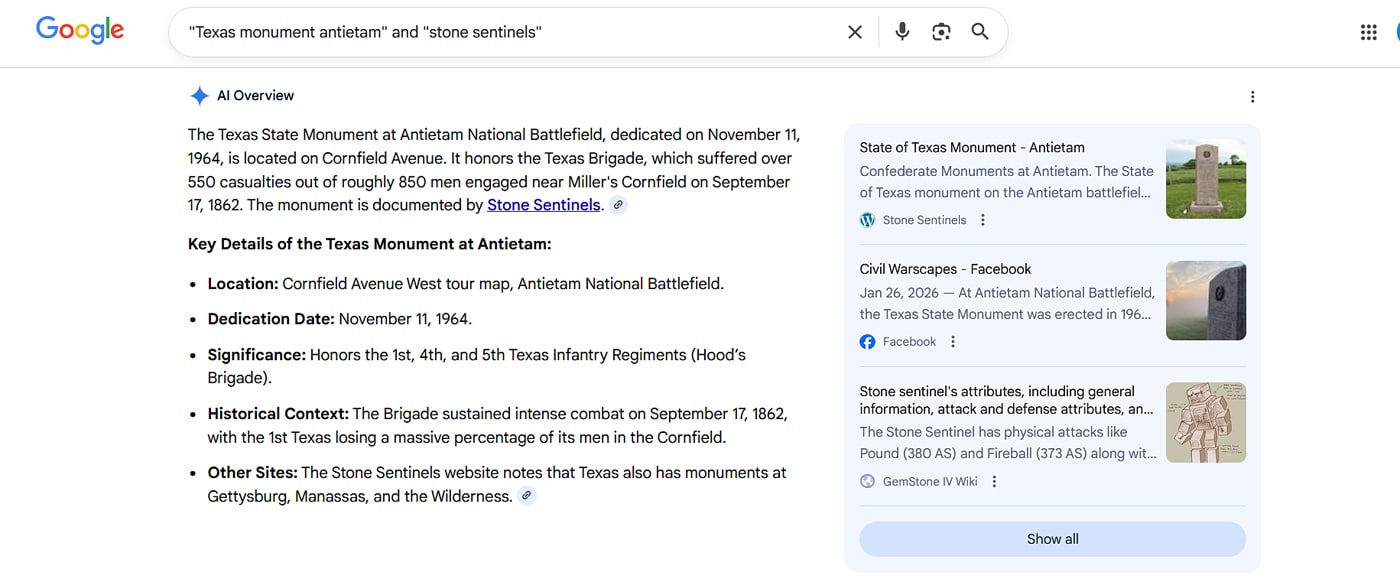
I recently researched specific Antietam monuments at https://stonesentinels.com, an excellent source for Civil War monumental research. I googled “Texas Monument Antietam” and “Stone Sentinels.” The AI Overview response appeared at the left top of the list. Just before clicking on the Stone Sentinels website on the right top, however, I noticed the oddities in the AI-supplied information:
1. AI Overview ends its opening Texas State Monument paragraph with the sentence, “The monument is document by Stone Sentinels.” The URL link is provided for “Stone Sentinels.”
2. The fifth (and last) bulleted notation under “Key Details of the Texas Monument at Antietam” credits Stone Sentinels with noting “that Texas also has monuments” at other battlefields.
AI Overview obviously responded to my two-part query by incorporating both “Texas Monument Antietam” and “Stone Sentinels” into its response. I have noticed a similar citation of non-AI sources in other AI Overviews, but certainly not in all situations.
I reported and edited 27 years for a major daily that insisted on quoting only sources who went on the record. We could not quote or “cite” an anonymous source. Given that background, I like that AI Overview cites some sources, at least, and provides the URL links.
Postscript: Emerging Civil War has started delving into using AI for Civil War research and scholarship. Here are two interesting posts:
1. Artificial Intelligence (ChatGPT) Tries the Civil War by Dan Walker.
2. Breathing Life into the Past: Enhancing Civil War Portraits with Artificial Intelligence by M. A. Kleen.


The last item, using AI to enhance photographs sounds interesting.
I’d like to see the same rigor around citing originals, so that history doesn’t slowly get blurry with unmonitored pictures adding and deleting details in the images.
We should discourage anyone being erased from history, decades in the future.
AI Overview is wonderful for a compact overview of the subject, but it can’t be quoted as a primary source in a paper/article! It’s also great as a memory refresher, but never as a definitive source. It usually appears at the head of a page of links to various sources, if you’re still in the learning process, and perhaps some new sources if you’re already there. The major caveat is that it’s picking up anything on the internet, so it’s only as good as what’s out there. I have seen it quote some amazingly incorrect things; therefore using it reliably requires already knowing your subject – i.e., going to primary sources for material and quotes. Even primary sources have to be evaluated for reliability. AI is a convenience but it isn’t an easy substitute for academic research. I once did a ChatGPT search on an unrelated subject and it brought back information on a website constructed by my cousin. It was correct, but had I been a novice, there would have been no way to know that or to pin down the source. AI Overview is actually better than that.
Yes, the large language models got free IP. Only a matter of time before it is trained to defaultly not show selected substantive facts. Imagining a search for “civil disobedience Tianamen Square” or “citizen standing in front of tank” with deepseek, kimi or qwen
I’ve found AI to be very useful, but like anything else, it needs to be used carefully and with human oversight. A lot of the “AI overviews” I’ve seen on Google are just wrong. It pulls information from the Internet, but not all that information is correct. Garbage in, garbage out, as they say. There is a “deep research” mode that ChatGPT offers that I’ve also found useful. It can cut research time down significantly, but it is just a start. You can’t just accept whatever it says, you actually have to investigate the sources. But it’s very useful for, say, asking for a list of published sources (books, articles) about a certain subject. It won’t capture everything, but it would take me weeks to find a similar list. It’s also very good at explaining complex ideas.
There will always be multiple truths when relying on many humans memories to recount even an event observed a few hours ago like a car accident. To me AI at the moment is a bit like a “consolidator”. It consolidates the various memories however unreliable and gives “a version of the truth”. Note I have not mentioned “facts” which is another subject.
Journalistic citation values accuracy and original reporting. AI citations, however, are often statistical links to detected sources within its training data. They do not imply verification or endorsement of the original content’s accuracy. We must recognize this difference to avoid misplaced trust in AI-generated summaries.