Who is R.P.G.?: Three Letters That Sparked Murder
ECW welcomes guest author Jody Wilson.
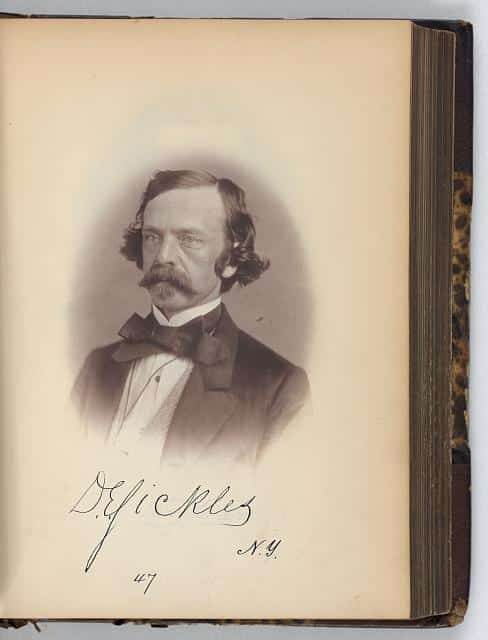
On February 27, 1859, Congressman Daniel Edgar Sickles confronted Philip Barton Key in Lafayette Square, directly across from the White House. Witnesses later testified that Sickles approached Key, demanded an explanation, and fired multiple shots at close range. Key, unarmed, staggered and collapsed on the street in front of Sickles. He was carried into a nearby building where he died shortly thereafter.[1]
The unraveling began on February 24, 1859. That evening the Sickles family entertained dinner guests before many departed for a social event at the Willard Hotel. As the party dispersed, a messenger arrived at Madison Place and delivered a sealed yellow envelope addressed to “Hon. Daniel E. Sickles.” Sickles accepted it without opening it and placed the letter in his pocket.[2]
Later that night, after returning home, he read the note. Its contents were restrained yet devastating: “Dear Sir, with deep regret I enclose this note, but I think it my duty to inform you that you have a rival in your wife’s affections… They meet at your residence; and when you are away, he hangs a string out of the window as a signal that he is in, leaves the door unfastened, and she walks in… I do not write this to gratify any feelings of malice… but simply because I think it is right you should know the facts… Your friend, R.P.G.”[3]
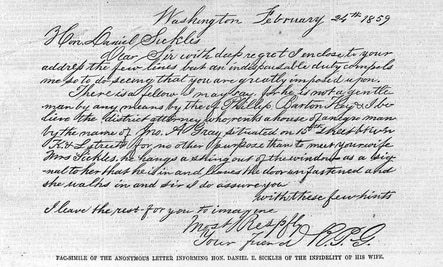
The specificity of the accusations, including household routines, signaling methods, and unlocked doors, immediately distinguished the letter from ordinary rumor. Initially, Sickles suspected political intrigue. Yet the level of detail prompted investigation.
The signature, “R.P.G.,” remains enigmatic. Some contemporaries interpreted it simply as initials. Yet mid-19th-century postal practice allows for another interpretation. “R.P.G.” was sometimes used as an abbreviation for Returned Post Gratis or Reply Paid Gratis, a notation indicating correspondence could be returned without charge. Read in this context, the signature may have signaled not merely anonymity, but detachment or an assertion that the information was offered freely, framed as civic or moral obligation rather than political transaction.
The anonymous letter did not arrive in isolation. In the spring of 1858, similar accusations circulated within Washington’s political circles. George B. Wooldridge, Mr. Beekman, and Marshall J. Bacon transmitted reports suggesting impropriety between Teresa Sickles and Philip Barton Key. These rumors prompted a written exchange intended to resolve the matter.[4]
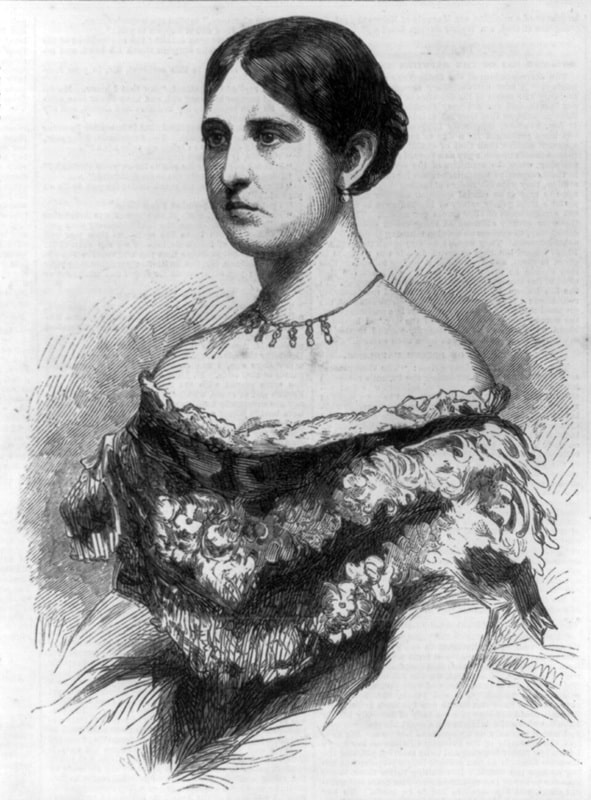
On March 26, 1858, Wooldridge summarized the claims: “Marshall J. Bacon informed me… that Mr. Beekman said that Mrs. Sickles had been out riding… and that they stopped at a house near Bladensburg… and that he had no doubt there was an intimacy… Mr. Bacon told me… that Mr. Key boasted that he only asked thirty-six hours with a woman to make her do as he pleased.”[5]
Key replied immediately, demanding clarification: “Herewith I send you a copy of a note… which you will be pleased to read and answer in writing…”[6]
Bacon responded carefully: “In the main, his statement is correct… Mr. Beekman was my author… I did not believe there was any truth in the statement… and I deemed it a fabrication.”[7]
The exchange was later reproduced during Sickles’s trial and published in the Times Union. At the time, Sickles accepted Bacon’s denial. Trust in his wife and friend prevailed.
When the R.P.G. letter arrived in 1859, it revived a narrative Sickles had consciously rejected the year before. This time he acted. He asked Wooldridge to observe Madison Place and question neighbors. Several confirmed seeing a man matching Key’s description entering the couple’s home and riding in his carriage during Sickles’s absences.[8]
Confronted with this corroboration, Teresa initially denied wrongdoing. When pressed, she confessed. Contemporary accounts record her exclaiming: “I am betrayed and lost!”[9] She admitted to “an intimacy of an improper kind,” adding, “I did what is usual for a wicked woman to do.”[10] Sickles demanded a written confession. The rage that followed was not sudden. It represented the collapse of trust carefully preserved in 1858.
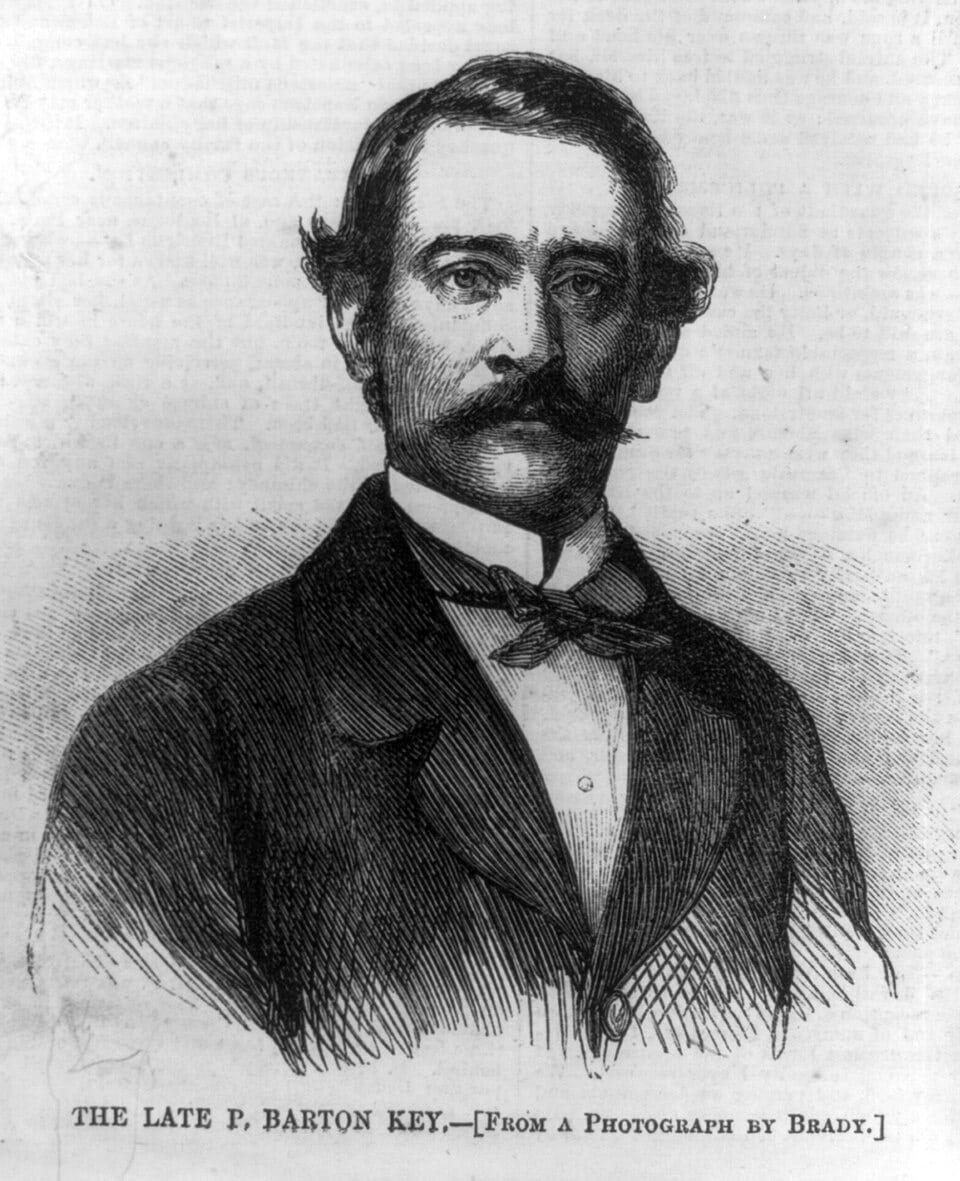
Philip Barton Key II was born on April 5, 1818, the son of Francis Scott Key. Trained as a lawyer, he served multiple terms as U.S. Attorney for the District of Columbia, most recently reappointed in 1858 with Sickles’s support.[11] Widowed and socially confident, he occupied a prominent position in Washington society, no doubt aided by both family reputation and his reportedly “remarkably handsome” appearance. On February 27, 1859, that reputation ended in Lafayette Square.
The Baltimore Sun devoted prominent coverage to Key’s funeral, emphasizing solemn ritual and social status.[12] Obituaries highlighted lineage and tragedy while minimizing moral culpability.
Public sympathy increasingly shifted toward Sickles, whose emotional distress became central to media narratives. In the moral language of the 1850s, a man’s public honor was inseparable from the perceived virtue of the women under his protection, and many believed he was obligated to defend the sanctity of his home and reputation, even if violence resulted.
After the shooting, newspapers reproduced the R.P.G. letter in full. Speculation over its authorship intensified.[13] Washington society proposed political enemies, servants, jealous rivals, and moral reformers. No definitive attribution emerged.
As the evidence emerges, Marshall J. Bacon emerges as the most credible. Born in New York between 1806 and 1813, Bacon trained as a lawyer and practiced in both New York City and Washington. In 1836, he married Belinda C. Graham, sister of John Graham, one of Sickles’s defense attorneys and of Charles Kinnaird Graham, who later served as a brigadier general under Sickles in the III Corps. Charles K. Graham was captured during the violent clash July 2 at Gettysburg that created more controversy for Sickles during his years serving in the Civil War. The familial and professional proximity of the Bacons, Grahams, Sickles, and Phillip Barton Key is difficult to ignore. In an age when reputation, obligation, and loyalty functioned as social currency, Marshall J. Bacon’s allegiance to Dan Sickles exacted a cost few men were prepared to bear.
Less frequently noted is Bacon’s affiliation with Freemasonry. Lodge records indicate he was a Mason in Wayne County, Michigan, by January 1848 before relocating to New York City and later Washington. Daniel Sickles was also a Mason.[14]
In 19th-century America, Freemasonry functioned as both a fraternal network and moral community. Members were encouraged to exercise influence discreetly. Within this culture, indirect intervention often replaced public accusation. Read in this context, the R.P.G. letter resembles a fraternal admonition: restrained, moralized, and anonymous.
By the late 1850s, Bacon had earned a reputation as a relentless exposer of corruption. In pre-war Washington and New York there was plenty to uncover. He was involved in exposing abuses within the Department of the Interior and gained national attention in connection with the Wanderer slave-ship scandal. Newspapers described him as sharp, morally driven, and unafraid of reputational conflict, qualities consistent with the tone and timing of the R.P.G. letter.[15]
Contemporary press made the connection explicit. The Buffalo Morning Express reported in 1860: “[Bacon]…the same Mr. Bacon who some time since wrote the anonymous note to Mr. Dan Sickles which led to the clear cementing of the amour between Mrs. S. and Mr. Key…”[16]
The phrasing is instructive. The letter did not create the affair; it cemented it, transforming rumor into certainty and suspicion into action.
In the aftermath of the shooting, while Sickles awaited trial, newspapers reported a striking gesture: Mrs. Belinda Bacon, accompanied by a friend, raised money and presented Sickles with a Bible.[17] The act carried heavy symbolic meaning. Why would the wife of the man who exposed Sickles’s humiliation offer spiritual consolation?
The R.P.G. letter did more than precipitate a murder. It exposed the fragility of reputation and the power of anonymous communication in 19th-century America. It authorized violence, reshaped legal doctrine, and redirected public sympathy.
Despite extensive press inquiry and historical scrutiny, its authorship remains unresolved. Probability points toward Marshall J. Bacon. Undeniable proof remains absent, but circumstantial evidence and cause is abundant.
167 years later, its voice remains anonymous. The R.P.G. letter endures as one of the most consequential unsigned documents in American history, a reminder that secrecy can wield power equal to revelation.
Jody Wilson is a public historian and nonprofit development professional at the Gettysburg Museum of History. She serves on several historical boards and is co-host of the Battle of Gettysburg Podcast, where she explores the Battle of Gettysburg and the controversial political and social climate of the 1850s that helped lead the nation toward the Civil War.
Endnotes:
[1] New York Herald, February 28, 1859.
[2] New York Daily Herald, March 1, 1859.
[3] Ibid.
[4] Times Union (Albany, NY), April 13, 1859.
[5] George B. Wooldridge to Philip Barton Key, March 26, 1858, in Times Union (Albany, NY), April 13, 1859.
[6] Philip Barton Key to Marshall J. Bacon, March 26, 1858, Ibid.
[7] Marshall J. Bacon to Philip Barton Key, March 26, 1858, in Times Union (Albany, NY), April 13, 1859.
[8] New York Tribune, February–March 1859.
[9] Ibid.
[10] New York Herald, April 1859.
[11] Maryland State Archives, “Philip Barton Key,” MSA SC 3520-15169
[12] Baltimore Sun, March 2, 1859.
[13] New Bern Progress, May 13, 1859.
[14] Wayne County, Michigan, Masonic Lodge Records, January 1848
[15] New York Herald, 1859.
[16] Buffalo Morning Express, 1860.
[17] New Bern Progress, May 13, 1859.


A most interesting article! Thank you for adding these details about the marital affair and the shooting which followed. You also make good points about the cultural context and expectations.
Excellent article, Jody!
Well written and researched. Thanks for sharing this unique historical perspective.
thanks Jody — fabulously interesting piece on Sickles … everyone knows the story of Sickle’s legal dream team (led by Edwin Stanton) and their successful insanity plea … but your story is a nice bookend to before the murder!
Jody. I really enjoyed your article. Great job.
Great Post. Enjoyed the previously unknown details (to me) in your article. Devil Dan at his finest.
Great article and story! Thanks for sharing it with us, Jody!