Goldrush at Deep Bottom
The evening of June 22, 1864, found a lull in the fighting at Deep Bottom, Virginia. The area showed signs of destruction. The once fine-looking mansions that overlooked the James River had been destroyed by the Navy over a month earlier. Now only their chimneys remained near the pontoon crossing.
Taking advantage of the peace, soldiers boiled coffee, and sat talking or smoking, while others were bathing near the crossing. Still others were seen trying to run down a rabbit.[1]
Two drummer boys from the 10th Connecticut Infantry decided to try fishing. They wandered down a ravine near the chimneys with their poles and shovels. “They were hunting for fish worms,” recorded Private Charles O. Poland, Co. B, 142nd Ohio.[2]
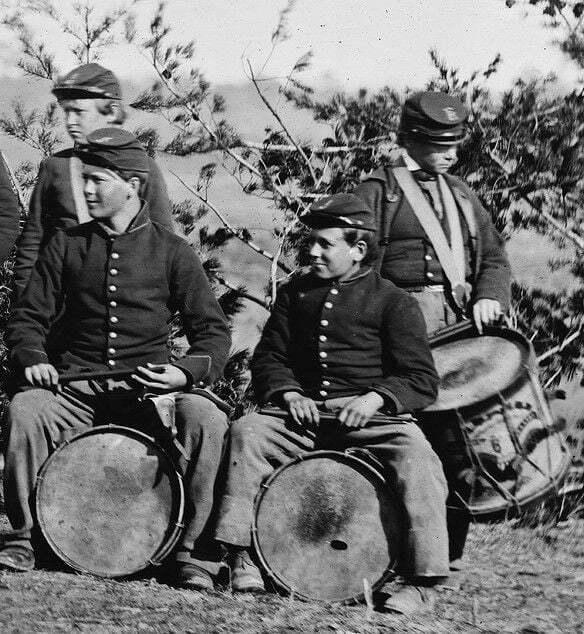
Digging at the edge of the ravine, the spade of one of the boys struck something solid. As they dug further, they could see it was a big lidded-pot, and the boys’ excitement got the better of them. Instead of keeping the find to themselves until they knew what they had, they blurted out in their astonishment for all to hear.
Soon men from the nearby 1st Connecticut Light Battery and the 10th New York Infantry rushed to see what the commotion was about. They began helping the drummer boys unearth their pot. Removing the lid they “found a large pot full of gold and silver coins.”[3]
A shout went up from the crowd. Muscling the two drummer boys out of the way, the older men leaped at the treasure. Greedy hands grabbed at the prize “dividing its contents among themselves, according to who could grab the most the quickest.”
Soon the pot was empty. It is unclear if the two drummer boys got any of the coins. As one soldier from the 1st Connecticut Battery said, “Some comrades got their share and Comrade Sloan still prizes as a souvenir a French gold coin which he got from the jar.” Estimates ranged from $500 to $6,000 was in the pot.[4]
Word of the gold find raced through the camps. “Like the rush of gold seekers to Cape Nome or the Klondyke, the soldiers lost no time in going to the riverside and digging for treasure. They sifted the sand, they searched under stones and tree roots, looked in crotches of the tree branches, and spent all their leisure time in the vain search for treasure, vain, because that jar was the only treasure found,” recalled Corporal Herbert W. Beecher of the 1st Connecticut Light Battery.[5]
Men plunged shovels into every auspicious-looking mound or plot of fresh earth. Some even opened a grave. Private Hiram T. Peck of the 10th Connecticut Infantry recalled, “The coffin was broken into, and a fellow of greater credulity than was really called for under the circumstances, explored the same with his hand, but did not succeed in bring anything to light except a few stained rags which the body was buried .”[6]
Gold fever soon subsided. The soldiers were distracted when they watched and cheered as the pontoon bridge opened, allowing the USS Baltimore, carrying General Grant, President Lincoln, General Butler, and Admiral Lee, to pass on an inspection tour up the James River.[7]
————
[1] Horn, John, Lee Besieged: Grant’s Second Offensive, June 18-July 1, 1864, California, Savas Beatie, 2025, p. 40. Root, Samuel H. Papers, Civil War Miscellaneous Collection, United States Army Heritage and Education Center, Carlisle, PA. Root to wife, June 25, 1864.
[2] Poland, Charles O., Diary. Special Collections. Virginia Polytechnic Institute and State University, Blacksburg, VA. Entry June 22, 1864. Diary, Charles O. Poland, 1864 (Ms2008-013) · VT Special Collections and University Archives Online
[3] Ibid.
[4] Beecher, Herbert W., History of the First Light Battery Connecticut Volunteers, 1861-1865, Personal Records and Reminiscences, the Story of the Battery from Its Organization to the Present Time. 2 vols. New York, A.T. De La Mare Ptg. And Pub. Co., 1906. Vol. 2 p. 500. #11 – History of the First Light Battery Connecticut … v.2. – Full View | HathiTrust Digital Library . Poland, Diary entry of June 22, 1864. Horn, Lee Besieged, p. 40. The price of gold per ounce today ia $4017.00. Gold Price Today | Gold Spot Price Charts | APMEX® $500.00 in 1864 would equal today $10,636.00 and $6000.00 would equal $136,891.26. How much is a dollar from the past worth today?.
[5] Beecher, History of the First Light Battery Connecticut Volunteers, p. 500.
[6] Peck, Hiram T., Army Journal: A Private Record of Life in the Federal Service during the Great Rebellion, New Haven, n.p., 1874. Horn, Lee Besieged, pp. 40-41.
[7] Horn, Lee Besieged, p.154.


An interesting tale. Thanks for sharing
Too bad that the drummer boys didn’t keep quiet. It would be interesting to see who ended up with the coins.