Waking Up Chancellorsville
It’s chillier than I’d like it to be this morning on the Chancellorsville History Trail, but my assumption is that I’ll warm up once I get walking. Temperatures are forecast to rise to the low 50s, but so far, they haven’t yet cracked 40. The past few days have been much warmer, so today feels like a step backward in the season, but I suppose that’s what March is all about.
I haven’t been out here since fall, when I walked the battlefield as part of my daily exercise. Once the weather turned colder, I traded in daily hikes for the warmer confines of the gym, but nothing beats the fresh air of the battlefield. Nothing beats being out in the woods. The sound of Route 3 is never far, but this trail can still feel solitary and re-energizing.
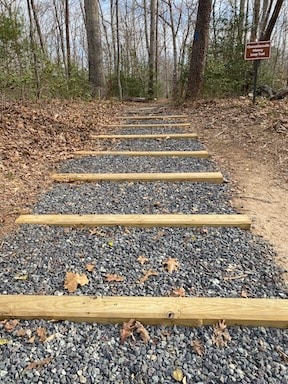 Every walk offers the chance to see something new, even as well worn as the path is and as familiar as the route is to me. For instance, since my last hike out here, the park has redone short, earthen steps at the trailhead. Access looks nicer and easier. While not history related nor a wonder of the natural world, such small details are exactly the kinds of details I try to notice. Appreciating small things cultivates a larger ethos of gratitude that makes every day fuller and richer.
Twice during the first stretch of my walk—from the parking lot to the Chancellorsville ruins—I see what look to be short lengths of smashed bamboo. Are they fragments of somebody’s broken walking stick? Not until a third time do I realize they are actually fragments of cornstalks from around the ruins, hauled into the woods by some beast or bird. Twice I also pass small piles of dog poop, left behind by some inconsiderate dog walker who must imagine the Poop Fairy will magically come along and clean up after them.
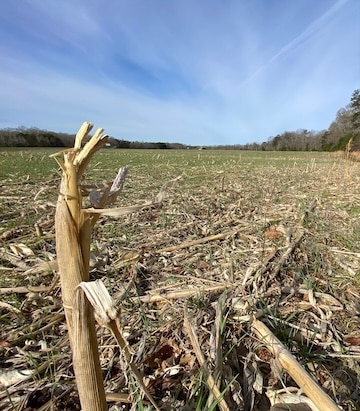 The path takes me across a small corner of the Chancellorsville clearing, from the wood line along the cornfield toward the parking area. In the summer, this short stretch will soak my sneakers with dew, but today, the grass is still trying to green itself. Brown patches scribble their way among the green, reminding me that spring’s work is still underway here, far from complete.
Later in the spring and through the summer, an array of fungi will dot the forest with a variety I never would have imagined had I not seen it with my own eyes. If don’t keep those eyes pointed front, my face will catch a spiderweb every 12 or 15 feet as I walk (one of many good reasons to wear a hat!).
Box turtles will come out in force in May as they hunt for mates, then become more mercurial to spot as summer grows older. Green snakes will ribbon through the branches of rhododendron bushes. Black rat snakes may curl up by the path like bike tires. Least frequently, I might even spot a copperhead slithering away. I have also seen skunks, raccoons, and deer out here, and once I flushed a bear out of one of the streamlets that wind through the woods.
In previous springs, stretches of this path have been wet enough to be small swamps. I can’t hike through them and instead must gingerly pick my way along the edges, searching for fallen logs or dry hummocks. Past Scouting projects have resulted in wooden walkways and earthwork-spanning bridges, but I can’t remember the last one installed. The path—and my dry feet—could benefit from more such bridging, and I sometimes catch myself plotting a trip to Home Depot to pick up the necessary materials to build one myself.
On the back side of the loop, between the old CCC buildings the park uses as maintenance sheds and the apex of Fighting Joe Hooker’s last line, several new houses have sprung up along the park boundary. I can hear voices from one of the back porches. It used to be all be wild in that direction.
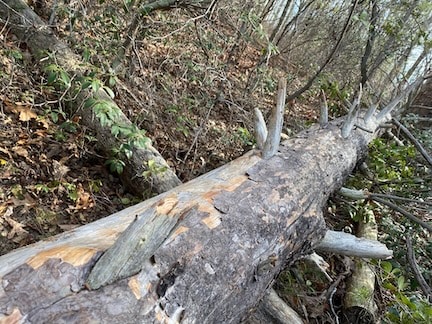
A little way beyond, I meet my first real obstruction: a tall Virginia pine tree has tumbled down over the trail. The park’s chainsaw crew usually clears tree-falls within a couple days, so this one must be new. Those March wins have blown their way across Chancellorsville several times in the past couple weeks, so this is just another sign of the season.
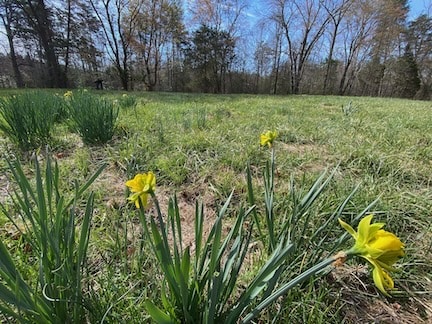
So two are the daffodils that sprout in the clearing around the Bullock house. As pretty as they are, they’re actually an invasive species. Years ago, a friend who worked in the parks’ natural resources division would spend weeks spraying them with a blue herbicide that stained everything: clothes, boots, hands, people who even looked at the stuff, it seemed.
The last leg of the loop—can loops have legs?—is mostly quiet, punctuated by the frantic work of a woodpecker somewhere to my west. Near the water tower along Bullock Drive, a bluejay sounds wicked angry about something. An oriole next to the path seems unconcerned when I stop to watch him. I hear other soft birdsongs along the way, but I’m not expert enough to be able to identify them. Just hearing them is pleasure enough.
It will be fun to watch this battlefield wake up as spring marches on. At some point, a great burst of energy will pop the buds open with what always seems to me to be time-lapse speed. In a matter of days, this battlefield will look like a wilderness again. The foliage will even muffle some of the engines on nearby Route 3 and the traffic along Eli’s Ford Road. Those noises never entirely go away, though, and instead serve the soundtrack for the need for battlefield preservation.
“April showers bring May flowers,” the old poem goes. May will also bring battlefield season, and Chancellorsville’s hidden history will once again have its moment as it does every year. My focus then will be different than today. Today, it is time to wake from winter’s slumber and, as we rub the sleep from our eyes, see our favorite battlefields anew with the freshness only spring can bring.


Lovely, vivid, descriptions.
Thanks!
thanks. I enjoyed joining you on your walk.
Thanks for “joining” me!
Love this!
Thanks!
Wish I could wake up every morning and take a refreshing walk through a battlefield. That was an excellent story to remind us of spring. Thank you!
Randy Stone
Middletown, NY
Thanks, Randy. I hope you get the chance to spend some time battlefielding in the season ahead.
Beautifully written! ECW should consider doing a series of similar style writing that highlight authors’ personal connections to battlefields.
Thank you. I come to all this history stuff a little differently than most of my colleagues since I’m a writing professor who happens to write about history (as opposed to a historian who happens to write).
Reminds me of my rambles around Gettysburg, beautifully said. Impossible to juxtapose with the incalculable butchery and human suffering. Nature works to soften the acts of man.
I enjoyed walking along with you on this battlefield stroll. Unfortunately a bad leg injury has me laid up for a few months so it will be a while before I can get to the hallowed grounds this year. Until then I will enjoy reading some good civil war books and checking out this site often.