A Pause on John Schofield and George Thomas
On just about any online Civil War forum, one thing is becoming increasingly clear: John Schofield cannot catch a break.
In just two weeks, I recorded six separate posts regarding Schofield, his military experience, relations with superiors and subordinates alike, and his conduct of the war both in Missouri in 1861 and in Tennessee in 1864. If anything, I hoped that Donald Connelly’s John M. Schofield: The Politics of Generalship might receive renewed attention, but I fear that has not been the case. Rather, these posts and the comment threads showcased an emerging common theme within the narrative of Federal operations during the Tennessee Campaign that can trace its roots back to the Schofield-Thomas factions of the post-bellum years.
This narrative generally follows along these lines: The sainted Gen. George Thomas assumed command of the U.S. Army in Middle Tennessee and squared off against a crippled, but still tenacious, Confederate foe in John Bell Hood’s Army of Tennessee. Crippled by a manpower shortage, Thomas tasked his subordinates with destroying Hood’s Army before it could arrive in Nashville. His principal field commander, the incredulous Schofield, proved difficult, inept, and insubordinate, and only by instances of pure luck did he manage to escape defeat at Columbia, Spring Hill, and Franklin.
At Franklin, Schofield was in the rear (preparing the army’s safe passage to Nashville) and thus not responsible for his army’s victory, and he merely succeeded because of Hood’s own ineptitude. With Hood’s Army crippled at Franklin, Schofield and his combined force of the IV and XXIII Corps marched to Nashville, where, at last, they came under the command of Thomas. External pressures then mounted on Thomas to attack and finally destroy the Army of Tennessee despite serious concerns regarding the environmental factors working against him. Threats to replace him and strong words from Washington were fueled by none other than Schofield, who, like Judas Iscariot, had sealed his betrayal for thirty pieces of silver, or in this case, another star on his shoulder board. At some point, this thread of thinking concludes with an alleged quote from Ed Bearss in which he claimed, “Not a back was safe with a knife in the hands of John McAllister Schofield.”
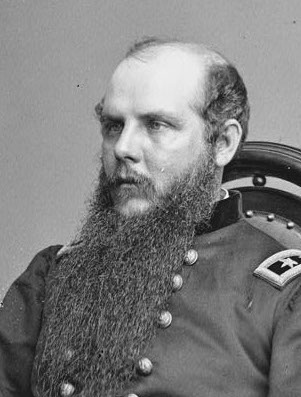
I can hear it in my sleep, and what it lacks in nuance, it makes up for in nonsense.
Without diving into a century’s worth of historiography and a point-by-point analysis of the factionalization that he and Thomas have so come to signify (if you want that, come to the ECW Symposium in August), it is safe to say that any mention of Schofield is sure to draw the ire of a very particular crowd.
The first crack in Schofield’s and Thomas’s relationship came when the former appeared before a military court at West Point and was sentenced to removal from the academy. Thomas, as a member of that court, voted to sustain his sentence, though Schofield likely did not know of this until 1868. Another skirmish came in 1869 following a brief clash over seniority, rank, and a command assignment to the coveted Division of the Pacific. The major break, though, came a year later when Schofield authorized an aide, William Wherry, to author a response to the Cincinnati Gazette’s publication of Grant’s orders to relieve Thomas and the subsequent avalanche of editorial comments.
Authored anonymously by “One Who Fought at Nashville,” Wherry’s article appeared in the New York Tribune on March 12, 1870. Wherry’s goal was simply to defend his superior, Schofield, from any criticism. In doing so, Connelly argues, he “needlessly disparaged Thomas.”[1]
Though he initially regarded the Gazette and Tribune pieces as “funny reading,” Thomas soon began to suspect that the timing of the letter and its anonymous nature could only have originated from Schofield as a device to “enable him to get my command.” Thomas then was obliged to respond. On March 28, he intended to set the record straight in a formal, written defense of his actions. As his pen scrawled across the page, Thomas’s agitation became apparent. “I want air,” he purportedly said to an aide. As he walked to the door of his office, the Rock of Chickamauga collapsed. He died a few hours later. Those close to Thomas and, indeed, many of his old soldiers, alleged that the Wherry letter and Schofield’s criticisms killed the general.[2]
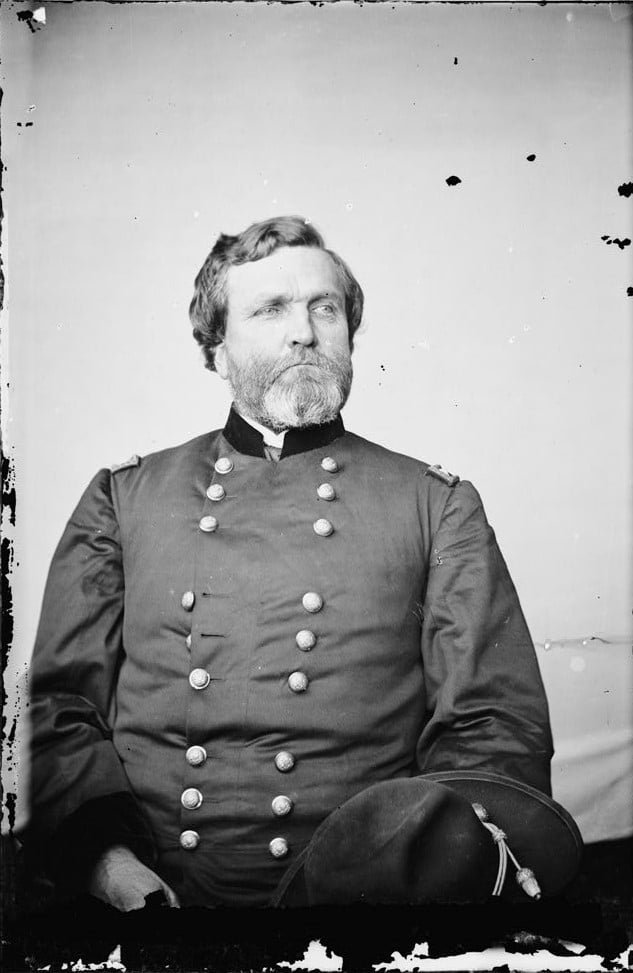
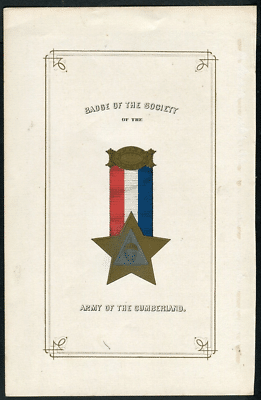
The battle lines were soon established between the Thomas-aligned veterans of the Army of the Cumberland and Schofield’s slighter following. A decade after Thomas’s death, Schofield furthered the divide when he submitted a letter to the Society of the Army of the Cumberland, in which he was openly critical of Thomas’s performance during the Tennessee Campaign. Over the next eight years, Schofield traded blows with Gen. James Wilson and James Steedman and was lampooned by the numerous writings of Army of the Cumberland veterans. These critics were quick to point out that during the battle of Franklin, officers of the IV Corps of the Army of the Cumberland, not Schofield, fought on the front line and repelled Hood’s attack. Their accounts, however, generally leave out the fact that the majority of the troops along the line, save Wagner’s Division and the IV Corps Artillery, belonged to the Army of the Ohio and were under the direct command of Gen. Jacob Cox, Schofield’s chief subordinate. These assertions planted the seeds for the more modern critiques of Schofield and the development of the popular narrative.
Today, Schofield’s critics are quick to quote material from the Wherry article or his memoir, rather than the far more critical Gazette columns or the Army of the Cumberland letter. Often, Schofield critics cite his memoir and the Wherry letter as the most egregious of the attacks on Thomas. But what did John Schofield actually say that bears so much criticism (bearing in mind that I still have to talk about this in August, and I don’t want to give away every spoiler)?
This passage in particular usually draws the ire of the Thomas faction:
Time works legitimate ‘revenge,’ and makes all things even. When I was a boy at West Point I was court-martialed for tolerating some youthful ‘deviltry’ of my classmates…and was sentenced to be dismissed. Thomas, then already a veteran soldier, was a member of the court, and he and one other were the only ones of thirteen members who declined to recommend that the sentence be remitted.[3]
Schofield continued:
Only twelve years later I was able to repay this then unknown clemency to a youth by saving the veteran soldier’s army from disaster, and himself from the humiliation of dismissal from command on the eve of victory. Five years later still, I had the satisfaction…of saving the same veteran general from an assignment to an inferior command…When death had finally relieved him from duty, and not till then, did I consent to be his successor.[4]
Self-serving? Absolutely. But is there more to the story?
Closer analysis of the Schofield-Thomas rivalry (last hard sell- you are going to want to sit in on this one at the ECW Symposium this August) shows that, as Donald Connelly concluded, “Schofield’s relations with Thomas had always been correct, but never cordial.” The two men simply belonged to two distinct generations.
Thomas, older and more experienced, maintained the old Regular Army’s rigidity and stoicism. Schofield, far younger and substantially more politically vocal, however, embraced the modernity of the new army and the post-war age. Where Thomas refused to blur the lines between service to the nation and politics, Schofield insisted the two worlds were not simply connected, but co-dependent. When Thomas felt slighted, he grew morose and disgruntled within the system he served. When a slight came Schofield’s way, he used the political machinery within and without the framework of the army, and occasionally the press, to maneuver to his desired position. As different as the two men were, their successful performance in the Tennessee Campaign brought the destruction of the Confederacy’s last mobile offensive force and affected an end of the war in the Western Theater.
George Thomas does not need a fan club, nor, for that matter, does John Schofield; after all, it is bad business to love dead people.
[1] Donald Connelly, John M. Schofield and the Politics of Generalship, (Chapel Hill, NC: The University of North Carolina Press, 2006), 150.
[2] Brian Steel Wills, George Henry Thomas: As True as Steel, (Lawrence, KS: University Press of Kansas, 2012), 443-444.
[3] Schofield did not learn of Thomas’s vote on the matter until 1868 and could not have conceived of any prejudice against him during the war.
[4] John M. Schofield, Forty-Six Years in the Army, (NY: The Century Co., 1897), 199.


I hope a hundred years after my death, people on the Internet will carry on my petty beef…