Doubleday’s Revenge
If you stand on the ramparts of Fort Moultrie in South Carolina, and look down the beach west of the fort’s massive guns, in the direction of Mount Pleasant, there once stood a luxurious beachfront hotel one hundred and sixty-two years ago. In the evening, with a little imagination, you might see its bright lights and hear the sounds of music and laughter of the well-to-do people dancing at one of its extravagant balls, or sitting along its wide veranda, or strolling along its sandy beachfront.
On July 8, 1850, the Moultrie House was opened. It “was a large, first-class wooden hotel near shore, on Sullivan’s Island. . .. It was kept open during the summer and was a favorite resort for planters and others, to enjoy the fresh sea- breeze, and the beautiful drive up the beach at low tide.”[1]
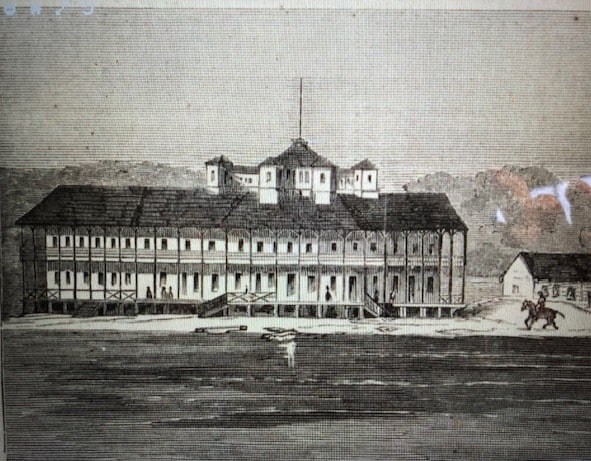
The Moultrie House was the first resort in the area where people came to escape the swarms of disease carrying mosquitoes – the summer perils of living inland. The sea breezes were a refreshing alternative to the hot, humid Low Country. Designed by architect Edward C. Jones at a cost of $35,000, it boasted “luxurious accommodations for two hundred people.”[2]
According to Charleston historian, John B. Irving, the building was two storied, 256 feet long and 40 feet wide. It had a front piazza 16 feet wide and a back piazza 10 feet wide. There were attached wings on either side of the main building. The east wing was 100 feet long and 35 feet wide containing a succession of rooms on the first floor that were linked by large folding doors, which when opened formed a huge grand ballroom. The west wing was 90 feet long and 20 feet wide with multi-paneled floor to ceiling windows. Behind the hotel were outbuildings which included the kitchen, two large cisterns, and a windmill which pumped water to the building. The hotel “combined comfort with pleasure” as it boasted, a large bath house for ladies, four billiard tables and three bowling saloons. “Anyone who was anyone” stayed there, and the hotel soon gained national attention.[3]
The glory days of the Moultrie House came to an abrupt halt in 1861 as the election of Abraham Lincoln as President prompted South Carolina to secede from the Union. A conflict between the Federal forces and the secessionists seemed inevitable. The city of Charleston was proving to be a dangerous place for the Union garrison stationed at Fort Moultrie. The southerners denied the garrison access to supplies, food, and reinforcements. The locals treated the Federal soldiers with contempt. When Captain Truman Seymour went to the Charleston armory for friction primers he was met by an angry crowd, threatened with violence, and turned away.[4]
But no one was more hated in Charleston than Captain Abner Doubleday. He was forty-two years old and a career army officer. He had graduated from West Point 24th the class of 1842. He had fought in Mexico, the Seminole Wars and on the plains in Texas. He had served at a number of Atlantic Coast posts and was now second in command to Major Robert Anderson at Fort Moultrie. The teetotaling, non-smoking captain had enjoyed a cup of tea at the Moultrie House back in friendlier days, but no more. “Charleston at this period was far from being a pleasant place for a loyal man”.[5]
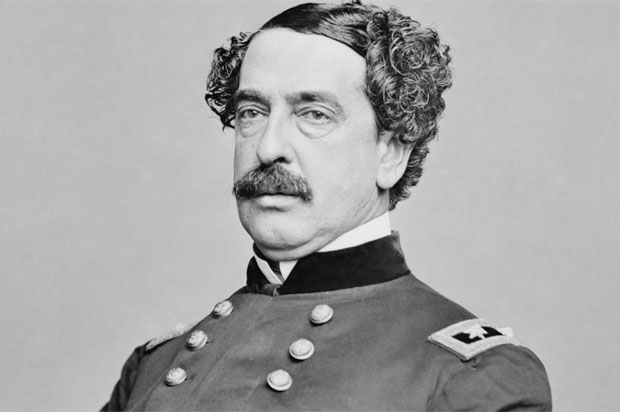
“I became quite unpopular in Charleston,” wrote Doubleday, “partly on account of my anti-slavery sentiments, but more especially because some very offensive articles” he had written appeared in Northern papers. These found their way into newspapers all over the country. As a result, he was eyed with suspicion and reviled for his abolitionist leanings.[6]
Doubleday did not mind repeating loudly that he was the only officer at Fort Moultrie who favored Lincoln’s election and who spoke out in his letters in very clear terms against slavery. Obviously, this did not make him too popular in the parlors of the Moultrie House. He soon received a letter warning him that if he were caught in Charleston, he would be tarred and feathered.[7]
Tensions were rising as secessionist forces began patrolling day and night around Fort Moultrie. Doubleday told Anderson that they could not defend the fort as the houses around them looked down into Moultrie and there were rumors of two thousand riflemen detailed to shoot from these commanding positions when word is given. Major Anderson decided to secretly abandon Fort Moultrie and move his men to unfinished Fort Sumter. During the night after Christmas, after spiking the forts guns, the Union garrison rowed across Charleston Harbor to Fort Sumter.[8]
“The next morning Charleston was furious. From December 26 until April 12,” Doubleday remembered, “they busied themselves in preparing for the expected attack, and our enemies did the same on all sides of us.” Doubleday soon learned that the new commander of the southern forces at Fort Moultrie was fellow West Pointer Roswell Ripley. Doubleday had known him at the academy as he was in the class ahead of Ripley. Although born in Ohio and raised in New York, Ripley “took pains to denounce [his fellow New Yorker] as an Abolitionist, and to recommend that [Doubleday] be hanged by the populace as soon as [he was] caught”.[9]
Ripley’s commanding officer was General P.G.T. Beauregard. On the afternoon of Wednesday, April 3, General Beauregard and South Carolina Governor Francis W. Pickens happened to be standing on the piazza at the Moultrie House when the 180-ton schooner, Rhoda H. Shannon en route from Boston to Savannah with a load of ice, mistook Charleston Harbor for the Savannah River. The captain, Joseph Marts, soon realized his mistake, but it was too late. The Confederates opened fire upon his ship. Captain Marts was aware of unrest in Charleston but thought that Sumter was to be turned over to the Confederacy. He quickly turned around.[10]
Doubleday, seeing the situation ordered his soldiers to man and load Sumter’s guns. Doubleday advocated for action. Major Anderson instead ordered two officers to be rowed “in a boat with a white flag to ask for an explanation, with the usual result,” Doubleday groused. It was found that the Confederate guard boat that should have been on patrol to warn unauthorized ships from entering the harbor was not on duty. Its captain thought the seas too rough. Captain Doubleday found the inaction frustrating but wrote, “In amplifying his instructions not to provoke a collision into instructions not to fight at all, I have no doubt that he [Anderson] thought he was rendering a real service to the country. He knew the first shot fired by us would light the flames of civil war that would convulse the world, and tried to put off the evil day as long as possible. Yet a better analysis of the situation might have taught him that the contest had already commenced, and could no longer be avoided.”[11]
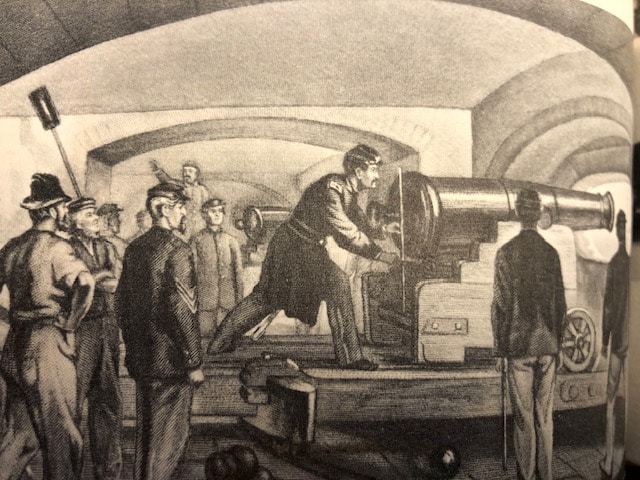
On April 12, 1861, at 4:30 in the morning, nineteen different Southern batteries opened fire on Fort Sumter. The garrison in the fort did not immediately respond. The men had roll call in the bombproofs and then had breakfast of pork and water. At 7 a.m. Anderson ordered Doubleday to divide the company into three details to man the guns in shifts. Their targets were to be the batteries on Morris Island and Sullivan’s Island.[12]
Battles & Leaders
Captain Doubleday sighted and fired the first Federal shot in retaliation at around 7:30 a.m. “In aiming the first gun fired against the rebellion,” he wrote, “I had no feeling of self-reproach for I fully believed that the contest was inevitable, and not of our seeking.” It was frustrating for Doubleday as his fire had little effect on Fort Moultrie or the floating battery off Sullivan’s Island. One participant recorded that “Doubleday’s men were not in the best of temper. They were irritated at the thought that they had been unable to inflict any serious damage on their adversary” while the rebel shots were slamming into Sumter. Then Doubleday spied the Moultrie House. “Since the rebel occupation of Fort Moultrie,” he recorded, “this hotel had been used as a depot and barracks for the troops in the vicinity.” But its Palmetto flag had been removed just before the bombardment began. The southerners would later contend that the Moultrie House was being used as a hospital and was flying a yellow flag. Through his glass he could see many spectators on the beach and piazza watching the duel between Sumter and Moultrie. “I saw no reason why the mere lowering of the flag should prevent us from firing at them,” wrote Doubleday.[13]
Doubleday went on: “Just before the attack was made upon us…I aimed two forty-two pounder balls at the upper story. The crashing of the shot, which went through the whole length of the building among the clapboards and interior partitions, must have been something fearful to those who were within. They came rushing out in furious haste, and tumbled over each other until they reached the bottom of the front steps, in one withering, tumultuous mass.”[14]
Captain James Chester of the Third Artillery remembered it differently. As he saw it, the two shots from the forty-two pounders struck the beach in front of the astonished spectators and bounded over their heads slamming into the Moultrie House. They both agreed that “the spectators scampered off in a rather undignified manner.”[15] Even a newsman reported that, “a party of gentlemen were setted [sic] in the parlor, watching the fight.” When the balls hit the second story “the gentlemen scattered miscellaneously.”[16]
To Doubleday, the sight of people plunging out of the hotel in undignified haste was a small but satisfying repayment for the many discourtesies he and his men had suffered for months. When Captain Seymour came to relieve Doubleday, Seymour in a joking manner asked him, “What in the world is the matter here, and what is all this uproar about?” Doubleday replied, “There is a trifling difference of opinion between us and our neighbors opposite, and we are trying to settle it.” Some Charleston newspapers “discoursed upon the barbarity of firing on a hospital.”[17]
On Sunday, April 14, Major Anderson arranged to surrender the fort to General Beauregard. As the Confederates concluded the negotiations and before the Federals boarded the waiting Isabel to take them to the waiting Union fleet, a Carolinian officer took Doubleday aside. He asked him why he had fired on the Moultrie House. “Not caring to enter into a discussion at that time,” Doubleday recorded, “I evaded it by telling him the true reason was that the landlord had given me a wretched room there one night, and this being the only opportunity that had occurred to get even with him, I was unable to resist it.” The southern officer must not have been a fan of the proprietor of the hotel since he laughed heartily and said, ‘I understand it all now. You were perfectly right, sir, and I justify the act.”[18]
So what happened to the Moultrie House? Sullivan’s Island soon became an island fortress as more and more fortifications were erected. Confederate soldier Gus Smythe wrote, “All the houses up to the church have been torn down and batteries erected on their sites. . .. A very heavy battery from the Moultrie House extended along the beach.” This was Forts Beauregard and Bee. The Moultrie House was left standing and continued to be used as a barracks and sometimes hospital. After the war the Moultrie House was destroyed. “Today no vestige remains of the once great hotel and the site has reverted back to dunes and thickets of myrtle groves.”[19]
[1] Doubleday, Abner, Reminiscences of Forts Sumter and Moultrie, 1860-1861, New York, 1876.
[2] Miles, Suzannah Smith, “The Last Resort”, Charleston Living Magazine, May –June, 2016. Sullivan’s Island, SC was one of America’s first resorts.
[3] Irving, John B. a promotional pamphlet referenced in Charleston Living Magazine.
[4] Doubleday, Abner, “From Moultrie to Sumter”, Battle and Leaders of the Civil War, Vol. I, ed. Robert Underwood Johnson and Clarance Clough Buel, New York, Thomas Yoseloff, Inc., 1959. p.42.
[5][5] Jones, Meredith, “In Memorium of Abner Doubleday, 1819-1893”, New York Monuments Commission for the Battles of Gettysburg, Chattanooga, and Antietam, Commemorative Address, Albany, New York, 1918. p.64. Gates, Arnold, “Abner Doubleday” entry, ed. Faust Patricia, L., Historical Times Illustrated Encyclopedia of the Civil War, New York, Harper & Row, Publishers, 1986. p.224.
[6] Doubleday, Abner, My Life in the Old Army: Reminiscences of Abner Doubleday, ed. Joseph E. Chance, Ft. Worth, Texas Christen University Press, 1998. p.195.
[7] Barthel, Thomas, Abner Doubleday: A Civil War Biography, Jefferson, N.C. & London, McFarland & Co., Inc. Publishers, 2010. Pp56-58, 67.
[8] Doubleday, Abner, “From Moultrie to Sumter”, Battles and Leaders, Vol. I, pp 42-46.
[9] Doubleday, Abner,” From Moultrie to Sumter”, Battles and Leaders, Vol. I, pp 42-46. Doubleday, Reminiscences of Forts Sumter and Moultrie, pp.161-162.
[10] Larson, Erik, The Demon of Unrest: A Saga of Hubris, Heartbreak, and Heroism at the Dawn of the Civil War, New York, Crown Publishing Group, 2024. Pp. 378-379.
[11] Doubleday, Reminiscences of Forts Sumter and Moultrie, pp.136-137.
[12] Meredith, Roy, Storm Over Sumter, New York, Simon & Schuster, 1957. p. 170.
[13] Doubleday, Reminiscences of Forts Sumter and Moultrie, p.161.Swanberg, W.A., First Blood: The Story of Fort Sumter, New York, Charles Scribner’s Sons, 1957. pp. 306, 329. Jones, Katherine M., Heroines of Dixie, Indianapolis & New York, 1955. p. 18. Chester, James, “Inside Sumter in ’61”, Battles and Leaders, Vol. I, p.68. In his article titled Captain James Chester contends that the Moultrie House was flying a yellow flag denoting its use as a hospital at the time. He also states that two sergeants aimed and fired the guns from Sumter without officer approval. Rosen, Robert N., Confederate Charleston: An Illustrated History of the City and the People During the Civil War, Columbia, South Carolina, University of South Carolina Press, 1994. p.70.
[14] Doubleday, Reminiscences of Forts Sumter and Moultrie.
[15] Chester, James, Inside Sumter in ’61. p. 68.
[16] New York Herald, April 13, 1861.
[17] Doubleday, Reminiscences of Forts Sumter and Moultrie, p. 162.
[18] Ibid. pp.161-162.
[19] Smythe, Agustustine T., Smyrhe Family Papers, Smythe-Stoney-Adger Collection, Charleston, S.C., South Carolina Historical Society. Miles, Charleston Living Magazine, May-June 2016. https://charlestonlivingmag.com/the-last-resort.


Great story Brian. A wonderful way for Doubleday to submit a “Do not recommend” review.
The Hospital story sounds fishy! Why would they have chosen a building, right on the beach, in full view of the guns of a fortress they were planning to attack, as a hospital. Additionally, it sounds like Anderson had not fired a shot prior to this action, so there shouldn’t have been any combat casualties.
After bombardment against Fort Sumter, The Moultrie House was recorded as “being used by Jasper Light Infantry as their quarters… At the time of bombardment 12-13 April nobody was in the Moultrie House, so nobody was hurt.” Yorkville Enquirer 25 APR 1861 p.2 c.6. The Washington D.C. Daily National Intelligencer repeats the article of the Yorkville South Carolina Enquirer on 2 May 1861 p.2 c.1. “Nobody was in the Moultrie House at the time of the bombardment, so nobody was hurt.” [Another report indicates: “The Moultrie House could accommodate 500 guests comfortably.”] The Abbeville S.C. Press of 22 FEB 1861 p.2 c.3 “Five members of [a local South Carolina Militia] returned home on furlough from their quarters in the Moultrie House.” [As of mid-FEB 1861 the Moultrie House appears to have been used as barracks for Secessionists.] The Washington D.C. Evening Star of 27 March 1861 p.2 col.2 “The Moultrie House is now used as a barracks.”
Thanks for bringing these sources to my attention, Mike. These are obviously sources I hadn’t checked.