Book Review: Requiem for Reconstruction: Black Countermemory and the Legacy of the Lowcountry’s Lost Political Generation

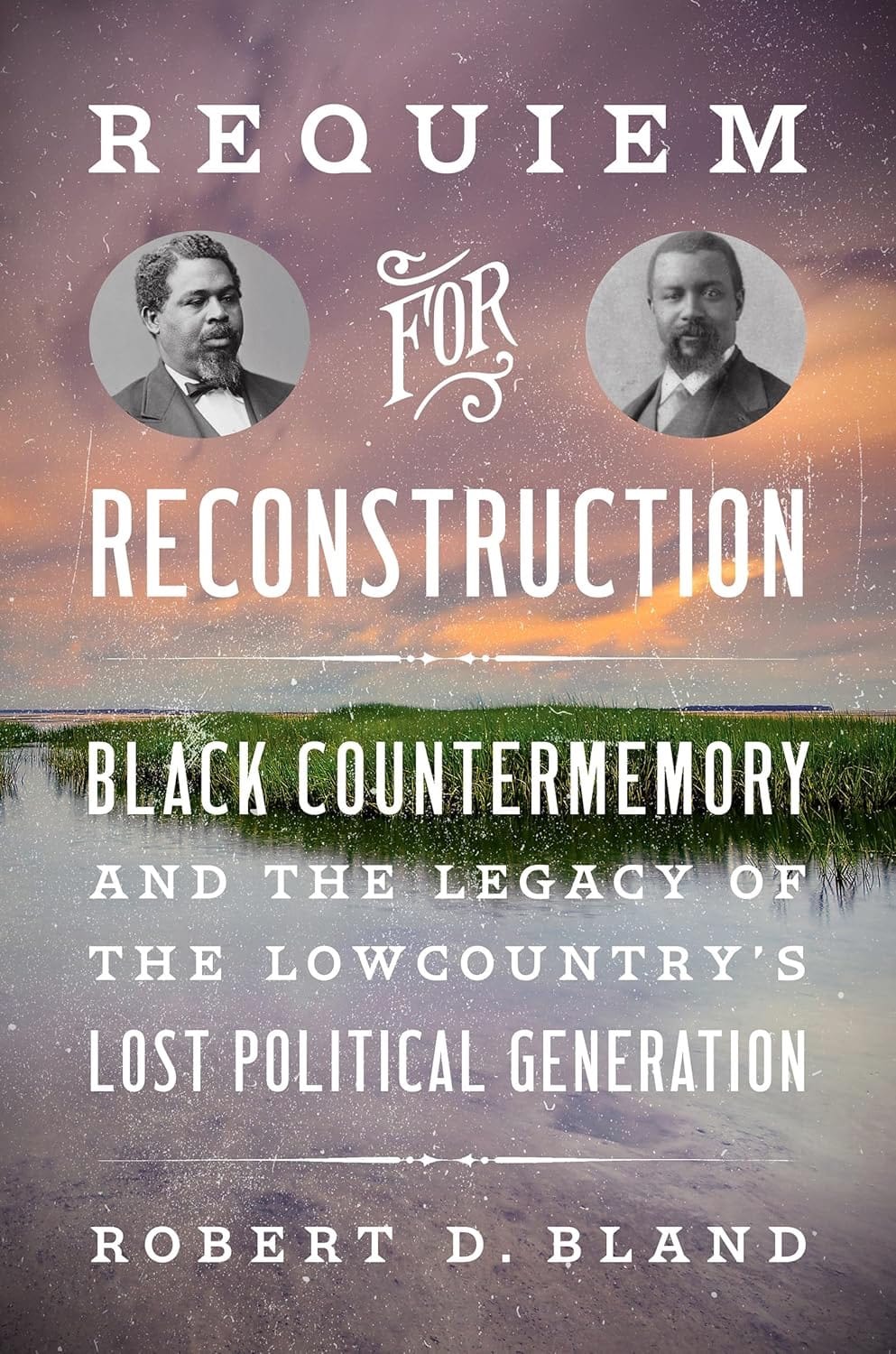
Requiem for Reconstruction: Black Countermemory and the Legacy of the Lowcountry’s Lost Political Generation. By Robert D. Bland. Chapel Hill: The University of North Carolina Press, 2026. Paperback, 260 pp. $34.95.
Reviewed by Rich Condon
In his 1935 seminal work, Black Reconstruction in America: 1860-1880, W.E.B. Du Bois summed up the post-Civil War period as “a brief moment in the sun” for those Black Americans who helped overthrow the pre-war order of a white supremacist slave society. Many of them came from varied socioeconomic backgrounds and had experienced, or actively participated in, the transition from a slave society to a free one. Du Bois also asserted that “a new slavery arose” in the wake of their social and political successes.[1] His statement rang true for millions of people during the Jim Crow era, but so did his recognition of the hopes, promises, and achievements of Reconstruction.
The assertions of many 19th century historians often painted Reconstruction as a failure; an effort fated to collapse from the onset of Black freedom in America. Instead of recognizing the violent dismantling of Reconstruction at the hands of former Confederates and paramilitary organizations, such as the Ku Klux Klan, Lost Cause mythology and dominant white narratives were hinged on the claim that African Americans were not yet ready for citizenship, and likewise were unfit for participation in a free society.
Robert D. Bland’s Requiem for Reconstruction: Black Countermemory and the Legacy of the Lowcountry’s Lost Political Generation, however, explores the efforts of Robert Smalls, William J. Whipper, Frances Anne Rollin, and contemporary Black Americans to produce and maintain a rivaling memory of the Reconstruction era, using the South Carolina Lowcountry as a case study for social and political successes which “captured the promise of postemancipation racial destiny.” (5) He accomplishes this while familiarizing the reader with one of the most misunderstood, and misinterpreted, periods in the nation’s history.
Using a variety of material sourced from the contemporary Black press, accounts of postbellum political history, and archival research, Bland is able to accurately depict the fight for memory and legacy by what he dubs the “Reconstruction generation.” (5) Organized in three sections consisting of a complete seven chapters, Bland’s work follows the Reconstruction generation from the establishment of 1860s Black political dominance in the Lowcountry to their waning 20th century legacy and influence on future professionals in the field of African American history.
Requiem for Reconstruction lends a meaningful contribution to the historiography of the post-war era while offering an important perspective on those who fought to establish a fair interpretation of Reconstruction’s successful trajectory. Indeed, much as the Reconstruction generation’s archival and documentary work supplied the building blocks for Du Bois’s writings on the period, the same can be said for Bland’s title, which deserves a spot on the shelf for any student of the Civil War and Reconstruction eras.
Rich Condon is a public historian from Pittsburgh, Pennsylvania, and a graduate of West Virginia’s Shepherd University. For over a decade he has worked with a multitude of sites and organizations including The Battle of Franklin Trust, the National Museum of Civil War Medicine, Soldiers & Sailors Memorial Hall and Museum, and the National Park Service, including work at Beaufort, South Carolina’s Reconstruction Era National Historical Park and Catoctin Mountain Park. He has written for Civil War Times Magazine, The American Battlefield Trust, as well as Emerging Civil War, and operates the Civil War Pittsburgh blog, which focuses on sharing stories related to western Pennsylvania’s role in the Civil War. Rich currently lives in Gettysburg.
[1] William Edward Burghardt Du Bois, Black Reconstruction in America: 1860-1880 (The Free Press, 1998), 30.


Very nice review of a book on an important topic, I look forward to reading it. I hope there’s mention in it of Benjamin Arthur Quarles, prominent African-American historian and an early exponent of the concept of black agency.