September 1861: Freedom Rings in Missouri
ECW welcomes back guest author Greg Wolk.
It was July 1910. A reporter from the Boston Daily Globe arrived at Nantucket harbor on a steamer from New Bedford. While the reporter’s name is lost to history, we know that his mission was to interview Civil War veteran Hiram Reed, an African American who arrived in Nantucket in 1861 after a life of slavery in Missouri. He traced his freedom to a military edict issued by Maj. Gen. John Frémont, then commanding the Western Department of the United States Army.
Reed was born in Kentucky in 1830, but he was brought to St. Louis as a child by John Reel, whose wife died in childbirth in 1833. Hiram Reed grew up alongside Reel’s daughter Harriet, who was three years younger than he was. Harriet was orphaned when John Reel died in 1838; thereafter she was raised on an estate north of St. Louis owned by Henry Miller Shreve, her maternal grandfather and an early pioneer of steam-powered navigation on the Mississippi River.[1]
Hiram Reed was the property of Harriet Reel by virtue of inheritance. Little is known of his life as a slave on the Shreve estate, although it is likely he was introduced to life on the river at a relatively young age. Even without the influence of the Shreve family, it was common for urban slaveowners to hire out slaves to work in the steamboat trade.[2]
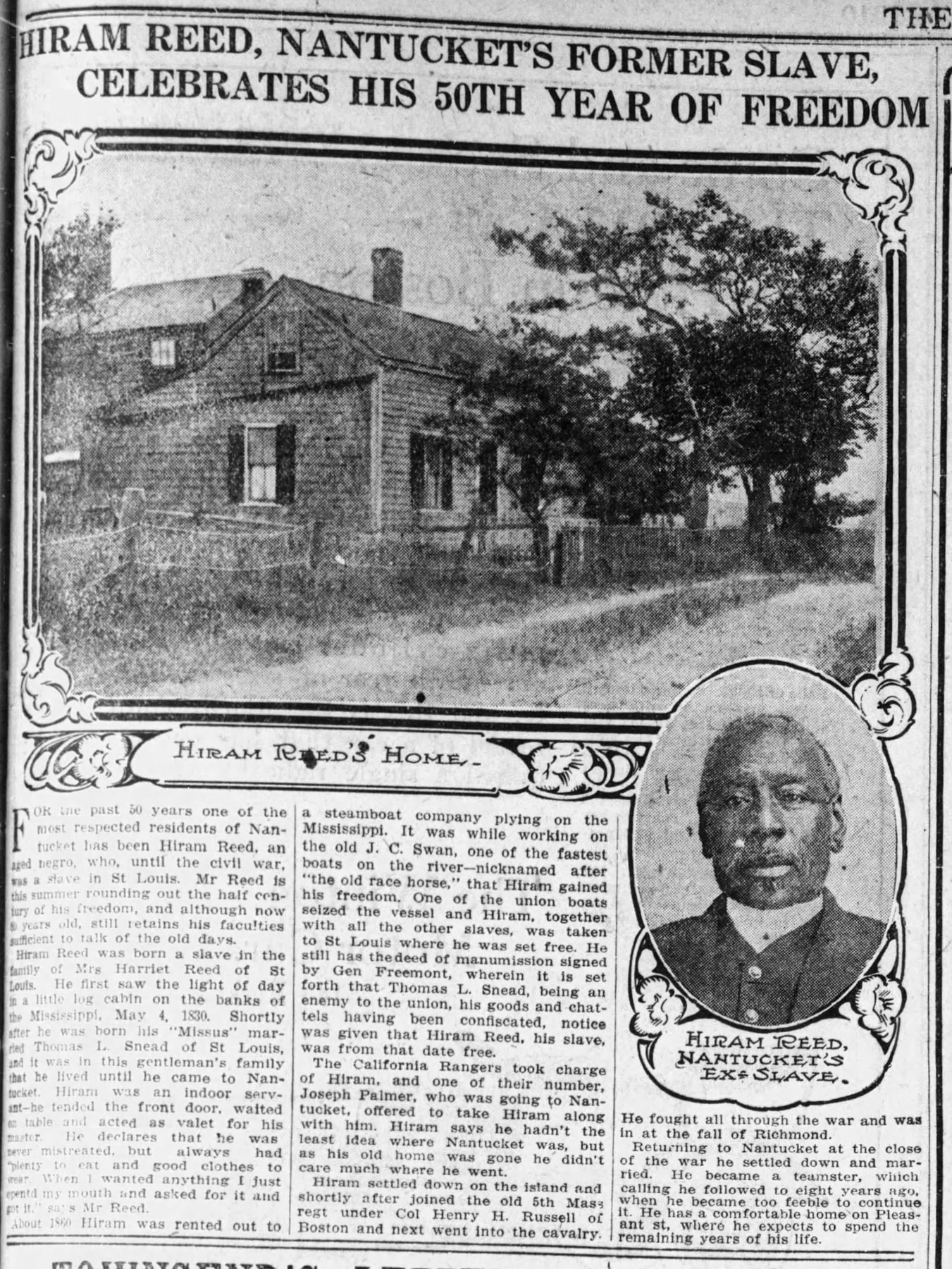
In 1853, Harriet Reel married Thomas Lownes Snead. By 1860, Hiram Reed was solely owned by Snead.[3] As of May 1861, Reed was working as a deckhand on a steamboat owned in part by Shreve family members, called J. C. Swon. Reed worked alongside Frank Lewis, a younger man also enslaved by Snead. J. C. Swon achieved a degree of infamy on May 10, 1861, after it landed in St. Louis carrying armaments and ammunition that secessionists had taken from the federal arsenal in Baton Rouge. Its cargo was intended to arm a pro-secession Missouri militia encampment in St. Louis called Camp Jackson, but Union officers discovered the ruse used to conceal the nature of Swon’s mission. The Union officer in charge, soon to be elevated to the rank of general of volunteers, was Army Capt. Nathaniel Lyon. He surrounded and captured the men at the encampment, along with the stolen arms.
Lyon aggressively pursued J.C. Swon under the laws of “prize and capture,” a doctrine of maritime law that recognized the rights of a combatant to seize and condemn enemy vessels for its own use. On May 22, 1861, when the offending vessel was found and captured 30 miles south of St. Louis, it was all but abandoned, resting on the Missouri shore and manned only by a watchman, a first mate and two deckhands.[4]
Lyon dutifully caused the vessel to be condemned by the federal court in St. Louis and placed into the service of the Union Army. When Congress went into session in early July, the Senate and House adopted the First Confiscation Act, which specifically applied the right of prize and capture to the property of home-grown insurrectionists. The act also appears to justify the seizure of human property, but to be charitable to Congress and to President Abraham Lincoln (who signed the act into law), it was unclear what would be the future status of enslaved persons employed in insurrectionist endeavors.
John Frémont dropped a bombshell on August 30, 1861. He put Missouri under martial law and declared that the property of any person taking up arms against the United States would be confiscated “…and their slaves, if any they have, are hereby declared free.”[5] Lincoln, concerned that Frémont’s action might upset the balance of power in states still considering secession, ordered Frémont to conform the language of his edict to the First Confiscation Act. Frémont refused.
On September 12, 1861, notwithstanding his disagreement with Lincoln, Frémont decided that Hiram Reed and Frank Lewis qualified for manumission under the terms of his August 30 decree. They were owned by a man engaged in active rebellion against the United States; Thomas L. Snead was then a colonel in the Missouri State Guard, fighting side-by-side with Confederates enrolled in Arkansas and Tennessee.
Reed and Lewis were the deckhands aboard J.C. Swon when the vessel was captured on May 22, 1861, which presumably brought their names to Frémont’s attention. Orders of manumission were written and delivered to them, rendering them the first enslaved persons ever set free based on the military authority of the United States.[6]
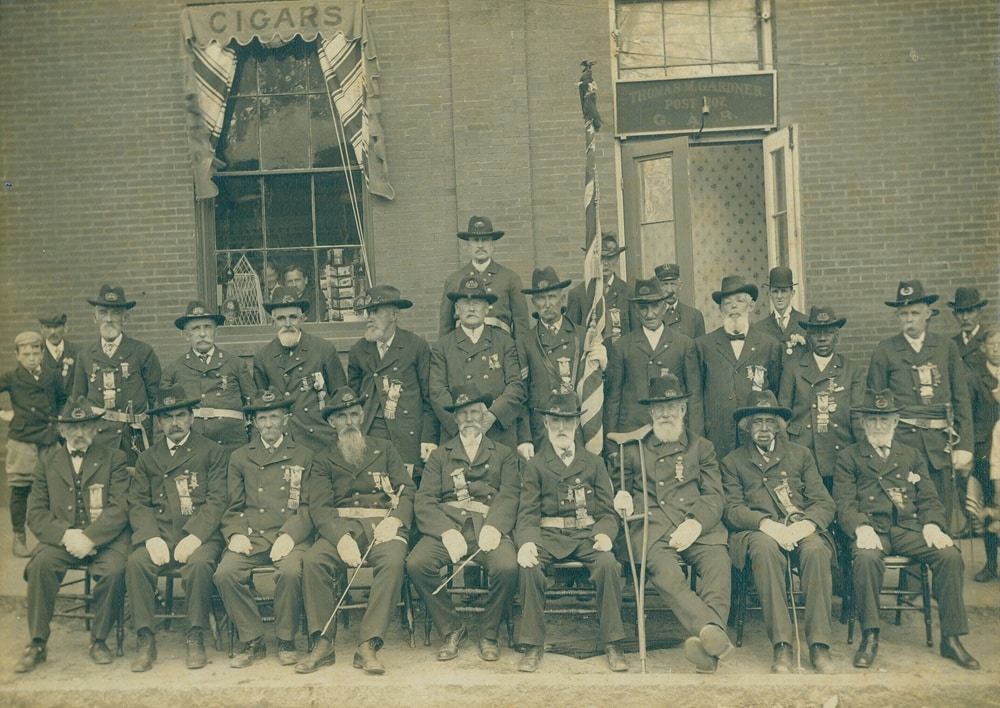
The reporter for the Boston Daily Globe who visited Hiram Reed in 1910 asked him: Why did you come to Nantucket in 1861? It had been nearly 50 years, but Reed distinctly remembered that a Nantucket native named Joseph Palmer, who planned to visit his old home, offered to escort Reed to the island. Palmer, who had known Frémont since the California Gold Rush, was in St. Louis in 1861 as an aide to the general.
In Nantucket in 1864, Hiram Reed joined the Army, enrolling in what became the 5th Massachusetts Colored Cavalry. His unit was present when Richmond fell in 1865. After his discharge Reed returned home to Nantucket, where he joined the Grand Army of the Republic, and served as an officer of his Post from time to time until he passed away in 1911. Reed died just three months shy of the 50th anniversary of Gen. Frémont’s manumission order.
Greg Wolk is a retired trial lawyer and writer. He serves on the Boards of Directors of the Jefferson Barracks Heritage Foundation and the National U. S. Grant Trail Association, both based in St. Louis. His works include Friend and Foe Alike: A Tour Guide to Missouri’s Civil War (Eureka, MO: Monograph Publishing Co., 2010), and numerous magazine articles focused on the Civil War in Missouri.
Endnotes:
[1] In 1814, Henry Shreve piloted a boat he built himself, Enterprise, from New Orleans to the mouth of the Ohio, being the first to navigate that distance against the Mississippi current in a steam-powered vessel. Florence L. Dorsey, Henry Shreve and the Conquest of the Mississippi (Boston: Houghton Mifflin Co.,1941), 102-103. Shreveport, Louisiana, is named for Henry Shreve.
[2] The practice of St. Louis’s enslaved persons working on steamboats was one of long standing, but it became more prevalent as the Civil War approached. British novelist Anthony Trollope toured the city in 1861, researching a travelogue he published in 1862. As he observed, waves of immigrants from Ireland and Germany in the 1848s and 1850s undermined any economic value there was in keeping enslaved persons for house servants. Anthony Trollop, North America (New York: Harper & Brothers, 1862), 381.
[3] United States Census, St. Louis township, 1860.
[4] “The Seizures in Missouri,” New York Times, May 27, 1861.
[5] Proclamation from Major-General J.C. Fremont. August 30, 1861, The War of the Rebellion: A Compilation of the Official Records of the Union and Confederate Armies, Series 1, Volume 3, 466-467.
[6] James Neal Primm, Lion of the Valley: St. Louis, Missouri, 1764-1980 (St. Louis: Missouri Historical Society Press, 1981), 243. Primm concludes that Hiram Reed was the first of the two men to be manumitted.


Excellent commentary and history of yet another Missouri related incident and the echo of its impacts. Bravo!
Excellent and well documented spotlight on war history that is frequently obscured in the shadows.
Heard his presentation on this subject and I found it to be very interesting. It seems no matter what you think you know about Missouri Civil War, Gregory Wolk brings to light events that are basically unknown, brought back to the forefront for our enlightenment. Great Job.
Greg is the true Missouri Civil War historian. When he does his research on a subject concerning the Civil War, he can dig up the most interesting facts and bring them to light. Who would have ever heard of Hiram Reed unless a person like Greg Wolk would have found it. It is a joy reading his books and articles about the war in Missouri. Great job again.
I have read a Greg Wolk book on a similar Civil War event, also having taken place in Missouri, and find his research and presentation a very fascinating read.