Raised in Riot: The Detroit Recruitment Riot of July 1862 and the Subsequent Raising of the 24th Michigan Infantry Regiment
ECW welcomes guest author Drew DeLong.
At the outbreak of war in April 1861, many Americans, both North and South, believed the war would be over quickly. James Henry Stine, the historian for the Union Army of the Potomac’s I Corps, recalled the excitement and patriotism that enveloped the country soon after the firing on Fort Sumter. “It had been given out by prominent men and officials that it would be a short war; Secretary [of State] Seward placed its duration at sixty days…The zeal of the Crusaders did not surpass the activity in both sections, and thousands enlisted through the recruiting officers…”[1] President Abraham Lincoln’s initial call for 75,000 volunteers was quickly met, and soon thereafter the amateurs marched off to war.
With the First Battle of Bull Run on July 21, 1861, the United States government soon realized that war would not be over in sixty days and that putting down the rebellion would require more than 75,000 men.
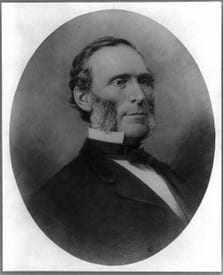
As the war raged throughout late 1861 and into early 1862 with mounting casualties, states such as Michigan struggled to recruit additional volunteers to fill depleted ranks. By the summer of 1862, the “utmost enthusiasm” earlier possessed by Michiganders wore off as the conflict had no apparent end in sight.
With the initial excitement and hopes for a sixty-day war gone, governors across the Union states began to experience difficulty in raising new regiments. Governors who once easily met recruitment quotas now faced resistance, war-weariness, and even open opposition, forcing them to rely more heavily on incentives, local pressure, guilt, and eventually the threat of conscription to fill the Union Army’s depleted ranks.
Earlier in the war, in September 1861, Simon Cameron wrote to Iowa’s attorney general, saying, “It will be unwise to draft the militia at this time. We prefer to rely upon patriotism of people for volunteer force required.”[2] As the war progressed and personal patriotism failed to fill the ranks of new regiments, fears of a draft soon spread to other northern states, including Michigan.
What made Michigan stand out from the rest of the states in the Union was “furnishing over six thousand more [men] than had been called for by the requisition of the government, exhibiting a degree of patriotism and promptness unsurpassed by any other State, and men too whose loyalty, patriotism, and courage had been tried and proved on almost every battlefield.”[3]
On July 12, 1862, Governor Austin Blair sent a request for volunteers for six new Michigan volunteer infantry regiments across the state. Three days later, an assembly was held in Detroit on the Campus Martius to recruit volunteers for the Union army. However, many of the civilians who attended were led to believe that the meeting’s purpose was to vote on a proposed draft for Michigan to fill its requested quota of regiments, not to volunteer then and there for the army.
To clear up the confusion, Henry A. Morrow, the judge of the recorder’s court of Wayne County, stepped forward, explained the purpose of the meeting, and exclaimed that he would be signing up, saying, “The government has done as much for me as for you, and I am ready to assist in upholding it!”[4] Not all were moved by his speech, and violence soon erupted amongst the crowd. Charles Lanman described the chaos that followed.
A public meeting…was called in Detroit, to be held in the afternoon of Tuesday, the 15th July…the gathering were surprised by a mob of men, who furiously interrupted the deliberations and entirely broke up and dispersed the meeting…The exhibition of this rebel spirit in our midst proved of immediate and lasting advantage to the cause of the army in the field, for it aroused such a feeling of indignation at these disloyal and treasonable operations, and such utter contempt for the ruffians who had been thus engaged, that the masses of the respectable citizens of both political parties determined the such proceedings should not be tolerated in Detroit…therefore….a meeting was appointed for Tuesday, the 22d of July…An immense fathering assembled under the call, severely rebuking the disloyal element, and with unbounded enthusiasm avowing a most faithful and persistent support of the war…and adopting instant measures for the recruitment of the regiments of the State, and urging the immediate re-enforcements of the armies of the Union.
This prompt action of the citizens had the desired effect, giving recruiting new life and energy, and led to the immediate proffer of the gallant 24th [Michigan] regiment to the cause of freedom and humanity, and served to end all open demonstrations in favor of rebellion in the metropolis of the State.[5]
Orson Blair Curtis, also present at the July 15 meeting, noted his experience of the riot.
The instigators had reported that the meeting was to prepare for a draft…And the riotous howls began…The mob next broke down the speakers’ stand, tore the Union bunting into strings, and…sought…the avowed intention of hanging Messrs Ward and Stewart, but were met by Sheriff Flanigan and a deputy, with drawn revolvers, who held the mob at bay for an hour and until darkness ended the riot.[6]
Embarrassed by the outcome of events that night, civic leaders and prominent public officials gathered a few days later, determined to show Wayne County’s loyalty and honor.
Men of Detroit! The fair fame of your city is at stake. Come forth in your might and prove your patriotism….Shall a few pestilent sympathizers with treason neutralize your patriotic effect?… Rebuke the traitors and vindicate the patriotism of the city. All who favor an energetic prosecution of the war are requested to meet on the Campus Martius on Tuesday afternoon at 3 o’clock, July 22, 1862.[7]
The July 22 meeting was a resounding success. Judge Morrow and Sheriff Mark Flanigan announced that they would be raising a regiment. Detroit businessman Duncan Stewart said, “I have not the language to deal a sufficiently withering rebuke to those who instigated the violence at the former meeting. This regiment [24th Michigan] must be raised.”[8]
On August 11, the regimental quota of ten companies, totaling 1,030 officers and men, including Pvt. Orson Curtis, was met. Designated the 24th Michigan, Henry Morrow commanded the regiment and was made colonel on August 15. His deputy was Mark Flanigan, given a lieutenant colonel’s commission the same day.
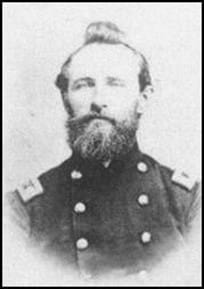
The influence and success of this subsequent meeting were tremendously beneficial to Michigan’s recruiting efforts. Aside from assisting in raising the 24th Michigan, seven other regiments were recruited, filled, and put into the field within 30 days, an example of recruiting not equaled in the state during the entire war.
The 24th Michigan marched off to war blissfully unaware of the horrors that awaited them. Part of the famed Iron Brigade, at Gettysburg they forever etched their name into the annals of history. Their unmatched bravery, courage, and sacrifice on July 1, 1863, resulted in the regiment suffering the highest total number of casualties of any Union regiment during the battle, losing 397 out of 496 men.
By war’s end, the 24th Michigan ranked 19th out of the 2,000 regiments that fought in Union armies, in total casualties, a testament to their bravery and sacrifice throughout countless battles. Of the original 1,026 men who marched off to war on August 29, 1862, over 300 never returned to their families. When the regiment reached Fort Wayne on June 20, 1865, only 200 of those original 1,026 men, identified by their iconic red circular patch of the old I Corps, were present for the city’s welcoming reception.
The staggering toll of casualties within the war’s first year of war made communities wary of sending more sons and fathers to the front, while the ever-lingering threat of a draft ignited nationwide riots and unrest. Detroit was not immune to such, yet through this climate of strain and uncertainty emerged renewed determination. The formation of the 24th Michigan Infantry was a testament to Michigan’s enduring commitment to the Union. Though unrest stirred in the streets of Detroit in 1862, the men who volunteered rose above the clamor, answering their state’s call with quiet resolve and stepping forward as willing guardians of its honor in a time of trial.
Drew DeLong is a Captain in the United States Air Force and holds a Master of Arts in the Military History of the American Civil War. A native of Wisconsin, he currently resides in Montana. When not doing research or writing on the Civil War, he enjoys traveling, playing soccer, and spending time with his wife, Anna.
Endnotes:
[1] J.H. Stine, A History of the Army of the Potomac (Philadelphia: J. B. Rodgers, 1892), 1.
[2] The War of the Rebellion: A Compilation of the Official Records of the Union and Confederate Armies, Series III, Vol. I, 539.
[3] Charles Lanman, The Red Book of Michigan; A Civil, Military and Biographical History (Detroit: E.B. Smith, 1871), 157.
[4] Alan T. Nolan, The Iron Brigade: A Military History (Bloomington, IN: Indiana University Press, 1994), 150.
[5] Lanman, The Red Book of Michigan, 158.
[6] O.B. Custis, History of the Twenty-Fourth Michigan of the Iron Brigade, Known as the Detroit and Wayne County Regiment (Detroit: Winn & Hammond, 1891), 26.
[7] Nolan, The Iron Brigade, 151.
[8] Curtis, History of the Twenty-Fourth Michigan, 32.


Very cool regimental history, appreciate your effort in bringing this story to light. Just one nitpick though … Lincoln didn’t call for 90-day volunteers because he thought the war would be short (though some undoubtedly did think it would be over quickly). Under the Militia Act of 1795, the President could call upon state militias in an emergency, but he was limited to 75,000 men and 90-days without the approval of Congress. On May 3, 1861, Lincoln issued a proclamation calling for 42,034 volunteers to serve for three years (Proclamation 83), which Congress retroactively approved at the beginning of August. So the gears were already in motion for 3-year enlistments before Bull Run.
Very interesting lesson in unintentional consequences. Thank you for sharing this.
On July 1, the 19 th Indiana was placed on the left flank of the Iron Brigade because of concern over the 24 th Michigan’s lack of experience. Turns out both regiments served heroically.