Book Review: Stonewall Jackson’s Winter Operations: The Raids Against the C&O Canal and the Bath-Romney Campaign, December 1861 to February 1862

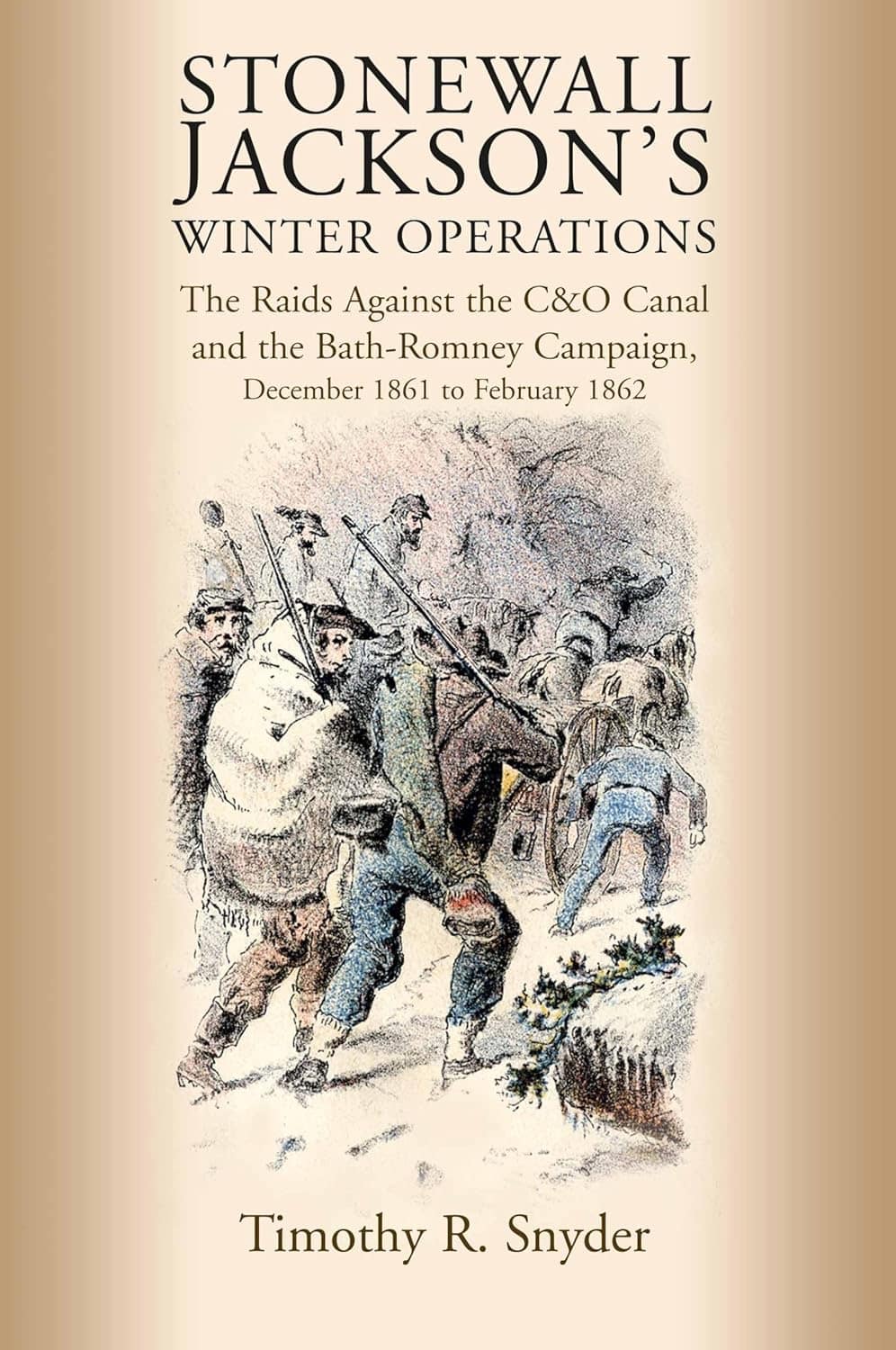
Stonewall Jackson’s Winter Operations: The Raids Against the C&O Canal and the Bath-Romney Campaign, December 1861 to February 1862. By Timothy R. Snyder. El Dorado Hills: Savas-Beatie, 2026. Hardcover, 293 pp. $32.95.
Reviewed by John B. Sinclair
Given the many books and essays examining Stonewall Jackson’s life, is there any aspect of his Civil War career that warrants book-length treatment? Author Timothy Snyder successfully answers that question with his narrative on (1) Jackson’s raids on Dam Nos. 4 and 5 in the Potomac River along the C&O Canal in Maryland in December 1861 and (2) Jackson’s subsequent Bath-Romney campaign in Virginia in January 1862.
Snyder is an excellent candidate to write on the Dam Nos. 4 and 5 raids given his discerning book on the C&O Canal and the Civil War.[1]
There have been few books about the Bath-Romney campaign, and so this new book is welcome.[2] Snyder has done extensive research on these subjects, including fresh firsthand accounts and other material. He writes well, and readers will have no trouble navigating his narrative. There are thirteen chapters and a Conclusion. An introduction by Steve French is illuminating. Good maps from the reliable Edward Alexander accompany the text; interesting photographs and illustrations enhance this book.
The author sets an odd tone in his Introduction. He argues at length that most historians have overlooked Stonewall Jackson’s faults and ignored his military failures. Years of reading Civil War history leave me with a different impression.[3] Snyder seems determined, however, to issue a corrective.[4]
The first 2 ½ chapters explore Jackson’s pre-war life, including West Point, the Mexican War, post-war service, VMI teaching, and his early Civil War military career. The narrative in particular covers Jackson’s sometimes prickly relationships with superiors, colleagues, and subordinates.
Stonewall Jackson arrived in Winchester, Virginia on November 4, 1861 as the new commander of the Valley District, tasked with protecting the left flank of Joseph Johnson’s Department of Northern Virginia. A week before his arrival, Union forces occupied Romney in the adjacent South Branch Valley, which represented a threat to Winchester. Jackson immediately began working on a plan to oust the Federals from Romney and other areas. He proposed to Richmond that William Loring’s brigades and Jackson’s old Stonewall Brigade be assigned to him, noting the hazard of oncoming winter weather. With some reservations, his plan was approved by Jefferson Davis, Johnston, Secretary of War Judah Benjamin, and Loring.
While waiting for Loring’s brigades to arrive, Jackson ordered raids on dams on the Potomac River near Williamsport, Maryland to cut off the flow of water into the C&O Canal. The Confederate government wanted to stop Federal commerce on this canal, including important coal supplies, from reaching Washington. Chapters 4 and 5 examine the three raids on Dam No. 5 and single raid on Dam No. 4. Snyder’s expertise on the C&O Canal shines through in this nicely detailed account of these December 1861 raids, including history concerning the canal and nearby towns, as well as Union defenses. Ultimately, the raids failed due to the dams’ sturdiness and harassing Federal fire.
Jackson’s march to Bath began January 1, 1862 on a morning with spring-like temperatures. As suggested by the book’s cover, it then often descended into nightmarish freezing, snowy, icy, and/or muddy weather creating a campaign march that rivaled the legendary Burnside’s Mud March. Tensions between Jackson and Loring descended into bitterness when Loring repeatedly stopped his men to rest and await rations. Jackson was outraged by what he considered Loring’s slow marches. Loring was justifiably stunned by Jackson’s seeming lack of concern for the comfort of his men and mulish refusal to explain to him (as second-in-command) where they were going and the purpose of the expedition. Their relationship only worsened throughout this campaign.
Bath was located near the Potomac River. Concerned about the Union garrison’s presence there threatening his rear, Jackson moved to eliminate that threat. After some skirmishing, Bath was taken relatively easily as the Union force evacuated before a battle could occur. Virginia militia assigned by Jackson to corner the retreating Federals failed in this task.[5] Jackson’s subsequent bombardment of Hancock, Maryland and failure to convince the Union commander to surrender the town led him to then turn to the principal objective of his campaign – Romney.
Given rampant sickness, frostbite, and desertions occurring among his men (with some freezing to death), the author believes Jackson then abandoned his plan to take Romney by force. The evidence proffered by Snyder, however, seems more circumstantial than direct. In any event, the Federals evacuated Romney, allowing Jackson to occupy it. After a week, Jackson returned to Winchester, leaving Loring’s brigades to garrison the town and shelter in homes and various buildings.
Loring and his men were unhappy about spending the winter there and petitioned the Confederate government to have them withdrawn.[6] They also felt that the Stonewall Brigade received preferential treatment during the campaign (though such is not detailed in this book). Indeed, fights broke out between Loring’s brigades and the Stonewall Brigade during the campaign over their opinions about Jackson. Davis ordered that Loring’s men and others at Morefield and Bath be evacuated due to intelligence revealing a Union threat to the area. This order resulted in Jackson tendering his resignation, which he later withdrew after much advice from others.
The final two chapters thoroughly recount Union forces moving back into Virginia and the Shenandoah Valley. Jackson’s Valley Campaign in the spring of 1862 then began.
Snyder concludes his book with harsh criticism of Jackson, much of which is justified but is a bit excessive. The author also returns to his Introduction’s criticism of historians for diminishing and overlooking Jackson’s faults and failures. Whatever the gauzy historical treatment of Stonewall Jackson in bygone eras, modern historians have largely cataloged his flaws and failures. The target audience of this book by and large is also so acquainted. Granted, the casual Civil War battlefield visitor may have a different view.
Although Jackson succeeded in ousting the Union forces from Romney, Snyder calls it a failure because Jackson supposedly wanted an actual battle or to capture significant numbers of prisoners.[7] This argument conflicts somewhat with a statement Snyder made in his book on the Civil War and the C&O Canal.[8] He disagrees with Jackson’s plan to attack the Union force at Romney, but does not detail what Jackson should have done with that threat on his flank. He criticizes Jackson for a flawed plan, but does not blame Davis, Johnston, Benjamin, and Loring for approving Jackson’s plan. Jackson no doubt deserves serious criticism for failing to work collaboratively with Loring.
Regardless of these reservations, I strongly encourage anyone interested in Stonewall Jackson to read this book on these understudied operations. Author Snyder has contributed significantly to the history of Stonewall Jackson’s Civil War career.
————
John B. Sinclair is a retired charitable foundation president and a retired attorney. He is a member of the Baltimore Civil War Roundtable, a member of the Sons of Union Veterans of the Civil War (James A. Garfield Camp No. 1), and a Life Member of the Lincoln Forum.
[1] Timothy R. Snyder, Trembling in the Balance: The Chesapeake and Ohio Canal during the Civil War, (Boston: Blue Mustang Press, 2011). He has also written various articles on the subject.
[2] The last one seems to be Thomas M. Rankin, Stonewall Jackson’s Romney Campaign, January 1 – February 20, 1862(Lynchburg: H.E. Howard, 1994).
[3] Snyder chides noted historian Gary Gallagher for not including the relatively small Bath-Romney campaign in an essay concerning Jackson and for overlooking Jackson’s military failures. Snyder overlooks in the same Gallagher essay his listing of much larger Jackson military failures. Gary Gallagher, Lee and His Generals in War and Memory (Baton Rouge: Louisiana State University Press, 1998), 109. Gallagher is no one-sided admirer of Jackson. Robert K. Krick is the preeminent historian of the Army of Northern Virginia and a recognized Jackson scholar. He examines Jackson’s subpar performance during the Seven Days battles in Robert K. Krick, “Sleepless in the Saddle: Stonewall Jackson in the Seven Days,” Gary W. Gallagher, ed., The Richmond Campaign of 1862: The Peninsula Campaign & the Seven Days (Chapel Hill: University of North Carolina Press, 2000) 66-95.
[4] In perhaps another oddity in his Introduction, Snyder ends by saying, “I largely eschew notes for biographical material, except for quotations and original research.” (xx)
[5] Snyder makes this curious supposition about Jackson and militia: “Like others from this time, he likely held a romantic notion of the competence of militiamen that stemmed from the American Revolution.” (117) It is difficult without evidence to imagine Jackson with his military background and stern views holding such an opinion. Certainly, George Washington held no such romantic notions about his militia as they disappointed him on so many occasions.
[6] No one in Anderson’s brigade under Loring signed the petition nor did any other officers under Jackson’s command, revealing a split of opinion.
[7] In his classic biography, James I. Robertson, Stonewall Jackson: The Man, The Soldier, and The Legend (New York: McMillan, 2007) 313-14, Robertson lists what he considers the benefits of the campaign.
[8] “[T]he actual object of his expedition was to free Romney, Virginia, from Federal occupation.” Snyder, Trembling in the Balance, 95.


This is an excellent, balanced review that other reviewers would do well to emulate. You’ve definitely piqued my curiosity about this book and I’ll be looking for a copy
Robert Penn Warren wrote “The Civil War offers a gallery of great human images for our contemplation.” Old Blue Light is right up there in the gallery. Was he Ewell’s “crazy as a March hare” or eccentric genius? I suspect an admixture of both.
Thanks — great review … interesting to read that Loring had the same beef that Generals Ewell and A.P. Hill had later with Jackson — that he kept his subordinates in the dark regarding his plans … tough for brigade and division commanders to execute commander’s intent if they have no idea what commander’s intent is … arguably Jackson’s most critical flaw and a big source of friction in the ANV.
Thank you, Mark. I seem to recall while reading Bobby Krick’s two-volume masterpiece on Gaines’s Mill that Lee became aware of Jackson’s secrecy issues with subordinates. He gently chided Jackson regarding same before the battle and encouraged him take his senior officers into his confidence. Aside from doing so with his brother-in-law, D.H. Hill, I don’t think Jackson was ever truly comfortable doing so. I agree it was his largest flaw.
Lee and Jackson had two fundamentally different leadership styles – it’s an incredible testament to Lee’s leadership that they were able to work so effectively together. Jackson practiced an authoritarian leadership style, which despite the name, isn’t always bad, but it doesn’t allow for subordinates to exercise any initiative. Jackson expected them to just do as directed at the moment without knowing anything about his plans. I think Mark put it perfectly, “tough for brigade and division commanders to execute commander’s intent if they have no idea what commander’s intent is.” In contrast, there were times Lee gave his subordinates almost too much leeway to carry out his intent (ala Stuart). I think the Romney Campaign really highlighted Jackson’s flaws, especially early on.
Thanks for the review. If anyone has questions about the book, I’ll be happy to answer them.