Book Review: Lincoln’s Frock Coat: The Enduring Mystery of an Assassination Relic

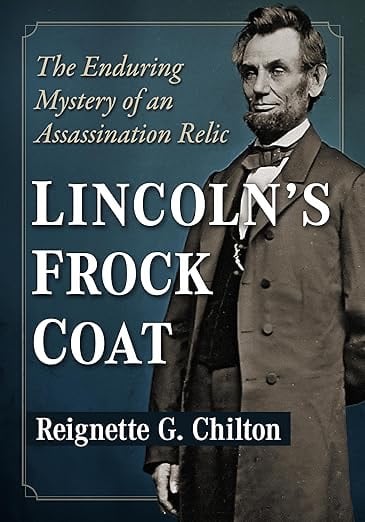
Lincoln’s Frock Coat: The Enduring Mystery of an Assassination Relic. By Reignette G. Chilton. Jefferson, North Carolina: McFarland & Company, Inc., Publishers, 2026. Softcover, 248 pp., $34.95.
Reviewed by Brian Matthew Jordan
When Mary Todd Lincoln gave away her martyred husband’s garments—including multiple frock coats—before leaving the Executive Mansion for the final time in May 1865, the grieving widow could not have known that she was touching off an historical mystery that would endure for more than a century: which was the frock coat that the sixteenth president wore to Ford’s Theater on that fateful Good Friday?
This is the question that author Reignette G. Chilton takes up in this, her second book. Chilton began historical research and writing after spending twenty-five years working for Brooks Brothers (the sixteenth president’s choice clothier). But make no mistake: the author works with the nimble precision of a professionally trained historian, in each chapter foregrounding for readers the fistfuls of documentary evidence she spent years quarrying from archives, newspapers, and eyewitness testimony. Aided by this trove of recondite sources, Chilton painstakingly unravels her eponymous mystery one thread at a time.
Across fifteen chapters, Chilton traces the “strange careers” of each coat. One suit was sent to William Morris Hunt, an artist who was then at work on a Lincoln portrait in Boston. Mary Lincoln presented another to the president’s valet, Charles Forbes (who, in turn, passed the garment along to Thomas Pendel, the Executive Mansion doorkeeper beloved by Tad Lincoln). Still another of Lincoln’s suits (and his “greatcoat”) went to Pendel’s long-time colleague, Alphonso Donn.
The suit in Hunt’s possession survived a devastating fire and was donated to the Smithsonian by the artist’s widow. Pendel sold his suit to an avid Chicago collector named Frank Granger Logan, who in turn loaned (and later donated) the suit, together with his impressive collection of Lincolniana, to the Chicago Historical Society. There, in the early twentieth century, it was placed on public display. Following his death, Alphonso Donn’s family posited the garments now in their possession as the authentic assassination relics, a claim that—crucially—had not been made during Donn’s lifetime. The coat from the Donn collection eventually made its way to Ford’s Theater where, 103 years after Lincoln’s murder, it was placed on display as the coat in which the president was martyred.
Competing claims of authenticity (and the remarkable attention they garnered in the press) led the distinguished historian Paul Angle, then serving as director of the Chicago Historical Society, to remove the Pendel/Logan coat from public display in 1949. Angle was persuaded by the supposed provenance of the Donn collection and “openly denounced the frock coat as a ‘phony.’” (7)
But Chilton argues that Angle got it wrong, and that the genuine assassination relic has been reposing in Chicago all along. She lays out the contextual evidence but hinges her convincing case on the firsthand accounts left to us by Drs. Charles Sabin Taft and Charles Leale, the medical duo who attended to the president that night. Both doctors described the cuts they made to the president’s clothing in their frenetic attempt to locate Booth’s leaden slug. Only the frock in Chicago aligns with these descriptions.
Chilton stops short of locating her tale in larger contexts. Despite all that we learn about the key protagonists, readers do not learn much about historical relic collecting, the traffic in Lincoln objects, the place of Lincoln in American historical memory, or the history of history museums, for instance. But none of this should detract from the gritty historical detective work evident on every page of this book. Prolifically illustrated and exceptionally well documented, Lincoln’s Frock Coat is an essential reference for scholars—not to mention a fascinating tale that will repay any reader interested in the “unspeakable calamity” that befell the nation on April 14, 1865.


How can we and future generations of unborn readers not be a built-in market for Lincoln material (great coat pun intended.) He bound a great nation (ours and our grandchildren’s grandchildren’s) together when it was ripping at the seams (great coat pun intended) almost shredded. And he did it with the public watching while he lost a child, while his nincompoop generals killed his constituency’s family members, while men around him had their own agendas, and somehow managed to tell stories that hit home then, today and likely will as long as human nature lasts. With his example of overcoming challenges and sudden death before getting an epilogue, and not only he being one of us, but us being one of him, that is everyone finds something in him that they find in themselves, that unless we of the future are AI-driven-drones, I can’t see the market going south.