The “Witness” Hemlocks at Ox Ford
ECW welcomes back guest author Dan Walker.
The Eastern Hemlock, which is nearly extinct south of New England, inspires in me an affection that’s almost irrational. The hemlock is a conifer like the spruce, but with flat needles. At a distance the smaller ones are hard to tell from cedar because you can’t see the needles, but the tall ones are darker and more symmetrical and can reach a hundred feet are more. In old-growth pure stands, they produce almost a feel of cathedral columns. West Virginia even has a park named for them: Cathedral State Park.
The agent of genocide is the hemlock woolly adelgid, a tiny, flightless, aphid-like insect that feeds on the sap of the hemlocks’ twigs. A tree will show it has become infested by the insects’ little white egg sacks clustered like snow grains around the twigs at the base of the needles on the bottoms. Upon hatching, the insects feed on the sap, eventually preventing new needle growth. The insect originated in Asia and was brought in on ornamental trees. Since appearing in Richmond, Virginia in the early 1950s the insect has eaten its way up and down the Appalachian and Piedmont regions.
I know of only a handful of still healthy native stands in Virginia, usually owing their escape to the luck of isolation. Some of these are what we call Witness Trees, in the best sense: Where they are and why they are can tell us not just about time, but about the interaction of historical moments and the land itself.
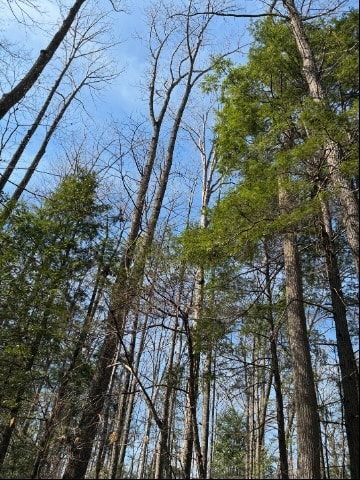
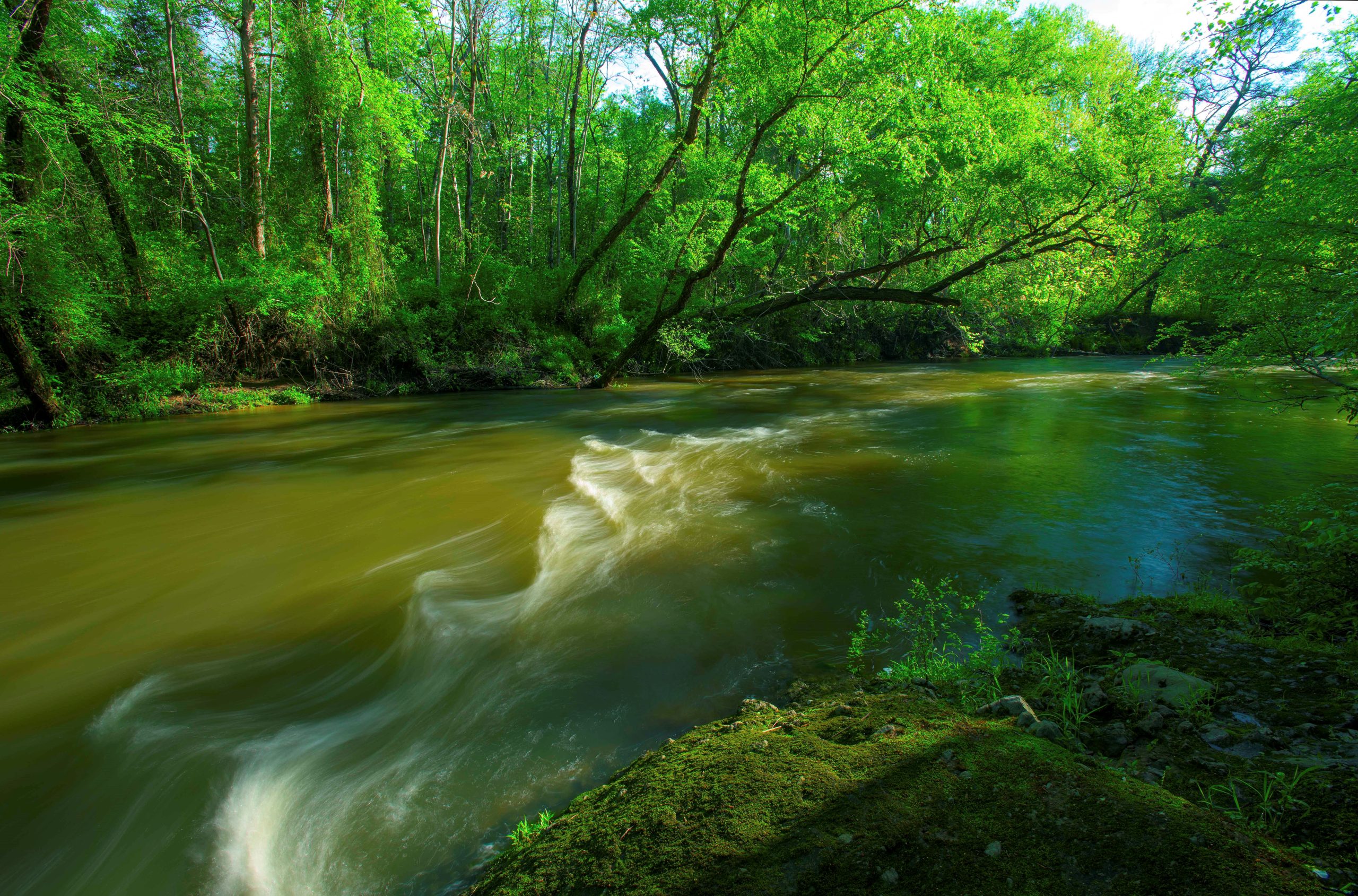
One of these groves is at Ox Ford and just below it in the North Anna Battlefield Park. And you can see why: Its north-facing south bank is steep, with ground well-shielded from direct sun. Other such spots are nearby on the South Anna and the Little River. These rivers rise east of the mountains, so, when the adelgids went down the drainages from the Blue Ridge, these habitats were isolated enough to escape the blitz.
Of course, the same bluffs made them ideal for artillery emplacements. Robert E. Lee, as has often been noted, saw this river as a promising place to give battle. Using Ox Ford as a hinge, he could swing his left back south, away from the North Anna, but anchored on its tributary, the Little River, tempting the enemy to send part of his army across, leaving some part vulnerable to a crushing blow.
When the armies were there in May 1864, the blow never fell, but had it done so, given the impressive nature of the works still visible, Lee’s men would have had time to clear even more trees and underbrush than they probably did right away. Maybe that’s why most of the hemlocks there now don’t look a hundred years old. Maybe the survivors literally dodged a bullet: seedlings maybe, with artillery roaring above them.
When I first visited the battlefield, the Gray and Blue Trails were already laid out and blazed. I believe there was a kiosk with a map. This was usually as far as we’d go at Shenandoah National Park, where I was a seasonal ranger from 1968-1980, except for a few easy-access nature trails with more signage. Later, during the 1980s, as a ranger‑historian at Fredericksburg and Spotsylvania National Military Park, I found the interpretation more extensive and the landscape restoration more aggressive.
Guided in part by the park’s 1986 General Management Plan, restoration projects often involved removing forests grown up long after the fighting.[1] I remember explaining to visitors why “all those wonderful old trees” along trails near the Bloody Angle at Spotsylvania or Saunders Field in the Wilderness were cleared. Those answers were easy: Yes, I’d say, those were nice big trees, but central Virginia has no shortage of oak-hickory forest. The real resource here, which it’s our mission to protect and interpret, is history.
Having seen all that, I could imagine a similar impulse at the North Anna: Look at all these woods that have grown up here since the battle. Why not clear the riverbanks to reproduce the original view?
But what if these stands are among the last of their kind? By now, they may be the last. And what if even a few of them were there at the time of the battle? I don’t know about the South Anna and the Little River; I haven’t been to either in a long time. If you have fond memories of those tall cathedral-like groves in Shenandoah, in the Limberlost or along the Hughes River or in White Oak Canyon, I suggest you don’t go there now.
So, let’s not go through that on the North Anna. If we need a sign to show what the view might have been and, as a sidebar, raise consciousness about the hemlocks, I’ll gladly help.
This is not an argument against landscape restoration per se. But in response to any visitor questions about the view there, I would note that it’s not uncommon for park management plans to consider ecological factors.
At any rate, I’d like us all to be aware of the tradeoffs. Such awareness may be needed elsewhere. Many battlefields are found along river channels, for obvious reasons. I’m too old to visit all that might harbor such survivors. But since some hemlocks do live on, I hear, in George Washington National Forest’s Ramsey’s Draft Wilderness—and even in Shenandoah, at least up to a few years ago, at the bottom of Nicholson Hollow—then there’s hope elsewhere on preserved ground. I’m thinking of Sailor’s Creek, and I’ll check when I can. It’s a state park, but worth a good look.
Update:
Yesterday, crossing my fingers and holding my breath, I went down to the North Anna to take a look. In a race to beat the spring foliage, I looked for the hemlocks. When I found them I was relieved: no signs of the evil adelgid. If you’ve seen the battlefield and are only interested in the hemlocks, just go down the Gray Trail nearly to the end, which is straight and well maintained, and pass the side trails on the left to various guideposts.
After a little less than a mile, just after Stop 8, you’ll likely see a few shrubby little ones that may not make it past the next heat wave, but thirty yards or so downhill to the left from Stop 9 you’ll begin to see some like the ones in the picture below, between the trail and the ford, that are tall and beautiful. And totally worth it.
Next time you take a walk there, look for them and hope you don’t have to see those little egg sacks under the needles along the stems. If you do, take pictures to remember them by—the trees, not the egg sacks—because any hemlock marked that way will be dead in a couple of years. And remember that these trees memorialize not only whatever clearing originally went on, but the lay of the land itself, which not only made it valuable for gun emplacements, but also for certain rare trees about to become even rarer.
Their demise may come, but hopefully not from well-intentioned view-restoration.
Dan Walker is a retired teacher of English and English Education, who also worked for twenty years as a seasonal Park Ranger in Shenandoah NP and a seasonal Ranger-Historian in the Fredericksburg and Spotsylvania National Military Park. He has also published poetry and novels, one of which is a sequel to Huckleberry Finn which takes Huck into the Civil War.
[1] Fredericksburg and Spotsylvania National Military Park, General Management Plan (1986) https://books.google.com/books/about/Fredericksburg_and_Spotsylvania_National.html?id=2fLcUYCiausC


Elm trees and Ash trees have their own six legged non-native enemies as well. The two legged ones are bad enough. It’s a sad thing my friend, thank you for bringing these living relics to light. Of dendrological historical note – in Fairfax County, Va, there are few trees older than 150 years. As part of the defenses of Washington, DC, Fairfax County was occupied for four years and had hundreds of military emplacements, many locations forgotten but some today marked by street names and/or signage. The tree was campfire, reinforcement for defensive works, winter huts (floor. walls. and roof,) cordoroy roads, fences, replacement parts for wagons, etc. General Winfield Scott ordered the removal of all trees within 2 miles of a railroad track in Fairfax to cut down (bad pun) on the damage that partisans were doing to the tracks. One tree worth visiting in busy Fairfax is known as the Mosby Oak, maybe 300+ years old, that stands, still, after lightning strikes and infringing road widening. Maybe 3,000 cars an hour pass near it daily during rush hour times. I picked up a leaf from it off the ground, now stored between pages 46-47 of Mosby’s Rangers by Wert.
Thanks for pointing out that tree, “Henry.” It’s on my bucket list now, which is already listing heavily. I now have some reason to drive up to Fairfax.