We’ll See You on the Battlefield: Learning History From the Black and Green Guns of Gettysburg
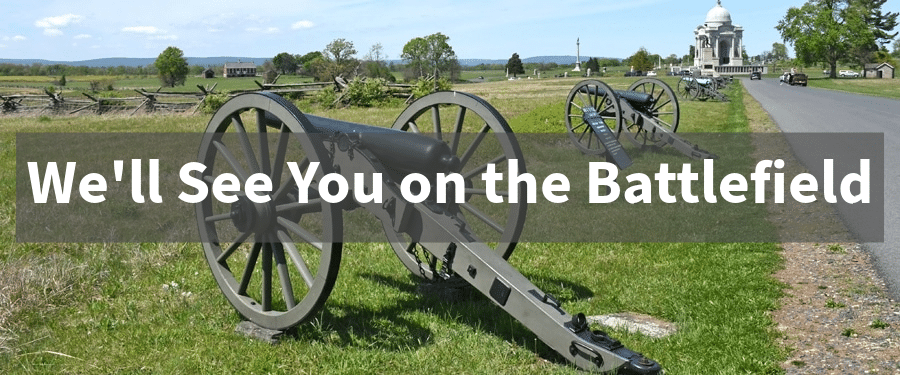
If Alfred, Lord Tennyson ever visited Gettysburg National Military Park, he possibly experienced what every newcomer does at this expansive Pennsylvania battlefield: “Cannon to the right of them, cannon to the left of them, cannon in front of them.” He may not have ridden with the Light Brigade “into the jaws of death” at Gettysburg, but he would have figured out (as do other first-time visitors) that the national military park abounds in cannons and that they all look alike: They are either black or green, with few exceptions.
But those cannons can teach a history lesson or two or three to Gettysburg visitors.
“A cannon is a cannon is a cannon,” my dear wife commented during our recent Gettysburg excursion. She did not add the clarifying, “no matter the color,” but the thought was understood.
Cannons abound at Gettysburg. They line parts of West Confederate Avenue (Seminary Ridge) and Hancock Avenue (Cemetery Ridge), overlook the Valley of Death from Little Round Top (Hazlett’s Battery), and recall the heroism of Southern artillerists’ heroism being shellacked by Union gunners (Benner’s Hill). Yes, they are either black or green, and they almost all have a cascabel, the round knob jutting from the end of the cannon.
Let’s start with the black cannons:
1. Examine a black cannon’s barrel, which is also called a “tube” (we’ve learned something already!). Is the barrel smooth from the cannon’s muzzle (the front opening) to its breech (the back end)? If so, this is a 3-inch ordnance rifle.
Or does a black metal band surround the cannon’s breech? If it has this reinforcing band, then this gun is a 10-pound Parrott rifle, thus named because it could fire a 10-pound shell and because it was designed by Capt. Robert Parker Parrott.
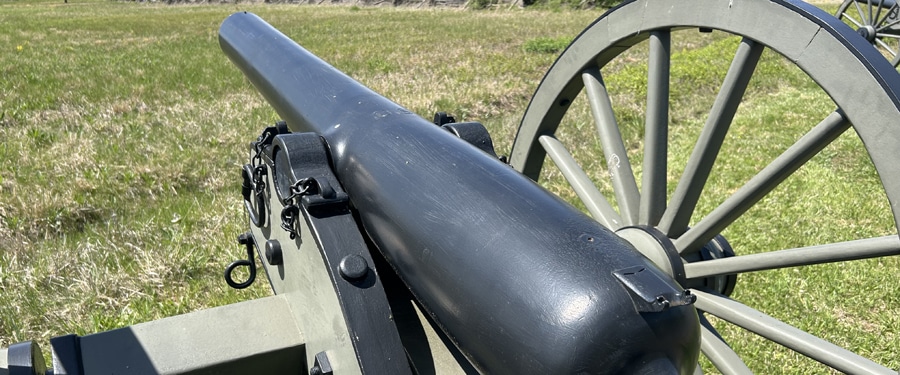
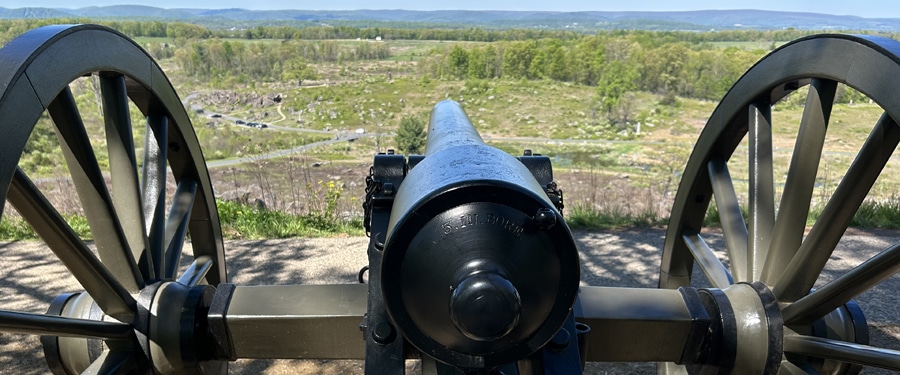
So we have identified the two types of black cannons found at Gettysburg. Let’s delve deeper.
2. Examine the muzzle. Do not stick a hand into it, because you never what might be inside it. Birds nest in Gettysburg cannon barrels, but you don’t want to disturb a critter with teeth or fangs.
Notice the grooves inside the muzzle. These indicate the barrel is “rifled,” meaning that the cannon can fire a shell a long ways with fairly decent accuracy.
Note the information stamped around the muzzle. This information reveals the manufacturer (the name is often abbreviated), year of manufacture, sequence of manufacturing (also called “registry number”), the tube’s weight, and possibly the initials of a government inspector.
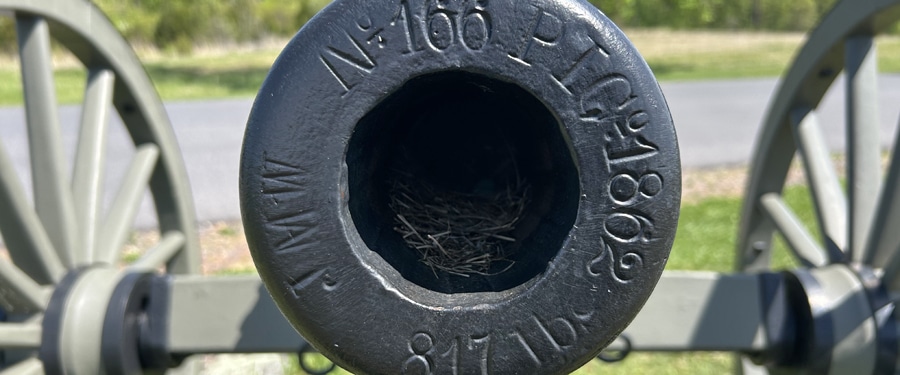
For example, two 3-inch ordnance rifles stand beside Hancock Avenue south of the Pennsylvania State Memorial. A nearby metal information panel indicates the rifles represent similar guns of Battery H, 3rd Pennsylvania Heavy Artillery. Stamped into one cannon’s muzzle are “No. 166, PICo, 1862, 817 lbs, JMW.” The 166th barrel made by the Phoenix Iron Company weighed 817 pounds, government inspector James M. Whittemore accepted the cannon for the War Department, and the barrel was made in 1862, thus making this a bonafide Civil War cannon.
Let’s look at the green cannons:
1. The green patina indicates the barrels are made of bronze, which like copper will develop a patina over time if not routinely polished. Civil War correspondence and official records often refer to bronze cannons as “brass.” The terms are interchangeable.
However, artillerists did not fire green bronze guns during the battle; they fired bronze cannons with barrels polished to a golden gleam. Two examples of such bronze cannons stand beside the High Water Mark tablet by the Copse of Trees. Albeit needing a thorough polishing, the cannons are the color that such guns displayed at Gettysburg in July ’63.
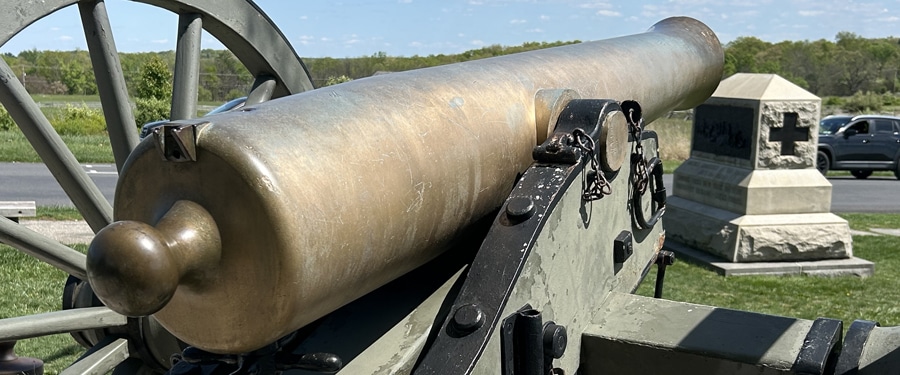
These two cannons are 12-pounder bronze Napoleons, named for the weight of the cannonball they could throw and for Napoleon III, who designed this particular type of cannon in 1853. Most green Gettysburg cannons (but not all) are 12-pounder Napoleons.
2. Examine the muzzle. Notice that the barrel’s smooth interior lacks grooves. This indicates that the cannon is a “smoothbore.”

And so we have learned to differentiate between the black and green cannons at Gettysburg. “Big deal,” you might think. “A cannon is a cannon is a cannon.”
But those cannons relay history. A few paragraphs back I referred to the Battery H information panel on Cemetery Ridge. This panel details what the battery did on July 2-3, 1863. Similar panels at other artillery displays (particularly along Seminary Ridge) relate battle details pertaining to specific batteries. If you read these panels while examining the black and green cannons of Gettysburg, you will learn history.
And ditto if you read the information engraved on the artillery-battery monuments, like that of the 6th Maine Battery, located just south of Battery H’s ordnance rifles. It’s a granite monument, and there are others on the battlefield. The 6th Maine Battery fired bronze Napoleons. Only yards away stand Battery H’s two 3-inch ordnance rifles, and there’s probably no easier location to examine black and green cannons at Gettysburg.
Do so — and learn history.


Excellent article. I’ll never look at the cannon at Gettysburg quite the same way again. As to not sticking your hand in the muzzles, I’ll always remember a trip to the Shiloh battlefield in 2016 when I encountered wasp nests in and around a number of cannons.
This is a nice summary. I’d only add that for the iron tubes, looking at the muzzle and/or for seams on the tube can help identify the relatively small number of post-war replicas. Obviously, there’s also a big difference between (1) concluding that a tube is an authentic Civil War manufacture and (2) concluding that the tube was present at the battle.