Book Review: A Mother’s Work: Mary Bickerdyke, Civil War-Era Nurse

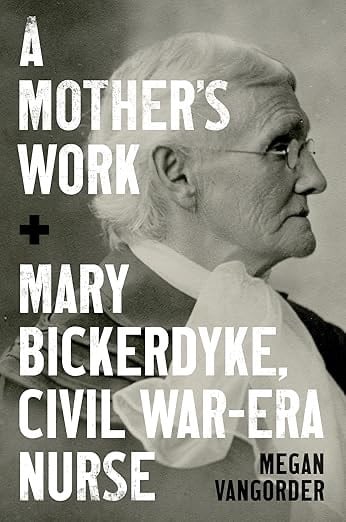
A Mother’s Work: Mary Bickerdyke, Civil War-Era Nurse. By Megan Vangorder. Chapel Hill: University of North Carolina Press, 2026. Paperback, 260 pp. $29.95.
Reviewed by Sheritta Bitikofer
Those who hear the name Mary “Mother” Bickerdyke might envision the lone woman with a lantern, searching for wounded soldiers on the midnight-cloaked battlefield at Fort Donelson. Others may recall the anecdote in Ken Burns’ Civil War documentary, when Gen. William T. Sherman was reported to have said about the widowed nurse, “She ranks me.”(75) But what Megan Vangorder in A Mother’s Work: Mary Bickerdyke, Civil War-Era Nurse attempts to do is peel back the layers of the mythology and historical narrative around “Mother” to reveal a greater understanding of women’s contributions and impact during and after the war.
Vangorder takes a unique approach to telling Bickerdyke’s story by providing a microstudy of primary sources and extracting broader meanings behind Bickerdyke’s life, career, and decisions as a lower-class widow and mother in the 19th century. The experiences and challenges of this one individual have the potential to represent multitudes, specifically in the way that Bickerdyke used her motherhood role to “care-switch” between the private and public spheres as the demand for nurses and caregivers to soldiers and veterans became an urgent matter. (31)
Bickerdyke, like the majority of mothers in the 19th century, stood on the front lines when it came to defending their families against sickness and death. Whether organically learned through experience or through private study, mothers were required to know how to soothe a fever, treat a wound, or any other common ailments. Mothers, also, were the keepers and orchestrators of the respectable “good death” for their loved ones in the comfort of home and surrounded by family.
In this pre-war society, Bickerdyke took her holistic medical knowledge and hired herself out as a “botanic physician” in order to financially support her two young sons after the death of her husband in 1859. (21) For a woman of the lower class, this move was necessary for survival. Yet as the Civil War engulfed the nation in conflict, her decision to leave her two sons and take her nursing to the battlefield could be seen as elective and controversial.
Along with countless other women, Bickerdyke broke out of the domestic sphere to apply her mothering skills in a professional way. In these nursing roles, women utilized their traditional medical knowledge to care for the sick and wounded in conjunction with the academic skills of surgeons and doctors. What male doctors and surgeons could not do was step into the void as the mothers, sisters, and wives who could not be by the soldiers’ deathbeds, providing a semblance of the “good death” in extraordinary circumstances. As a result, women earned the monikers of “Angel” and “Mother.” Not everyone was accepting of women’s entry into the medical field, but in the long term, these women built on the foundation laid by women nurses decades earlier, validating the effectiveness of maternal care in the wake of advancing scientific practices.
Vangorder charts Bickerdyke’s rise from a community physician to a nationally renowned nurse who earned the love, loyalty, and respect of soldiers, which supported her career goals as a caretaker of veterans in the decades after the war’s end. Her tireless efforts to secure pensions for not only ailing veterans, but also other wartime nurses and herself (prior to the Army Nurses Pension Act of 1892), demonstrated her ambition to extend her role as mother and guardian of her “boys in blue” within institutionalized systems. In contrast, her involvement in grassroots charity campaigns and her private occupation as, essentially, a hospice nurse for veterans, once more, showed her flexibility for care-switching across bureaucratic lines and doing whatever it took to make sure care and relief were provided for those who needed it most.
The complicated and sometimes strained relationship between Bickerdyke and her sons is mapped throughout the book. Bickerdyke’s apparent abandonment of her domestic motherhood in exchange for a civic motherhood is explained with great care by referencing the direct words and documented actions of Bickerdyke and her sons throughout her career as “Mother.” Additionally, the silence surrounding the employment of Lydia Foster by Bickerdyke as both servant and ghostwriter is respectfully evaluated within the 19th-century treatment of Black women, and the significance such silence plays in understanding the social hierarchies of race, gender, and class of the times.
Those who wish to understand Bickerdyke’s life and works within the context of the world in which she lived will gain an enlightening perspective of womanhood and motherhood in a nation forever changed by war. These roles paved the way for women to venture into professional occupations outside of the home while still adhering to moral and societal virtues, following in the footsteps of determined trendsetters like Mary “Mother” Bickerdyke.


Thanks for this EXCELLENT review!
Mother Mary Bickerdyke is an underappreciated woman who sacrificed “quality time” with her own family in order to provide invaluable care to strangers on the battlefield. Arguably, the most crucial care provided by Bickerdyke: extremely clean (sanitized by boiling) bedding, bandages and clothing; and wholesome fresh foods that included fruit and vegetables for soldiers recovering from illness and surgical operations. “Higher class women” who would have used Bickerdyke’s services as live-in maid prior to the war were often jealous of Mary’s accomplishments, achieved through the use of simple solutions and common sense [such as “the frequent changing of bandages”]. And Mary Bickerdyke likely saved the lives of Generals Stephen Hurlbut and John Logan through these low-impact methods.
I, for one, will put “A Mother’s Work” on my 2026 Christmas List.