Echoes of Reconstruction: Memorial Day 1870 a Central Feature of Reconstruction
Emerging Civil War is pleased to welcome back Patrick Young, author of The Reconstruction Era blog.
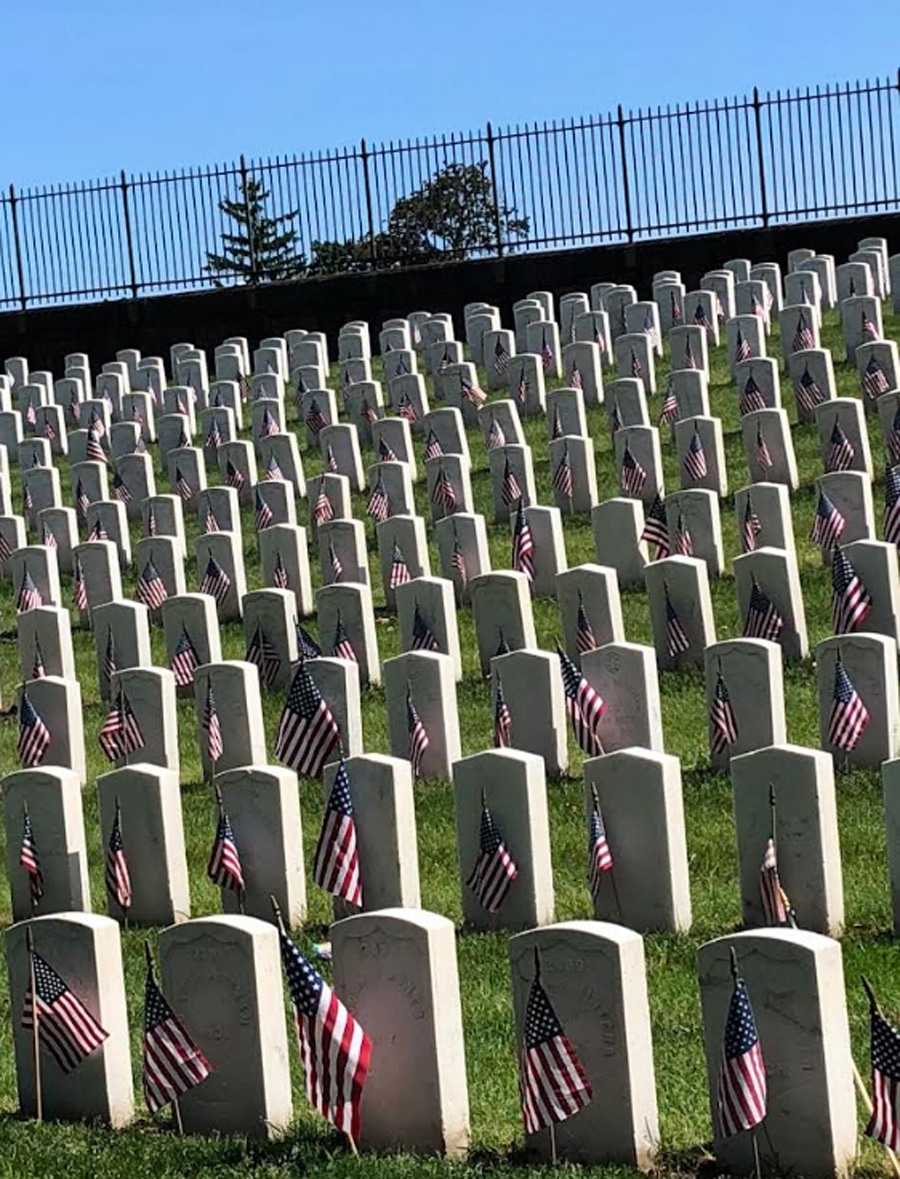
Memorial Day, also called “Decoration Day,” was celebrated throughout the North on May 30, 1870. Just five years after the end of the Civil War the day was, according to the New York Times, only second to the 4th of July in calling forth people’s patriotic feelings. The day was first celebrated in 1865 by freed enslaved people in Charleston honoring the “Racecourse Martyrs,” Union soldiers who had died while prisoners at a local racecourse. Other days honoring the Union dead were held over the next three years, but the day took on a national character in 1868 when former Union General John Logan pronounced May 30 as the nationwide day to decorate the graves of Union soldiers.
Two years later, the New York Times reported that all over New York there were ceremonies to recall those lost during the Civil War. Nearly the entire front page of the May 31 paper was filled with reports of the parades, speeches, and the decoration of the dead soldiers’ graves. The newspaper said that while the holiday had strong patriotic appeals, it was also a time of mourning for the men so recently killed.
According to the New York Times; “The 30th of May has come to be a National holiday-not by any enactment of Congress…but by the general consent of the people.” Nowhere in the country, said the Times, was Memorial Day celebrated more appropriately than at Cypress Hills Cemetery. The report said that thousands of people of all classes attended.
The Cypress Hills Cemetery had men who were not killed on the battlefields, but who survived and were taken to New York to be treated. Many were mortally wounded and would die soon after arriving. Others made some progress in their initial weeks, but developed an infection and lost their lives months after they were wounded.
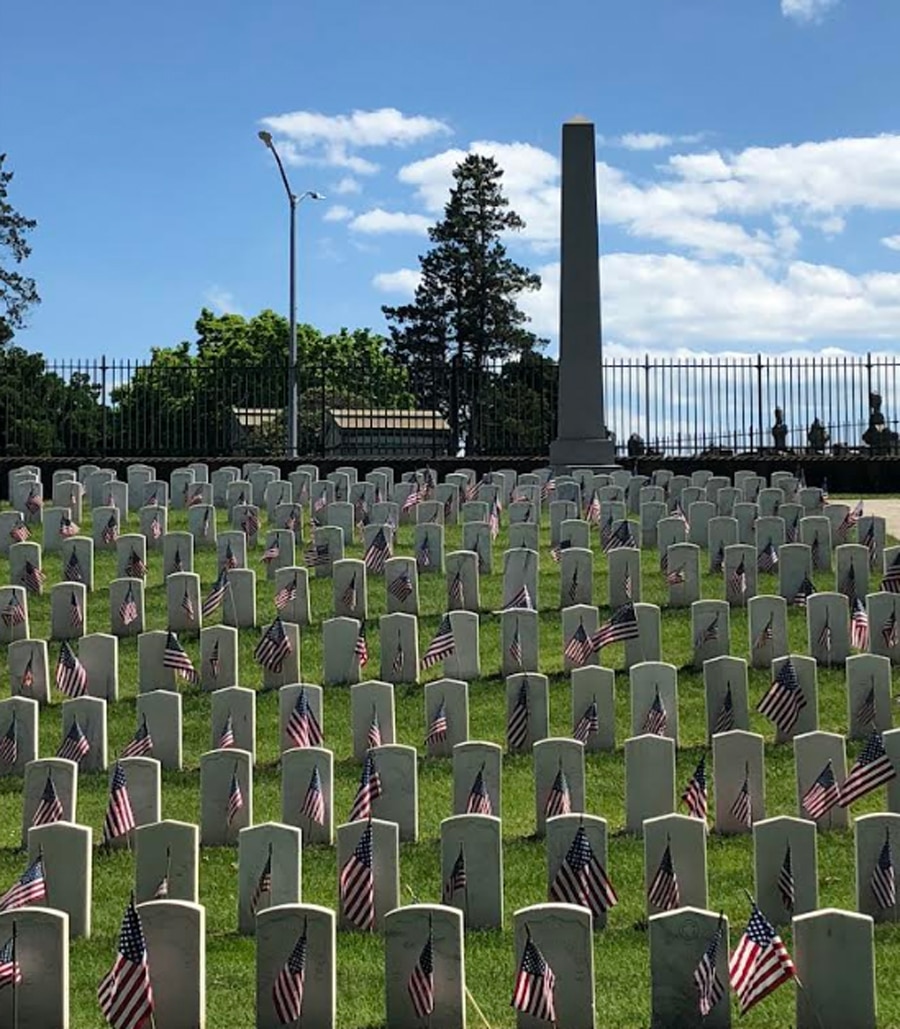
Cypress Hills Cemetery with Confederate graves pointy at the top. (Photo by Patrick Young)
If you visit today you will find men placed into their graves based on when their body was transferred. There is no division by state since the overseers did not want to reinforce the centrality of States’ Rights. You will also see that at this New York cemetery, white soldiers and colored soldiers are buried right next to each other with no separate segregated locale for interring the United States Colored Soldiers apart from the white dead.
Most extraordinary in the cemetery is that Confederate dead are scattered among the Union dead. These were men captured in battle who were transferred to New York. They were imprisoned on Hart Island, a small island east of City Island. Hart was used as a camp to train United States Colored Troops, and later in the war it became a prisoner of war camp. There were 3,413 Confederate Prisoners of War on the island of whom 235 died.
After extensive coverage of the day’s ceremonies at the Academy of Music, the parade in Union Square in Manhattan, the observance at Cypress Hills Cemetery on the border of Brooklyn and Queens, and services by the Robert Gould Shaw Post of the Grand Army of the Republic in Staten Island, the New York Times covered other observances in New Jersey, Washington, D.C., and at a graveyard for United States Colored Troops in Virginia.
Just a few miles away from Cypress Hills is one of the most famous cemeteries in the United States, Green-Wood. The cemetery is focused on Battle Hill where a significant part of the Battle of Long Island was fought during the Revolutionary War. The major monument on the top of the hill is the New York City Civil War Memorial. A magnificent work of art, veterans assembled here this Memorial Day just as they did during Reconstruction and every year thereafter.
My wife and I were taking a ride through the cemetery back in 2018. We stopped to see Henry Ward Beecher, Henry Halleck, and a number of other Civil War Era “permanent residents” of the famous cemetery. While we were driving towards the exit, Michele asked me to stop when she saw two graves with the same last name on them, one with a Union and one with a Confederate grave stone. The Union stones are rounded at the top and the Confederate stones are pointed.
We immediately wondered if these two men were brothers or cousins. Both from Maryland, both died during the Civil War. The two men were brothers, and they disagreed violently over which side to support when the war broke out. Clifton Prentiss joined the Union army, while his younger brother, William Prentiss, became a Confederate. They both survived the heaviest fighting of the war, but with just a few weeks left in the conflict, both were wounded at Petersburg.
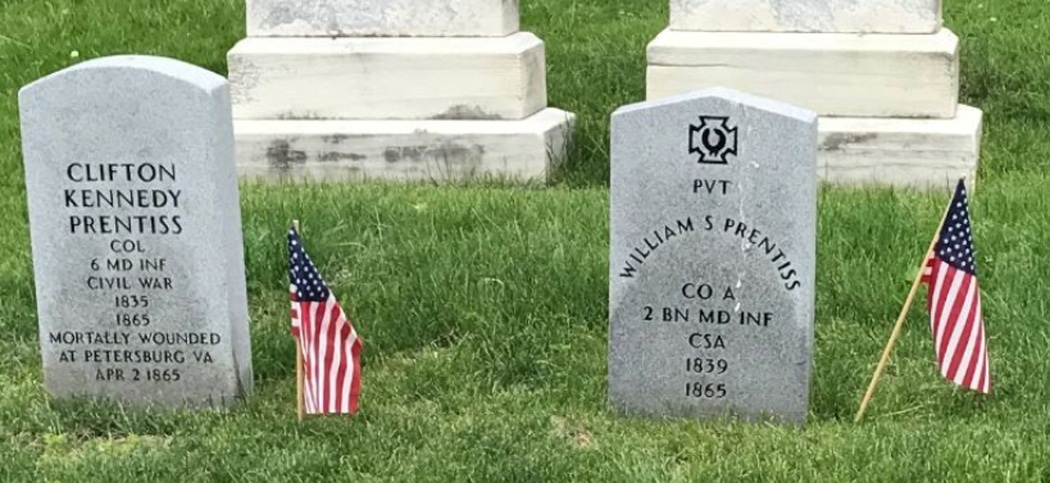
Clifton was living in Baltimore when Fort Sumter was fired upon, and two days after war had broken out he volunteered as a private for the United States Army. He was steadily promoted until, by the time of his death, he was a brevet colonel of the 6th Maryland. William enlisted in the First Maryland (Confederate) Infantry Regiment and later transferred to the Second Maryland.
Both wounded brothers were taken to a hospital in Petersburg and afterward to Armory Square Hospital in Washington. There they were cared for by a volunteer nurse, Walt Whitman from Long Island who in civilian life lived just a couple of miles from Green-Wood.
In his work Specimen Days, Whitman recorded his experience with the two men:
May 28–9.—I STAID to-night a long time by the bedside of a new patient, a young Baltimorean… (2d Maryland, southern,) very feeble, right leg amputated, can’t sleep hardly at all—has taken a great deal of morphine, which, as usual, is costing more than it comes to. Evidently very intelligent and well bred—very affectionate—held on to my hand, and put it by his face, not willing to let me leave. As I was lingering, soothing him in his pain, he says to me suddenly, “I hardly think you know who I am—I don’t wish to impose upon you—I am a rebel soldier.” I said I did not know that, but it made no difference. Visiting him daily for about two weeks after that, while he lived, (death had mark’d him, and he was quite alone,) I loved him much, always kiss’d him… In an adjoining ward I found his brother, an officer of rank, a Union soldier, a brave and religious man, (Col. Clifton K. Prentiss, sixth Maryland infantry, Sixth corps, wounded in one of the engagements at Petersburgh, April 2—linger’d, suffer’d much, died in Brooklyn, Aug. 20, ’65.) It was in the same battle both were hit. One was a strong Unionist, the other Secesh; both fought on their respective sides, both badly wounded, and both brought together here after a separation of four years. Each died for his cause.


What a tragic tale. Have you seen the grave of Clarence MacKenzie, drummer boy of the 13th New York State Militia at Green-Wood?
I went there about 15 years ago fir the first time and return to the grave site every couple of years. I wrote about it here:
https://thereconstructionera.com/remembering-the-drummer-boy-of-greenwood-cemetery-in-brooklyn/
Thanks Patrick … you and your wife recovered a wonderful and very sad Decoration Day story — a great piece … thanks again.