A 77-Year-Old General and the Captains of Wall Street Mobilize the North
ECW welcomes back guest author Leon Reed.
At the start of the Civil War, Brig. Gen. John Wool, Department of the East commander, maintained headquarters in his hometown of Troy, New York. On April 16, he was one of the first speakers to draw in the flag not just as the national banner, but as a universal symbol of loyalty to the Nation: “Will you permit that flag to be desecrated and trampled in the dust by traitors? Will you permit our noble Government to be destroyed by rebels in order that they may advance their schemes of political ambition and extend the reach of slavery? . . . My friends, that flag must be lifted up from the dust into which it has been trampled, placed in its proper position, and again set floating in triumph to the breeze.”[1]
On April 21, as the massive, pro-Union rally in Union Square was unfolding, Wool was at his headquarters, sending and receiving a barrage of telegrams: checking arsenals to determine their available inventories of arms, and assessing the status of state mobilization efforts. That evening, officials of the newly formed Union Defense Committee (UDC), made up of New York business leaders, urged him to come to New York City to take charge; Wool and an aide boarded a train for New York the next day.
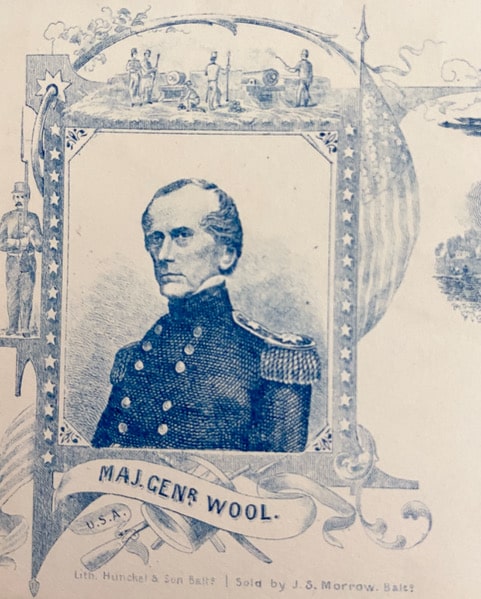
Fearful of the risk to the Union, Wool “assumed responsibility for mobilizing his own Department of the East …” The UDC, which worked closely with Wool, summarized that in the hectic last week of April, Wool “chartered vessels, forwarded supplies, purchased ammunition, garrisoned forts, directed the movement of troops, ordered the occupation of navy depots and army arsenals from Portland to St. Louis, supplied arms and ammunition of war to the western governors; in a word, had set in motion the entire military force of the North.”[2] These actions were taken during the period when the national capital was cut off after Baltimore leaders had severed rail and telegraph lines north of town.
The decisions flew fast and furious. Arms were dispatched to fill a request from Gov. Andrew Curtin of Pennsylvania, and then four other eastern states. Wool advised several governors to garrison vulnerable forts with state troops. He advised the governor of Illinois to occupy the St. Louis Arsenal and distribute weapons to several western states.
As early as April 23, he wrote, “It is impossible to describe the excited state of the people of the north. New York City is ready to forward 80,000 men for the defense of the Union and its preservation.” He took pains to keep General-in-Chief Winfield Scott informed, sending summary accounts of his efforts to meet the requests of the governors of various states for arms and accoutrements.[3]
Working closely as a team, Wool and the UDC took actions extending far beyond the scope of the UDC’s original purpose of facilitating the formation and transportation of New York militia regiments.
For example, while chartering ships to transport troops was part of the UDC’s original mission, the committee also chartered the Quaker City to protect merchant shipping in the Chesapeake Bay from Confederate privateers. Within a week, the committee had chartered 20 steamers for blockade duty and had them outfitted at the Navy Yard.[4] In its April 1862 report, the Executive Committee noted that the Quaker City captured eight vessels attempting to circumvent the blockade. Subsequently, the Quaker City was purchased by the federal government and made a U.S. warship.[5] In the first week of its activities, the UDC also chartered a vessel to transport to Annapolis rail workers who repaired the branch rail line from Annapolis to the Baltimore & Ohio mainline to facilitate the flow of troops.[6]
The UDC went beyond the normal practice of helping outfit new regiments and assumed total responsibility for forming four regiments by recruiting, organizing, and outfitting them, and helping to select officers. The four regiments, the Garibaldi Guard (39th New York Infantry), Mozart (40th), DeKalb (41st), and Tammany (42nd), were some of the most distinguished to serve in the war.
Its purchases extended beyond buying uniforms, rifles, and other supply items for new regiments. For example, the committee began to supply rations and equipment to troops in the field, whether from New York or not. One ship was sent to Fort Monroe with food and medical supplies. The UDC purchased the first ambulances for the armies, and at nurse Dorothea Dix’s request, provided 100 cots for the Washington Hospital.
As a result of its wide involvement in the arms business, the Wool-UDC team was also able to alert authorities of suspect arms purchases in places as diverse as Canada and Belgium.
Perhaps its most controversial actions were to supply arms to the “Union men” in states that were threatened with takeover by secessionists. Three slave states – Kentucky, Missouri, and Maryland – ultimately decided to remain in the Union, but at the beginning April, Kentucky and Missouri had governors who were suspected of pro-secession sympathies, and all three state militias were controlled by men who ultimately served in the Confederate armies. The UDC purchased 5000 rifles for the “Union men” in western Virginia and another 1,000 rifles plus ammunition for the “Union men” in Kentucky. They advised Missouri militia leaders to use the supplies in the St. Louis Arsenal, but ultimately provided arms for Gen. John C. Frémont as well.
In late April, the committee sent telegrams to all the loyal governors, asking about the number of troops that had enlisted and the condition of the units. Within 24 hours, the committee heard from thirteen governors and reported that sixty-three regiments had formed and twenty-four more were being formed. This was the first indication to the War Department of the dimensions of the military force that was coming into being and the timing of their taking the field. A history of the UDC observes, “Everywhere the Committee appears to have been recognized as the most effective agent in the defense of the Union.”
But politics were never suspended for the duration. With the UDC, Gov. Edwin D. Morgan, politician Dan Sickles, and the adjutant general were all involved in raising troops; with Secretary of War Simon Cameron, who implemented a restrictive policy toward accepting regiments into federal service, and a president who occasionally directly accepted regiments from people, such as Dan Sickles, who had bypassed the system, overlap, confusion, and turf contests were inevitable. Within days of Abraham Lincoln’s call for troops (April 25), the UDC found that the governor was unwilling to accept additional regiments without specific authorization from the national capital.
The committee learned from Washington that “the administration was evidently chagrined, and General Scott discontented with General Wool’s aggressive independence in the period from April 21 through May 1.”[7]
General Scott finally reprimanded Wool on May 1. Citing the need for “carrying out the business of the several staff departments with system, under their proper chiefs,” Scott ordered Wool to cease purchases that might interfere with the purchasing departments.
In a speech to the UDC, Wool outlined the work he had done in the early days of the mobilization crisis:
- Answering requisitions from nine state governors for arms and ammunition;
- Chartering ships and forwarding troops to Washington D.C.;
- Chartering ships to protect shipping from privateers;
- Ordering a ship, plus supplies, ammunition, and armaments to the defense of Fort Monroe;
- Supplying rations to the troops in Washington;
- Suggesting to Rep. Frank Blair and the governor of Illinois that they take possession of the St. Louis Arsenal.
He also gave several governors and mayors authority to occupy and improve the defenses of several coastal forts.[8] Despite the fact that most of his actions proved to be necessary, Washington still felt a need to slap Wool’s knuckles, and ordered him back to his isolated headquarters in Troy, New York. And as the state adjutants general began to produce a flow of three-year volunteer regiments, the need for ad hoc groups like the UDC declined. But in those hectic first weeks, as even Gen. Scott later acknowledged, the work of Wool and the UDC were vital in starting the vast mobilization and protecting the capital.
Leon Reed the author of four books on Gettysburg monuments, No Greater Calamity for the Country: North-South Conflict, the Secession Crisis, and the Onset of Civil War, and co-author of the forthcoming On Fames Immortal Scroll: Alabama Troops at Gettysburg. He lives in Gettysburg.
Endnotes:
[1] Harwood P. Hinton and Jerry Thompson, Courage Above All Things General John Ellis Wool and the U.S. Military, 1812-1863, (Norman, University of Oklahoma Press, 2020), 290.
[2] Reports, Resolutions, and Documents of the Union Defense Committee of the Citizens of New York (New York: Baptist and Taylor, 1862), 22.
[3]Samuel Rezneck, “The Civil War Role 1861-1863 of a Veteran New York Officer Major-General John E. Wool (1784-1869),” New York History, Vol. 44, No. 3 (July 1963), 242.
[4] Union Defense Committee, 20.
[5] “Report of the Executive Committee, April 30, 1862,” in Union Defense Committee, 11.
[6] Edward K. Spann, Gotham at War: New York City 1860-1865, (New York: Rowman & Littlefield, 2002), 25.
[7] Union Defense Committee, 21
[8] “General Wool to the Union Defense Committee,” Ohio Statesman, July 30, 1861.


I believe that General Wool has some form of monument in Manhattan.
My mistake, it’s General Worth!
Great description of the earliest days of the war. Former Mass governor George Boutwell met with Wool in NY while on a dangerous journey to Washington to coordinate the Massachusetts contribution of men and material, being one of the first to meet with Lincoln and Scott a few days after the 6th Mass. regiment was attacked in Baltimore. As Lincoln told the men of the regiment as they bivouacked in the Capitol building, “you are the only Northern realities.” See BOUTWELL: Radical Republican and Champion of Democracy, p. 84.
Excellent piece – definitely fills in a gap in my research. I’ve always had a question in the back of my mind about how Virginia unionists armed themselves so quickly and I guess now I have my answer. If you have any more specific info about the 5,000 rifles for the “Union men” in western Virginia – when they arrived and who got them, please let me know!
The city of Troy was firm in its celebration of ‘our general’ Wool.
On his demise the general was honored by massive crowds and the installation of by far the tallest obelisk in Oakwood Cemetery.
No good deed goes unpunished, as they say.
Very informative. I own one of the author’s books on GNNP monuments; extremely helpful.