The Implementation of Voting by Mail During the Civil War
 ECW welcomes Andrew C.M. Mizsak, M.A.P., MBM
As the summer faded into the fall of 1864 with cooling temperatures, the heat of the presidential campaign rose. Abraham Lincoln, prosecuting the war of the rebellion, was seeking re-election, while his ousted former front-line commander, George McClellan, challenged him at the polls.
Soldiers in various camps, wishing to make their voices heard, knew that it was impossible to travel home for the November election. Between the fighting, transportation, logistical issues, and the time to make a return trip to the front, voting was all but impossible.
President Lincoln believed “We cannot have a free government without elections…” Therefore, in order to live true to the proclamation made in the Gettysburg Address less than a year earlier, to ensure that government continued to be “…of the people, by the people, and for the people,” he endeavored to assure that his commitment to the voice of the people was true and consistent.
Leading up to the 1864 presidential election, the majority of Union states modified their election laws to grant soldiers in the field the ability to vote by mail.1
Soldiers voting while deployed was not a concept novel to the Civil War. In fact, this process was initially used during the War of 1812.2
Railroads made the process of voting by mail easier. A soldier in the field could request that a ballot be sent via US mail by rail. The system allowed ballots to be safely sent to the soldier and securely returned to the election official for processing.
Did President Lincoln overstep any constitutional bounds by supporting vote by mail during the Civil War? Or was he simply articulating a policy position by urging the states to implement this system? The Constitution tells us in Article I, Section IV, that it is the Congress that sets the “time, place, and manner” for Federal elections. It could be argued that the president did not overstep constitutional bounds because he did not change the time, place, and manner of the elections, but rather made a policy recommendation to Union states, and reaped the benefits of that recommendation by securing over 75 percent of the military vote in the Northern States.3
Was it the Northern states that only benefited from vote by mail? The National Association of Letter Carriers, in an October, 2024, article in their magazine, “The Postal Record,” stated that Missouri, a southern state, first began using vote by mail for Missourians at the front in 1862.4 By the time the Civil War ended, over half of the states in the Confederacy also employed vote by mail as a means to allow those soldiers in the field to participate in the electoral process.
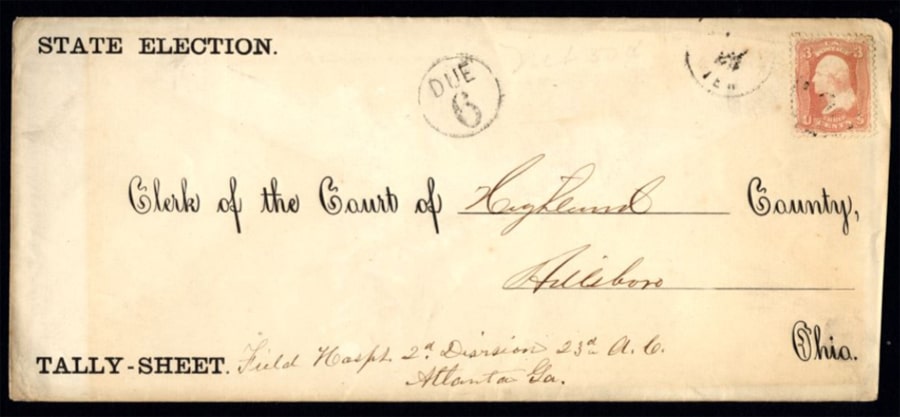
In the North, Ohio initially extended the right to vote by mail for troops in the field. For the 1864 election, Ohio ensured accuracy of ballot returns and counts by differentiating the ballot and return envelope between a state or federal election.5 At that time, Ohio conducted state elections in October of even-numbered years, while the federal election, pursuant to the Constitution, was held on the first Tuesday, following the first Monday in November.
The vote by mail system changed the American political landscape. It permitted the voice of those who could not be home on Election Day the same opportunity to allow their choices of candidates and issues to be recorded in a manner equal to their fellow citizens at home.
But vote by mail has also nearly always been subject to controversy. Does it advantage one political party over another? Is the gathering and mailing of ballots a secure process? During the Civil War, Democrats expressed concern that the election would be co-opted or the ballots tampered with, while the Republicans believed the process as the means to re-elect Abraham Lincoln and continue the war effort.6
Vote by mail is nearly as old as the Republic itself and has been considered to be safe and secure for generations, even during times of great national crisis. It is also a manner in which States can exercise their Constitutional obligation of conducting and counting elections. Given the historical utilization of vote by mail, coupled with its effectiveness during the Civil War, voting by mail continues to serve as a strong symbol of the steadfast endurance of this nation’s system as a representative democracy.
Civil War Round Tables can replicate this unique Civil War voting experience to bring engagement opportunities to members and prospective members. Do you need to meet a quota to conduct a vote to approve or reject an issue? Open up a voting window of time. Allow votes by proxy (as long as there is documentation from a missing member designating a certain person as their proxy). Allow votes via email, as long as the call for the vote, the tallying of the votes, and the closure of the vote are documented and done in a transparent manner in accordance with your bylaws.
In these uncertain times of rising gas prices and dining out becoming dispensable, consider allowing those alternative means to engage members. That could also include putting your meetings back on a virtual platform like Zoom.
President Lincoln recognized the importance of soldiers’ engagement in the democratic process of our nation. Consider how we can use this wisdom of engagement to bring your decision-making process to your members.
Andrew Mizsak is a director for the CWRT Congress and Commander, James A. Garfield CWRT.
1 Monson, Derek. A Brief History of Vote by Mail. The Sutherland Institute. October 13, 2021. A brief history of vote by mail – Sutherland Institute. Accessed May 3, 2026.
2 Bunch, Lonnie G. III. How the Civil War Spawned the Mail-In Ballot. Smithsonian Magazine. Office of the Secretary of the Smithsonian. September 3, 2024. How the Civil War Spawned the Mail-In Ballot | Smithsonian Voices | Office of the Secretary of the Smithsonian Magazine. Accessed May 3, 2026.
3 Rotondi, Jessica Pierce. Vote-by-Mail Programs Date Back to the Civil War. The History Channel. Vote-by-Mail Programs Date Back to the Civil War | HISTORY. Accessed May 3, 2026.
4 The National Association of Letter Carriers. “As if Present,” The Postal Record. September/October 2024. Absentee.pdf. Accessed May 3, 2026.
5 Smithsonian Snapshot. A History of Voting by Mail. The Smithsonian Institution. September 19, 2024. A History of Voting by Mail | Smithsonian Institution. Accessed May 3, 2026.
6 Strochlic, Nina. How Mail-In Voting Began on Civil War Battlefields. National Geographic. November 4, 2022. Washington, DC. The National Geographic Society. How mail-in voting began on Civil War battlefields | National Geographic. Accessed May 3, 2026.


Correct me if I’m wrong, but I think they also gave some units furloughs home so they could vote.
Except today, with computers, the chances for fraud is increased exponentially. There so many cases of fraud from the 2020 election. And the voting patterns that happened before and after vote counting was stopped in several states are statistically impossible. We already had vote by mail, but it is a very stringent process, not the mass mailing of ballots as happened in 2020. Voting is a right that should require all but a small percentage of the population, to make an effort to exercise. And having a valid ID is a must to have legitimate elections. Something that nearly all other modern countries requires: in person voting and requiring an valid ID to vote.
Those saying that certain minorities have a hard time getting an ID smacks of the racism uttered by slaveholders during the pre-Civil War period, for why the slaves should never be freed.
This is an attempt by Andrew Mizsak to influence followers of ECW to normalize mail-in voting- full stop. He is a “Democratic Consultant and Strategist”, according to his Facebook profile. Yes, we’ve always had mail-in voting, but it was only for those who couldn’t physically make it to the polls to vote- the elderly, disabled and those away on military duty. For anyone who doubts this system is wide open to fraud, just look at what’s happening in California right now.
Correct me if I am wrong, but I thought this was a blog to discuss matters relavent to the study of the Civil war and its impact on all of us, not a vehicle to launch ad hominem attacks on contributors and repeat partisan political propaganda.
I just wanted to say thank you for checking out my page! I truly appreciate it!
And thank you for reading!