The (Nearly) Forgotten Origins of Civil War Computer Gaming
I’d like you to time travel with me. Not to the 1860s, but to 1990. It’s a quiet weekend at your local library, and you’ve signed up for an hour of computer time. Games like Where in the World Is Carmen Sandiego?, Battle Chess, and King’s Quest look fun enough, but they don’t quite scratch that history itch. What’s a young Civil War buff to do?
Time to boot up Civil War, a text-based strategy game released by International PC Owners (IPCO) in 1983 through its user-contributed software catalog. Even by the early 1990s, the black-and-white MS-DOS interface already looked dated, but beneath its primitive presentation lay a game with surprising depth and replayability.
Civil War was originally created in 1968 by three Massachusetts high school students: L. Cram, L. Goodie, and D. Hibbard. It later evolved into a one or two-player game through modifications by G. Paul and R. Hess of Technology and Information Educational Services (TIES) in St. Paul, Minnesota. Written in the BASIC programming language, it was among the world’s earliest computer games and gained wider attention after appearing in David Ahl’s 1973 book 101 BASIC Computer Games.[1]
The premise is simple: you take command of the Confederacy and fight your way through 14 historical battles, making strategic decisions and comparing your performance to the actual historical outcome. The battles can be played in sequence or selected individually, and some versions even include a hotseat mode that lets two players face off against each other.
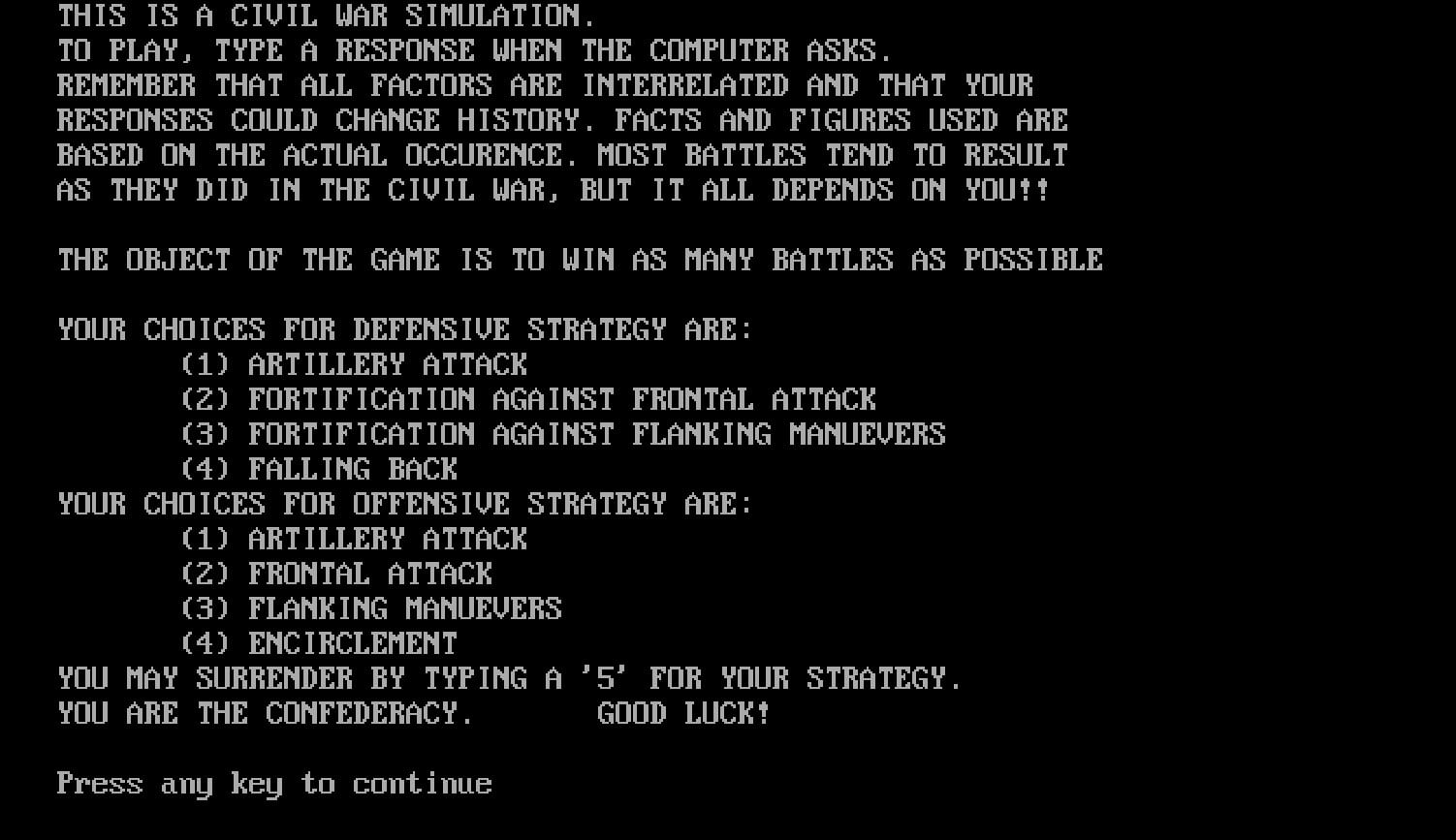
The mechanics are straightforward as well. Before each battle, you are given an army size, an offensive or defensive posture, and a limited budget to divide between food, salaries, and ammunition. Your spending choices determine your army’s morale rating, which ranges from poor to high. Lose too many battles, and inflation begins to climb, shrinking your available funding by cutting a percentage from your total resources.
Your base budget is determined by multiplying your historical troop strength by an inflation modifier and then dividing the result by 20. For example, if you have 18,000 men and an inflation rate of 10 percent, the formula becomes 18,000 × 90 ÷ 20, giving you a base budget of $81,000. The game then factors in how much of your budget you managed to save in previous battles, applies that percentage to your base total, and rounds the final amount up to the nearest hundred dollars.
Cleverly, Civil War also tracks your casualties from battle to battle. If your losses consistently exceed the historical totals, the number of troops available in future engagements will decline. If you manage to keep casualties below their historical levels, however, your available manpower will grow, giving you a larger army in the battles ahead.
Depending on whether you are attacking or defending, the game offers four tactical options such as “Artillery Attack,” “Frontal Attack,” or “Falling Back.” These choices are weighed against your opponent’s strategy, your army’s morale, and the amount spent on ammunition to determine the battle’s casualties. Ammunition spending directly reduces a casualty multiplier applied to your army. A good rule of thumb is to spend an amount on ammunition roughly equal to, or slightly greater than, your troop strength. Spending nothing on ammunition guarantees a disastrous defeat.
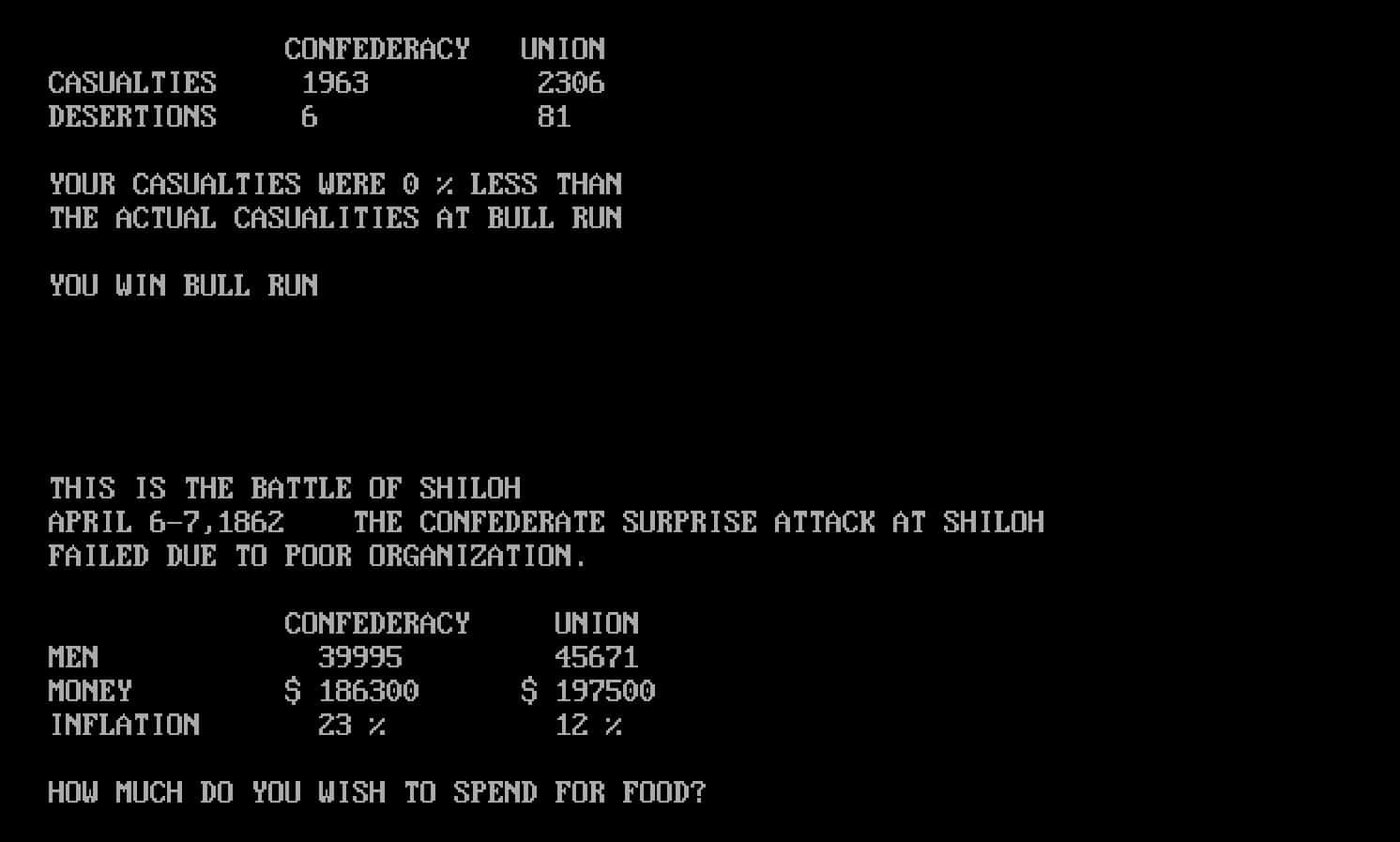
Desertions, influenced by overall morale, are added to the casualty total. In practice, food matters far more than salaries when calculating morale. Every dollar spent on food generates more morale than a dollar spent on pay, making food the most efficient way to strengthen it since the two values are simply combined by the game’s formula.
The side that suffers the fewest casualties wins the battle.
The game is surprisingly sophisticated. Multiple factors influence casualty calculations, and the rudimentary AI uses a weighted probability system when selecting its strategies. Each option begins with an equal 25 percent chance of being chosen, but the game tracks your tendencies over time. If you repeatedly favor a tactic like “Flanking Maneuvers,” the AI gradually increases the likelihood that it will choose the most effective counter-strategy.
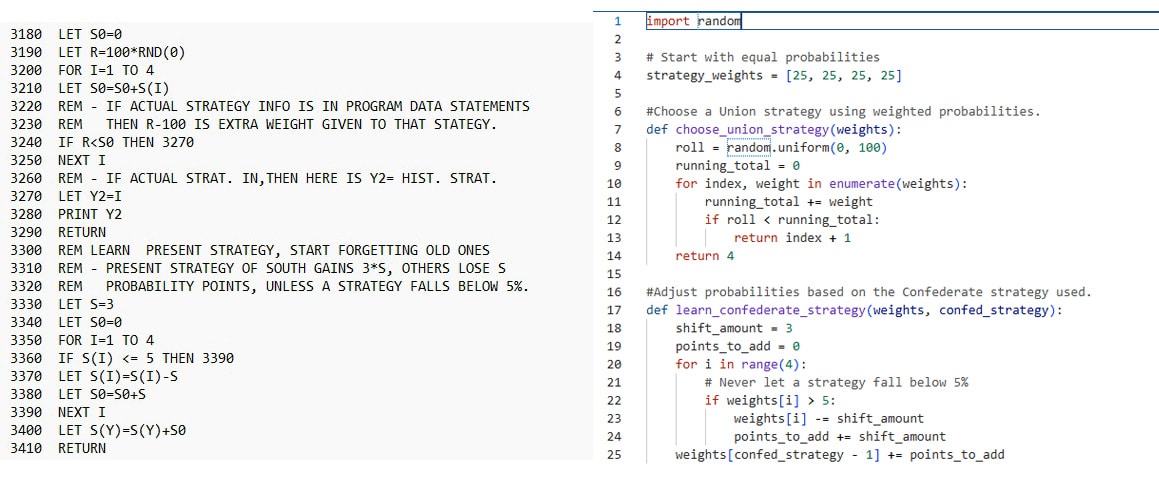
Because the original code is so simple, it doesn’t take a programming genius to recreate it in modern languages like Python or even in HTML and CSS for a web browser. In fact, the entire 400-line BASIC game, complete with all 14 historical battles, battle descriptions, economic calculations, and the AI learning system, can be rewritten in just 140 lines of Python.
The game also lends itself easily to modification. You could add or replace battles, let players command the Union instead of the Confederacy, or introduce more advanced mechanics such as weather effects or slight random variations to reflect the chaos of combat. Even the morale system could be reworked so that spending on salaries carries more weight.
Civil War is a masterclass in emergent gameplay: the idea that a very small set of rules can produce surprisingly complex situations. With only three budget inputs (food, salaries, and ammunition) and a single strategy choice numbered one through four, the game forces players to weigh logistics against combat effectiveness and short-term victories against long-term survival.
At the same time, you are constantly trying to outguess an AI that gradually “learns” your preferred tactics. Devoid of unnecessary fluff, every decision has a direct, visible, and mathematical effect on the fate of your army.
Today, the game survives as abandonware and can still be played through the Internet Archive in a web browser. For aspiring Civil War strategists, it remains a surprisingly addictive piece of gaming history.
[1] “The Mainframe Ancestors,” The Wargaming Scribe, November 28, 2022. https://web.archive.org/web/20260608121326/https:/zeitgame.net/archives/7631; An online version of the game’s source code can be found here: https://www.atariarchives.org/basicgames/showpage.php?page=46


Oh! How I miss Sid Meyer’s Gettysburg!
You might be able to find it on Internet Archive. I loved Civil War Generals 2. Wish someone would make a remastered version like they did with C&C
A favorite and I bought a book and programmed my own scenarios. It does not play well on modern computers, sadly.
OMG. We had six machines in high school (76 or so) and they were fed with wide sheets of paper you tore off. We played this game (hard to call it a computer–I don’t even recall a screen of any kind, but this was my favorite game. I can even recall now how the small room smelled. This is wild. Thanks for the memory. Had forgotten about it.
Very interesting! About a year or two ago I started thinking about this game again and tried to find it. I forgot what it was called – but when I finally looked into it more, I was shocked at how sophisticated it actually was behind the scenes. Thank you for sharing the memory. That must have been an exciting time. When I was in elementary school, the PC was just starting to take off but we couldn’t afford one.
I grew up on Avalon Hill’s historical simulation games. No computers. I’m old. 🙂
I have an article scheduled for July 1st you will love! Make sure to check back
For those interested – I’m making an updated version of this game with new features, more battles, and the ability to choose your side. Email me at makleen2 at gmail.com (replace at with @) and I’ll send you a dropbox link where you can download the game when it’s ready.
As a young enthusiast I spent more hours than I can remember in the 1970’s, long before the days of MS-DOS and Windows, playing the game on an acoustically coupled modem and a 110 bps (YES, BPS) teletype terminal.
I would greatly enjoy reliving the heady days of the original Oregon Trail, Civil War, etc, simulations. I have already acquired the old Crowther Woods Colossal Cave Adventure (ADVENT) which I still enjoy. BEWARE THE UBIQUITOIUS DWARFS!
Great memories!
I never played this one, but I still have the 1996 edition of American Civil War: From Sumter to Appomattox from Interactive Magic on my computer. My wife can always tell when I decide to play it because the amount of mouse clicking per second goes up exponentially. I just rechecked. It has a 98-page instruction manual complete with bibliography for quotations used within.
I miss the old game booklets with all the illustrations and background info. They just don’t make them like they used to!
I played both Civil War Generals and Civil War Generals 2 extensively. A great simulation thay sadly won’t run on current computers.
Me too! CW Generals 2 was my favorite. There are versions out there that you can supposedly download and play on Windows 10 or 11 but I wouldn’t risk getting a virus over it
I have Civil War Generals 2 on my laptop! Seems to have been virus-free, but it’s definitely a risk.
I lost Fredericksburg as the Confederacy.
Anyone remember the Avalon Hill board games like Gettysburg and Chancellorsville?
Yes! Check back on July 1st because I have an article scheduled about that exact subject…