Book Review: William Henry Seward’s Quest to Save the Nation During the Secession Winter (November 1860-April 1861)

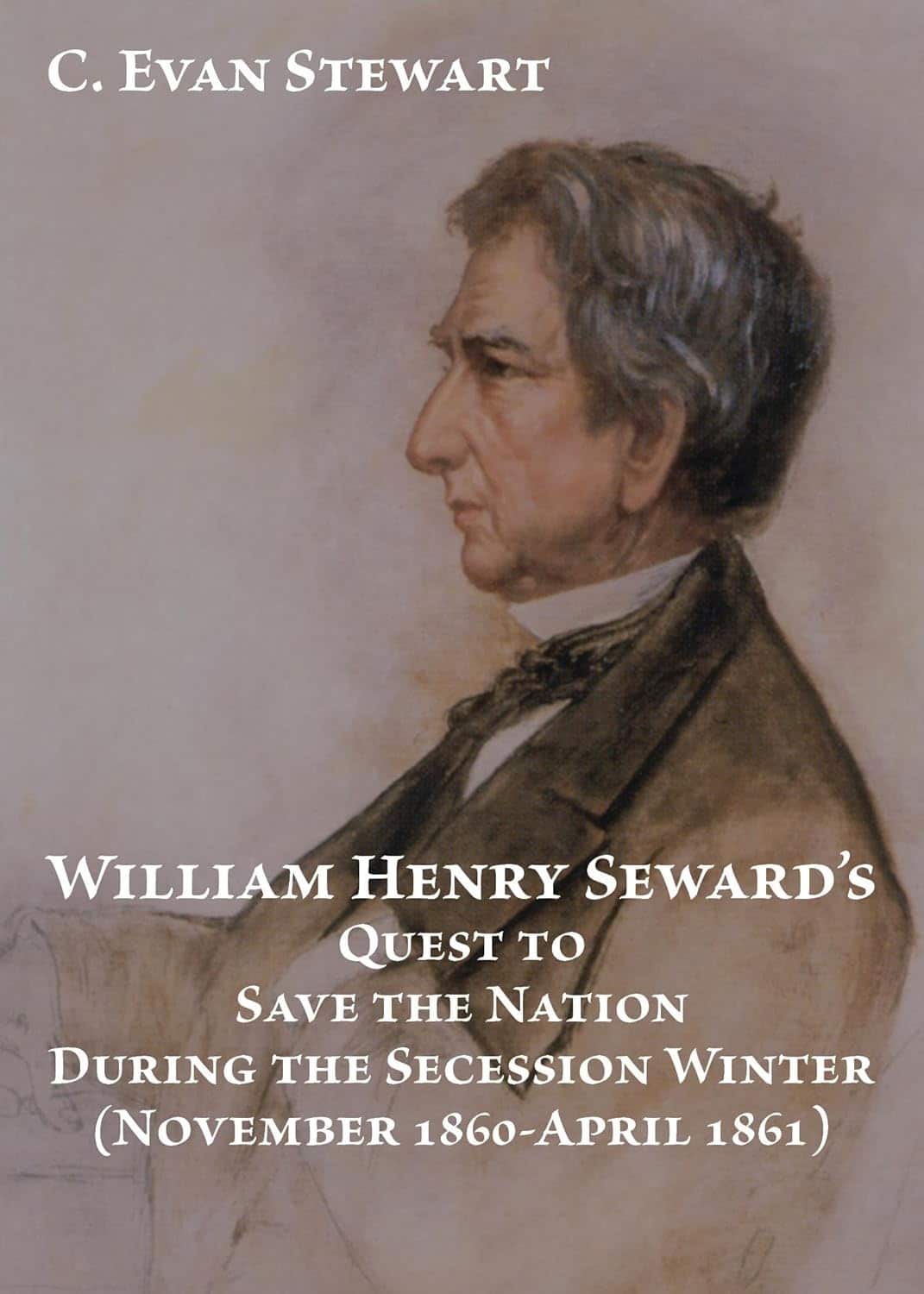
William Henry Seward’s Quest to Save the Nation During the Secession Winter (November 1860-April 1861). By C. Evan Stewart. Northport, NY: Twelve Tables Press, 2026, 205 pp. $20.95.
Reviewed by Al Mackey
In 1860 William H. Seward of New York was the odds-on favorite to win the Republican nomination for President of the United States. It was not to be. Abraham Lincoln won the nomination and then went on to win the Presidency. Seward, dejected by his loss, nevertheless went on to campaign for the Republican ticket and then to serve as Lincoln’s Secretary of State. On Lincoln’s election, the cotton states of the South began to claim they had seceded from the United States, and those seven states formed what they called a separate country, the Confederate States of America, before Lincoln was even inaugurated. The time between Lincoln’s election and the start of the Civil War with the firing on Fort Sumter is often called Secession Winter. This book seeks to focus on Seward’s actions during that crucial time.
Mr. Stewart has done prodigious research for this book. His thesis appears to be that Seward, one of the most experienced politicians in the nation at the time, worked tirelessly to stave off civil war, and if only Lincoln had taken his sage advice the crisis could have been peacefully solved.
Lincoln’s inexperience and Seward’s vast experience are matters of record and cannot be disputed. One wonders, however, if Mr. Stewart took into account the near religious belief the Confederate leaders had in the danger to the continuation of slavery and their commitment to its protection. The only way to stave off the war appeared to be the guarantee of the continued existence and expansion of the institution, and while Lincoln would acquiesce to its continuation where it already existed, he and much of his party, as well as their supporters among the electorate, were unalterably opposed to its expansion. Had Lincoln agreed to allow unrestricted expansion of slavery, those supporters would rightly have felt betrayed. That fact seems to argue against the possibility of a peaceful solution.
Stewart marshals an impressive array of evidence to show what Seward was doing. He mostly leans on secondary sources, and he has selected sources that are among the best in the scholarship. He also has some primary sources, both published and from archival sources. His end notes are at the end of each chapter, much appreciated by this reader, and they are comprehensive.
By focusing on Seward, the book contributes to our understanding of secession winter by seeing it through Seward’s perspective. His argument would have been stronger had he not distracted from it by attacking other historians who disagree with his perspective. Additionally, while one would expect Lincoln to play a diminished role in a book about Seward, and while one would expect a reasonable critique of Lincoln’s actions, it seemed to this reader that Mr. Stewart went a bit too far in blaming Lincoln for starting the Civil War by attempting to re-provision Fort Sumter. It takes too much agency away from Confederate President Jefferson Davis, who ordered the firing, and fails to take seriously Lincoln’s perspective, which was that a simple landing of food need not result in violence.
Even so, with those caveats I believe this book is a worthy addition to the historiography of the beginning of the Civil War and the efforts to stave off war. I think anyone interested in that time period will find the book to be useful.
Al Mackey is a retired US Air Force colonel currently contributing to his community by serving as a substitute teacher in Pennsylvania. A lifelong student of the American Civil War since taking an undergraduate course with Professor James I. “Bud” Robertson at Virginia Tech, Al blogs at Student of the American Civil War, where he posts reviews, videos, interviews, interesting articles he finds, and research results.


Sometimes one can be too close to the forest to comprehend the trees. This appears to have been the situation of William H. Seward, especially during his tenure as U.S. Senator from New York, 1849-1861. Personally friendly with Senator Jefferson Davis, yet reviled by the Southern press [“Seward requires the same medicine as Charles Sumner, only in a double-dose”] Senator Seward’s positions on the key topics of the day were known to everyone; and the Democrat Party of 1860 does not seem to have considered Republican candidate for Presidential Nomination Seward a threat to their program of continued domination of National Governance. Fate took a hand, and Abraham Lincoln stepped into the role as Republican Candidate… yet a disappointed Senator Seward did not take his bat and ball and return home. His wealth of experience and political savvy suddenly became assets: Seward’s machine maneuvered to acquire Secretary of State; Senator Seward’s knowledge of political friends and foes, and how they reacted under pressure, became invaluable to President-elect Lincoln. During the Secession Winter William H. Seward may have saved Abraham Lincoln from assassination, and likely saved strategically important Pensacola Bay from Confederate occupation. [And Secretary of State Seward’s support for a pre-emptive strike in September 1861 may have saved Maryland and Washington, D.C. for the Union.]
For those of us interested in “what took place behind the curtain,” this book by C. Evan Stewart has potential to answer significant questions, especially as regards the early-days relationship of Lincoln and Seward. Thanks to Al Mackey for providing this honest review.