White Mansions: Country Music’s Ode to the Confederate Experience
ECW welcomes back guest author Keith Moore.
In 1978, English song writer Paul Kennerley employed a host of country music stars to bring to life his uniquely European take on the War Between the States. Told from the perspective of Southerners during the conflict, “White Mansions” — subtitled “A Tale from the American Civil War 1861-1865” — is a 15-song concept record whose story is delivered through the voices of four characters played by musicians Steve Cash, Jessi Colter, John Dillon and Waylon Jennings.
Born just outside of Liverpool, Kennerley’s fascination with country music started when he was young. He explained his interest in a 1980 interview with A&M Records:
“I have always been turned on by American music, especially country music,” Kennerley said. “You really can’t write country music without country lyrics. When I was seven or eight, I had a brother who was fanatical about Elvis Presley and that started my interest. Five years ago, when I heard Waylon Jennings on the radio in England, it was a complete revelation. I loved it… it was like the Rolling Stones playing country. For me, country music is like hymns — religious music.”
Not surprisingly, Kennerley’s first order of business for his project was to secure the services of Jennings, the same man he heard sing just a few years prior. It was a wise move; the Texas native was a bona fide country music superstar at this point in his career. Jennings scored four consecutive No. 1 country albums between 1975 and 1978 (and hit the top spot twice more in 1980 and 1986).
The rest of the album’s lead participants were also well known. Cash and Dillon arrived via country rockers the Ozark Mountain Daredevils, best known for “Jackie Blue,” a Top 5 song in 1975, while Colter was not far removed from her biggest success; “I’m Not Lisa” was a No. 1 country song in 1975 (and a Top 5 pop hit).
The record’s supporting cast is just as impressive. Produced by Glyn Johns (best known for his work with Humble Pie and the Steve Miller Band), “White Mansions” features appearances from guitarist Eric Clapton and former Eagle Bernie Leadon. Drummer Henry Spinetti played with the likes of Gerry Rafferty and Leo Sayer.
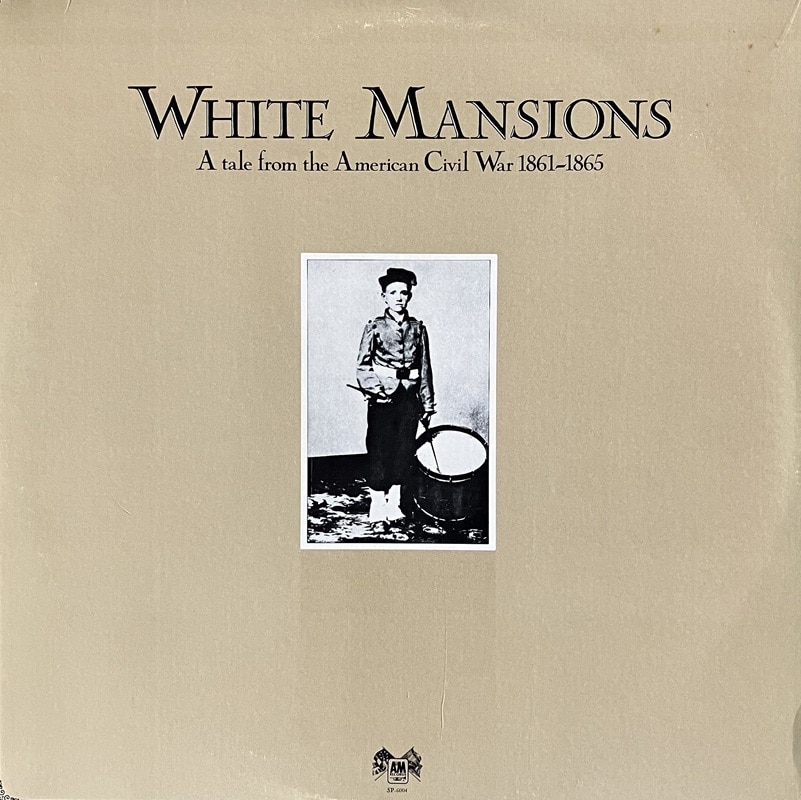
Cast assembled, Kennerley took to creating and assigning parts for his singers. Dillon played the role of Matthew J. Fuller, the son of a cotton planter who joins a Georgia infantry regiment as a captain, while Colter played his significant other, Polly Ann Stafford, who works in a hospital during the conflict.
Cash assumed the part of Caleb Stone, a poor Southerner who fights the Union to protect his way of life and to maintain his perceived superiority over the slave population. Jennings’ role as the nameless Drifter moves the record forward as the concept’s narrator (listeners had access to Kennerley’s storyline and character descriptions in an elaborate 28-page booklet that accompanied the original vinyl version of the album).
***
Released in June 1978 on A&M Records, “White Mansions” may be rooted in country, but it incorporates various other elements of popular music including rock (“Southern Boys”) and ballads (“Story to Tell [The Preface]”). There is even a waltz-inspired duet featuring Colter and Dillon called “The Last Dance & the Kentucky Racehorse.”
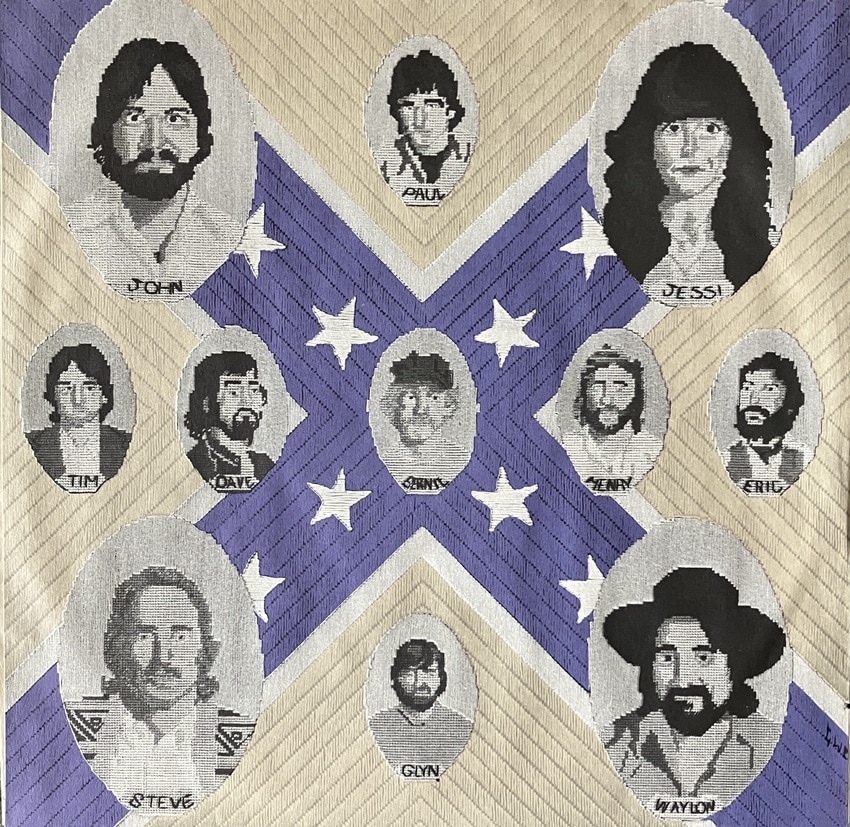
The album is unapologetically told from the Southern point of view. This is obvious from several of the record’s song titles — “The Southland’s Bleeding” and “They Laid Waste to Our Land,” for example — and from the inner sleeve, which features the musicians pictured on a Confederate flag.
Moving from the start of the war to its conclusion over the course of 15 songs, the album opens with two tracks that introduce the concept and establish the characters’ viewpoint on the conflict. The first is Jennings’ “Dixie, Hold On:”
Oh Dixie, watch this black cloud roll
She’s coming down to tear away your soul
How much longer can you pretend
That your plough ain’t threatened by their pen
Hold on, oh, oh, Dixie hold onTo stand alone and cut America in two
Means everything’s lost, the constitution’s fallen through
To leave the Union is to weaken what is strong
You think it right, they think it morally wrong
But you’ll fall, oh, oh, Dixie you’ll fall[1]
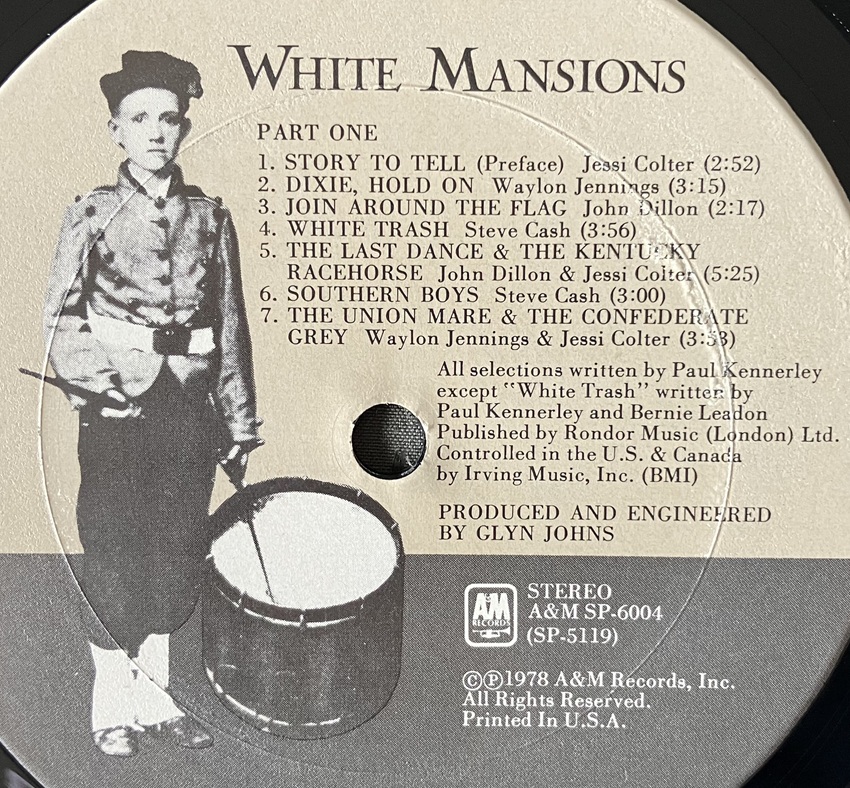
“Join Around the Flag” (performed by the character of Fuller) also helps lay the groundwork for Kennerley’s narrative, albeit from a more personal perspective:
The State’s called its sons to its side, boys
They’re hoisting up the ‘Stars and the Bars’
We must all prepare to fight
For a cause we feel is right
And join Jeff Davis from near and farThey can’t understand our way of life, boys
They don’t want slaves in the new territories
The knowledge that they lack
Is there’s no cotton if there’s no Blacks
And that gives us the reason to secede[2]
As the record evolves and the war progresses, Kennerley doesn’t shy away from the realities of the conflict. In “No One Would Believe a Summer Could Be So Cold,” for example, with the death toll rising and tide turning in favor of the Union, Fuller wonders if it’s all been worth it:
You may’ve heard of the cost of Gettysburg loss
Well, I was there with Lee
And since Vicksburg’s gone, it won’t take ‘em long
To capture TennesseeSometimes I wonder if we’re doing right
And if we’re going to win this war
I start to forget just why we’re here
And what we’re fighting for[3]
Kennerley also acknowledges the devastating mental and physical toll of warfare. Take the graphic “The King Has Called Me Home,” for instance, as sung by Cash:
When the only guts and brains that you’ve got
Are the ones that are stuck to your boot
And you’re riding like hell through Virginny
Just to find somebody to shootYou start to feel disgusted about the bones you busted
And the sight of leaking spleens
Well, my mind got numb so I put down my gun
And turned to the Nazarene[4]
As the war concludes, Kennerley leaves it to Jennings to deliver the somber “Dixie, Now You’re Done,” a poetic elegy to the Confederacy:
Oh Dixie, hang your head and cry
You have seen so many children die
You had courage and you had pride
But the Union could never see your side
At all, oh, oh, not at allOh, Dixie, now the land is scarred
The States are bleeding, they’re wounded and marred
Mister Lincoln isn’t here to lend a hand
Now he’s gone and bitter hate rules the land
You’re done, oh, oh, Dixie, you’re done[5]
The end of Kennerley’s fictional character-driven concept is best captured in the lyrics to “Praise the Lord,” a choral piece sung by a group of characters known as The Slaves: “Sing praise to the Lord, I’m a free man/Massa Abe done take these chains off a me/I will walk all the way to Ohio/’Cause the Lord done set me free.”
***
Despite a couple of tepid reviews (Bruce Eder of AllMusic called the album “entertaining and maybe even diverting, even though there’s not much to the songs…), “White Mansions” was a moderate commercial success. The record only climbed to No. 181 on the Billboard Top 200 album chart but fared much better on the country chart where it peaked at No. 38.
Cash and Dillon went back to their day jobs with the Ozark Mountain Daredevils, while Colter and Jennings together recorded “Leather and Lace,” a 1981 gold record for RCA. Their musical partnership was an extension of their personal relationship; the two were married in 1969 and remained so until Jennings’ death in 2002 at the age of 64.
Kennerley wasn’t done exploring his country music-inspired fascination with American history and the Old West in particular. Two years later he grabbed another quartet of famous singers — Johnny Cash, Charlie Daniels, Emmylou Harris and Levon Helm of the Band — and recorded a concept album built around the life of a famous outlaw: “The Legend of Jesse James” debuted in 1980 on A&M Records.
Ultimately, Kennerley abandoned his biographical-based concept albums to focus more on his songwriting. He penned numerous hit songs for a variety of country artists throughout the ‘80s and ‘90s, including Patty Loveless and Tanya Tucker. In 1989, Kennerley was named Broadcast Music Inc. (BMI) Country Writer of the Year.[6] Not bad for an Englishman from Liverpool.
Keith Moore is a native New Englander with an advanced degree in literature from the University of Oklahoma. His short fiction has appeared in Bluestem Magazine, Ponder Review and The Raven Review; his writing has also been published in The Boston Globe, the Cape Cod Times and PopMatters.
Endnotes:
[1] Kennerley, P. (1978). Dixie, Hold On. On White Mansions. A&M Records.
[2] Kennerley, P. (1978). Join Around the Flag. On White Mansions. A&M Records.
[3] Kennerley, P. (1978). No One Would Believe a Summer Could Be So Cold. On White Mansions. A&M Records.
[4] Kennerley, P. (1978). The King Has Called Me Home. On White Mansions. A&M Records.
[5] Kennerley, P. (1978). Dixie, Now You’re Done. On White Mansions. A&M Records.
[6] Lorie Hollabaugh, “Paul Kennerley Unearths Raw Work Tapes on New ‘Demos 1979-2005’ Double CD,” MusicRow, Dec. 19, 2025, https://musicrow.com/2025/12/songwriter-paul-kennerley-unearths-raw-work-tapes-on-new-demos-1979-2005-double-cd/.


I’ve never heard this album before, so I gave it a listen. It’s fun, fast-paced, classic ’70s country and it avoids sounding cliche or overdone.
Agreed! Kennerley’s follow-up — “The Legend of Jesse James” — is also worth a listen (particularly the Emmylou Harris tracks).
Waylon Jennings did a song called The Ghost of Robert E Lee which has always been a family favorite
I will have to check this out. There are a fair number of albums ‘out there’ that are devoted to the Civil War and/or certain aspects of it. What surprises me is how many ‘heavy metal’ bands have made the War a subject of some of their recording projects. An interesting album that came out several years ago is titled “The Monitor”. It’s worth a listen!
fwiw I’m partial to “Civil War Trilogy” by Bob Gibson & Bob Camp. “Two girls waiting by the railroad track – for their darlings to come back. One wore blue and one wore black.”