Book Review: Witness to War: The Story of the Civil War Told by Those Who Lived It

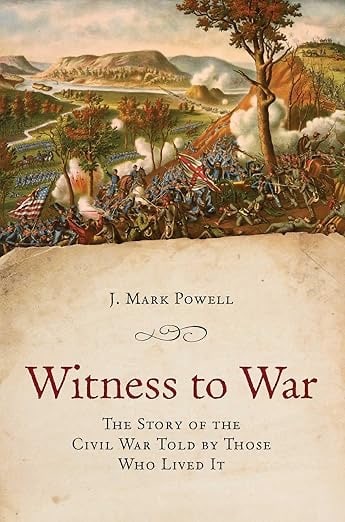
Witness to War: The Story of the Civil War Told by Those Who Lived It. By J. Mark Powell. Essex, CT: Stackpole Books, 2026. Paperback, 458 pp. $24.95.
Reviewed by Nate Brother
When seeking to understand a historic event, the most important tools are the words of those who witnessed, participated, and reckoned with it. This is the perspective taken by J. Mark Powell in his newest book, Witness to War: The Story of the Civil War Told by Those Who Lived It. The book is a curated collection of 432 previously unpublished letters from “witnesses” of the Civil War assembled into a comprehensive history of the conflict. These 432 voices join together to highlight the nuances and contradictions that defined the Civil War experience.
The most popular primary source accounts of the Civil War often come from the postwar memoirs of prominent generals or politicians such as The Personal Memoirs of U.S. Grant and Edward Porter Alexander’s Military Memoirs of a Confederate. There are a few commonly cited accounts created during the war by soldiers or civilians, such as Mary Boykin Chestnut’s diary, that have been used ad nauseum by Civil War histories over the past few decades. While other voices still exist in published and unpublished forms, they are scattered across compendiums and collections.
In contrast, Witness to War is the product of over three decades of research and compilation by Powell, who recounts having read more than 20,000 letters during his study. The end result is over five hundred new letters from 432 witnesses constituting the first full history of the war told through period letters. As Powell explains, “It isn’t just a ‘bunch of Civil War letters.’ Rather, it is a grouping specifically curated with the intention of telling the war’s story in its entirety through original correspondence.” (x)
The book is divided into five primary chapters, each representing the war years from 1861 to 1865. Aside from brief contextual notes by Powell introducing the witnesses and the event or aspect of the war they were reacting to, the bulk of the book is excerpts from the letters. This relative lack of context makes the collection best suited for audiences with at least some knowledge of the Civil War. For that audience, Powell’s goal of opening “a unique window into the period, allowing us to view the conflict as they did while it was actually happening” is accomplished. (viii)
One underexplored aspect of the Civil War that is laid bare in this collection of accounts is the widespread misinformation and confusion among soldiers and civilians alike. In studying the war now, with the whole story available to us, it is easy to lose sight of the uncertainties and fluctuating hopes that governed the lives of Americans in the Civil War Era. Troops in different theaters were often misinformed of the events of the wider war, with Richmond’s capture being falsely reported multiple times in the west before April 1865.
Another example is a letter by Lawrence B. Worth, a corporal in the 7th Iowa. Worth’s letter summarized the Battle of Shiloh while erroneously reporting that Confederate general Braxton Bragg had been killed. The letter also includes a surprising critique of Ulysses S. Grant, with Worth concluding that “[Grant] is not fit for a military man.” (91-92) This assessment, while just the opinion of one soldier, challenges beliefs that Grant was unanimously beloved by his troops during his victories in the West. Another example from the Confederate perspective comes from Robert Hancock Wood, who in September 1861 worried that the Confederate invasion of neutral Kentucky amounted to “abandoning our principle of self defense.” (51) It is letters like these that remind us that groups in the Civil War, whether they be soldiers or civilians, were not monoliths. Individuals often held differing beliefs than what has been attributed to their groups in historic hindsight. In the privacy of personal letters, the witnesses expressed surprising opinions on people like Grant and Abraham Lincoln, and topics such as grand strategies and emancipation.
One relative gap that exists within the collection of letters are the perspectives of Black Americans. There are a few USCT letters included later in the book, including a remarkable letter by Luther Lee Parks written less than an hour before his death, and the book closes with a letter from a formerly enslaved woman. However, these accounts are drastically outnumbered by white soldiers and civilians, likely due to a dearth of sources. Key events like the Emancipation Proclamation and the Battle of Fort Wagner are only explored through white perspectives.
Regardless, Witness to War is a well-crafted collection and is the result of a monumental research and compilation effort. Powell’s witness-driven narrative provides new perspectives for those interested in the full Civil War Era, and is a format that has the potential to be used in future works on other historic topics, both in the Civil War Era and beyond.
Nate Brother is a graduate student studying Civil War history at Virginia Tech. Originally from Kentucky, Nate’s primary research interest are Civil War memory and the development of Civil War historic sites.


What a fascinating and unique approach and a treasure trove for any historian. One thing that concerns me though in this review is the line “excerpts from the letters”. Can you say more about that? Does the author explain what he chose to include and what he didn’t? The value of primary sources is somewhat compromised when they are incomplete.