John Wilkes Booth’s Nephew, Edwin Booth Clarke: The Ghost Child, 1861-1881
ECW welcomes back guest author Lisa G. Samia.
For many years, the story of the short life and death of John Wilkes Booth’s nephew, Edwin Booth Clarke, was only a passing note in the history of the Booth family. So little is known about him. He joined the British Merchant Navy and accidentally drowned at sea on December 10, 1881. Nothing more.
However, this short epitaph on Edwin Booth Clarke sent me in search of more information. It was because of my research and writing on the life of his mother, Asia Booth Clarke, and the lack of any information beyond the brief notice of his untimely death, that I believe I uncovered some information that might not be widely known. While my research continues to determine exactly what happened to this young man, my description of Edwin Booth Clarke remains, in my opinion, The Ghost Child.
John Wilkes Booth was close to his older sister, Asia, their relationship forged during their teenage years and continuing into their early adulthood. It extended to when Asia was married, and John would stop by her home in Philadelphia to visit her and her children whenever his travels allowed.
There is a truly poignant moment that Asia writes in her memoir of her brother John, after the assassination, “All written or printed material found in our possession, everything that bore his name was given up, even the little picture of himself, hung over my babies’ beds in the nursery. (He had placed it there himself, saying, ‘Remember me, babies, in your prayers.’)”[1] One of those babies was Edwin Booth Clarke.
He was the first son born to John Sleeper Clarke and Asia Booth Clarke in Philadelphia, Pennsylvania, on March 8, 1861. Edwin had one older sibling at the time of his birth: his sister Asia, born in 1860.
The first mention of Edwin Booth Clarke appears in a letter from Asia Booth Clarke to her lifelong friend Jean Anderson. Asia wrote to Jean on March 3, 1863, from her home in Philadelphia, “John [Wilkes] Booth laughs outrageously at me for having babies – he can’t realize it- he says to think that our Asia should be a mother.”[2] While Edwin and his sister Asia are not named specifically, these two children were residing in the Clarke household in March 1863.
In 1868, Asia and her family left the United States to reside in England. The reason for this self-imposed exodus, while not specified by Asia, was twofold: first, that her husband John Sleeper Clarke had secured a place for himself in England’s acting and theater management world. Secondly, it gave her a reason to leave the United States because of the lingering horror of her brother John’s crime.
According to Asia, this move would be only for a few years. Little did she know that the last sight of the shoreline of the United States on March 18, 1868, aboard the ship Russia that sailed for Liverpool, England, would be her last.[3] Asia wrote to her friend Jean Anderson in February 1868, as she prepared to leave the United States, about her son Edwin, “Eddie is so good and gentle he says and such a comfort to him, [John] but I would most gladly deprive him of the comfort and have my boy with me. I most reluctantly let him go with his father, expecting though that he would bring him back in two months. This is now the six months since they left home.”[4]
And in a letter dated in March 1868 after she arrived in London, she wrote, “I found Eddy able to speak German fluently, so have enjoyed [surely employed} a little German girl a waitress.”[5]
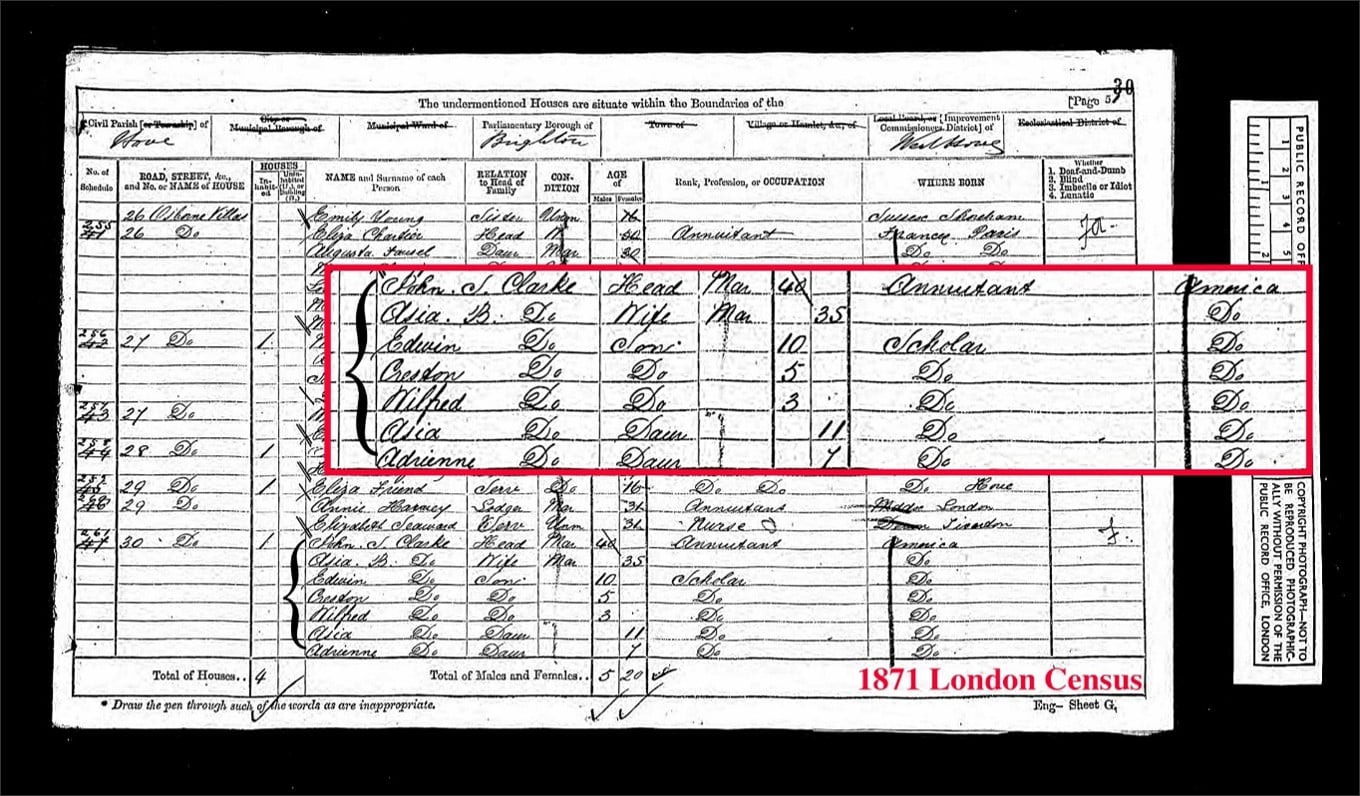
Next, we find him on the 1871 London census; he appears at 26 Osborn Villas, Hove, Brighton, England, with his father John, mother Asia, sisters Asia and Adrienne, and brothers Creston and Wilfred. In 1871, Edwin is ten years old and listed as a scholar on the census.[6]
Little further information was available until 1878 from a news article from the Daily Memphis Avalanche, indicating that he had received an appointment as a midshipman at the United States Naval Academy.[7]
However, further research does not quite agree with this information. From the United States Naval Academy, “In response to your inquiry regarding Edwin Booth Clarke, the only information I could find on him in the Naval Academy archives is in one of the registrar’s rolls, where it indicates that he was ‘permitted’ on July 6, 1878 for a cadet engineer and did not report. The annual register for 1878-1879 provides information on cadet engineers (at this time, those attending the academy were divided into cadet midshipmen and cadet engineers). I assume that the line in the registrar’s record means that he received permission in July to report for the entrance examination to be held on September 15, and that he did not appear.” [8]
It is unclear why Edwin did not show up to take the exam. There is no documentation to support his reasoning or why he ended up in England to enlist in the British Merchant Navy sometime in 1878.
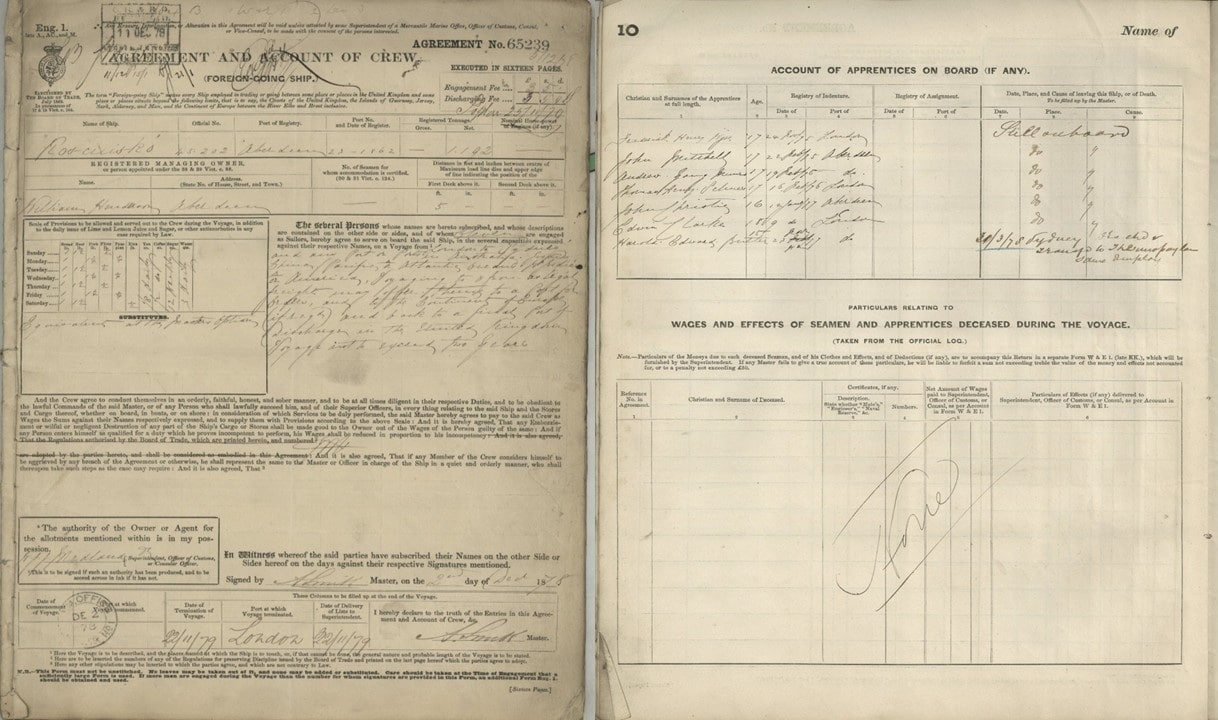
The Archives of Memorial University of Newfoundland, St. John’s, Canada, lists him as an apprentice aboard the ship Kosciusko on the London to Sydney route from 1878-1881.
There is also very little correspondence regarding Edwin Booth Clarke and his time at sea; only one line was found in a letter from Asia to her brother Edwin. On February 2, 1880, Asia wrote to him, “I had a few lines from Rose [Asia’s older sister], telling me of Ted’s ship being at Melbourne – only 2 days previously we had the same news from a young friend here who is in the shipping office.” [9]
Because we can trace Edwin’s movements at least partially through his time aboard Kosciusko in 1881, there are still unanswered questions about what happened to him in December 1881.
New Zealand newspapers revealed that on June 7, 1881, Edwin Clarke was shipwrecked aboard the Hannah while on a mission to Mutton Bird Island in New Zealand.[10] He was rescued from the island the next day and taken to Wellington Hospital in New Zealand, to recover from his injuries.[11]
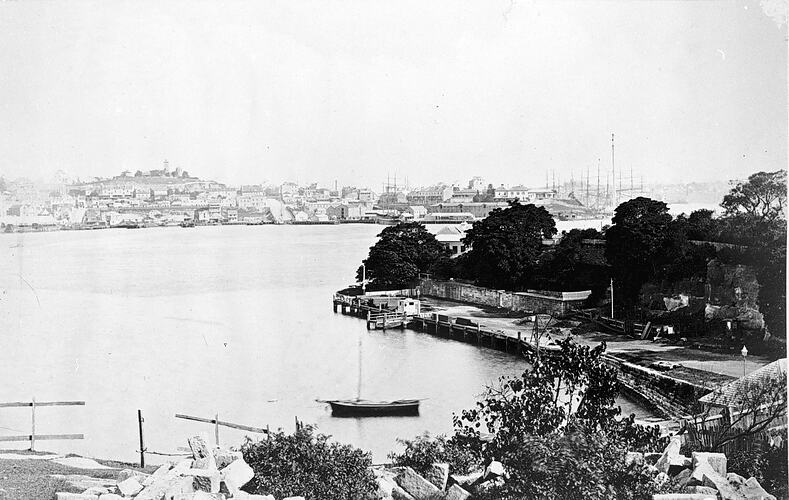
Further documentation provided from the National Archives of New Zealand indicates that Edwin had his transportation paid by the government from Wellington to Sydney aboard HMS Wolverine. As a member of the British Merchant Marine, his payment for transportation aboard a warship to Sydney, where he was in port on many occasions, would be appropriate in most cases.
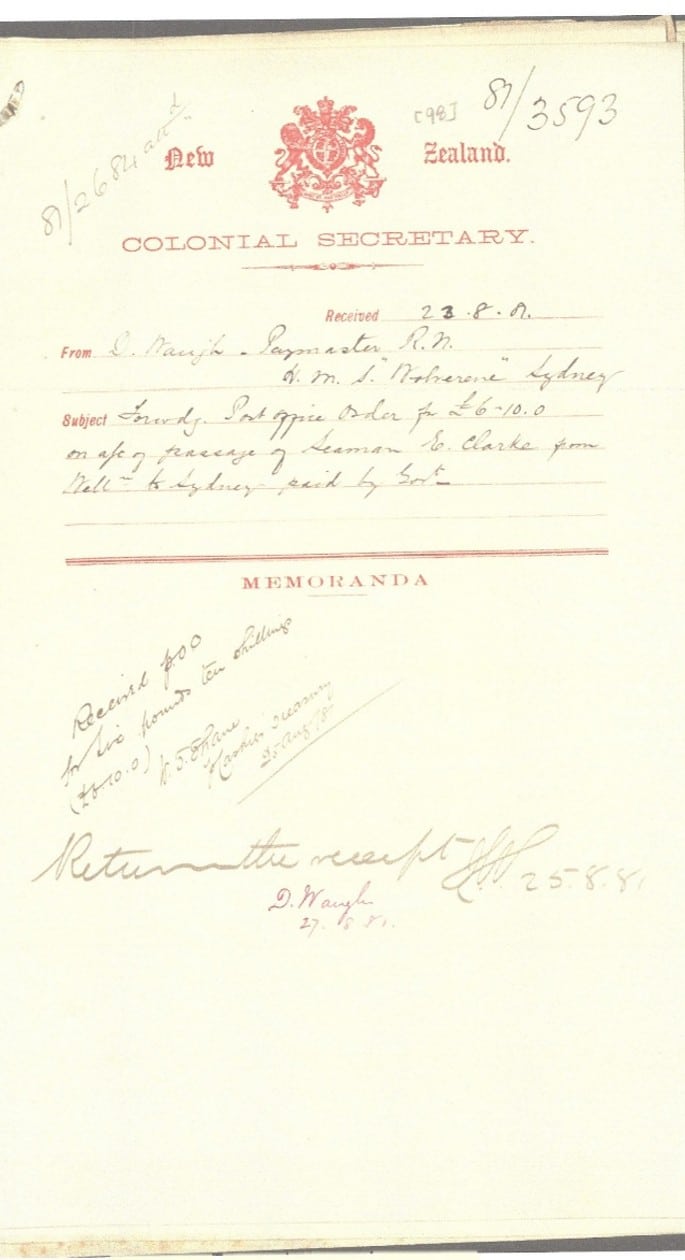
The colonial secretary’s office in New Zealand has official documentation of his transport, dated August 23, 1881. This was the last documented acknowledgment of Edwin.
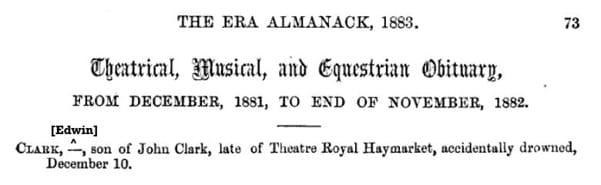
A notice in The Era Almanack, a theatrical publication in London, in 1883 announced young Edwin Booth Clarke lost his life by accidental drowning at sea on December 10, 1881.
There is no official record of Edwin for sailors lost at sea. Research with the General Register Office, Certificate Production for the United Kingdom, for a death certificate shows no record of his death. Research within the crew lists of a seaman lost at sea in the United Kingdom has no record of his death. Nor do Newfoundland, New Zealand, or Australia, for that matter.
There is no stone in a cemetery anywhere to be found to mark the end of this young life. Asia is silent on this event, and there is no mention of this tragedy in any family letters. Her favorite child drowned at sea at the tender age of twenty, no body to claim, and no gravesite to visit.
Perhaps the lingering question about the mysterious death of Edwin Booth Clarke is simply that he just fell overboard. Yet, why is there no documentation of the death by the Merchant Navy or the Royal Navy that went through great pains to move him from Wellington Hospital in New Zealand back to Sydney, Australia? There are many, many lists of sailors lost at sea, but Edwin’s name is nowhere to be found. Accidental drowning without documentation is a broad term for a cause of death that, to this day, still feels incomplete.
Edwin was Asia Booth Clarke’s son; he died at age twenty, with only a vague notice in history. And because of that, until such time as a definite document is revealed, Edwin Booth Clarke remains the Ghost Child.
Lisa G. Samia is an award-winning poet and author. She was selected as the National Parks Artist in Residence for Stones River, Murfreesboro, Tennessee, in 2025, and the National Parks Service Artist in Residence for Manassas National Battlefield Park in 2021, and the National Park Service Artist in Residence for Gettysburg National Battlefield Park in 2020, all for poetry.
Endnotes:
[1] Asia Booth Clarke, The Unlocked Book a Memoir of John Wilkes Booth by His Sister Asia Booth Clarke (New York: G.P. Putnam’s Sons, 1938), 110.
[2] Clarke to Anderson, March 3, 1863, BCLM Works on Paper, Legal, Maryland Historical Society, Baltimore MD.
[3] New York Times, March 19, 1868.
[4] Clarke to Anderson, February, 1868, BCLM Works on Paper, Legal, Maryland Historical Society, Baltimore MD.
[5] Clarke to Anderson, March 12, 1868, BCLM Works on Paper, Legal, Maryland Historical Society, Baltimore MD.
[6] 1871 London Census.
[7] The Daily Memphis Avalanche, Memphis, Tennessee · Sunday, April 14, 1878.
[8] Communication with Jennifer A. Bryan, Ph.D Head of Special Collections & Archives, Nimitz Library U.S. Naval Academy, August 6, 2024.
[9] Clarke to Edwin Booth, February 2, 1880, the Players Club, New York.
[10] Waikato Times, Waikato, New Zealand, 7 June 1881.
[11] Waikato Times, Waikato, New Zealand, 8 June 1881.


Well written and well done!
Thank you!
There is very little more challenging than the type of international research you have done here. It requires not only the lucky survival and availability of records, but also the good will of distant librarians and archivists.
This result is very impressive.
Thank you.
Heavily researched and very much enjoyed the backstory to the Booth family. It adds much to the context surrounding the Lincoln assassination and the impact it had on John Wilkes Booth’s family. Another layer to an already fascinating story in American history. Well done.
The “Ghost Child” title fits perfectly. Such an interesting piece of history that almost got lost forever.
Wow, I had no idea Asia Booth Clarke even had a son who joined the British Merchant Navy. The mystery around his death is wild.
Fascinating research and wonderfully written!
This is such a heartbreaking story. So sad that he was lost with no real answers or even a grave.
Well written article! Lisa has uncovered a lot of new history about Asia Booth Clarke and her family. She tells the story well. I can’t wait till her book about Asia comes out!!
One may reasonably ask: “What relevance does a child born during the American Secession Crisis have to the conduct of the Civil War?” When that child is a member of the Booth Family – the closest Americans came to Showbiz Royalty during the mid-1800s… as well as nephew to one of America’s infamous assassins, responsible for significant disruption to “what might have been” the post-war programme envisioned by the long-suffering Leader of the North… so close to Complete Victory, yet just beyond his firm grasp…
To this day John Wilkes Booth remains an enigma: Was the assassination of President Lincoln a plot of Booth’s own making? Or did he have authorization from someone near the top of the Confederate Government? Did the Catholic Church have a role in Lincoln’s assassination? Did Booth somehow act “on behalf” of Secretary of War Edwin Stanton?
The extended Booth family was divided in its loyalty: John Wilkes, Junius Jr., and Asia are known to have favoured the Southern Cause; Edwin (born 1833) is known to have favoured the North. Edwin “Ghost Child,” living in England cut off from direct contact with family in America would have been subjected to Asia’s recollections of her brother, John Wilkes; and John Wilkes not only left important papers with Asia; he confided in her. Did Asia ever pass significant information gleaned from her Assassin Brother… to anyone else?
I highly doubt either the Catholic Church or Edwin Stanton had a role in Lincoln’s assassination …
Thanks for the article! I’m sure there is more to Edwin’s story! I’ll let you know after I did a little bit! Sorry but there isn’t any evidence that the Catholic Church or Stanton had anything to do with Lincoln assassination! The only connection to the Catholic Church is the Papal in Rome had John Surratt as a Vatican guard before he was discovered and brought back to the US for trial!