Book Review: A Little Piece of Hell at Gettysburg: The Attack and Defense of the Rose Farm, July 2-3, 1863

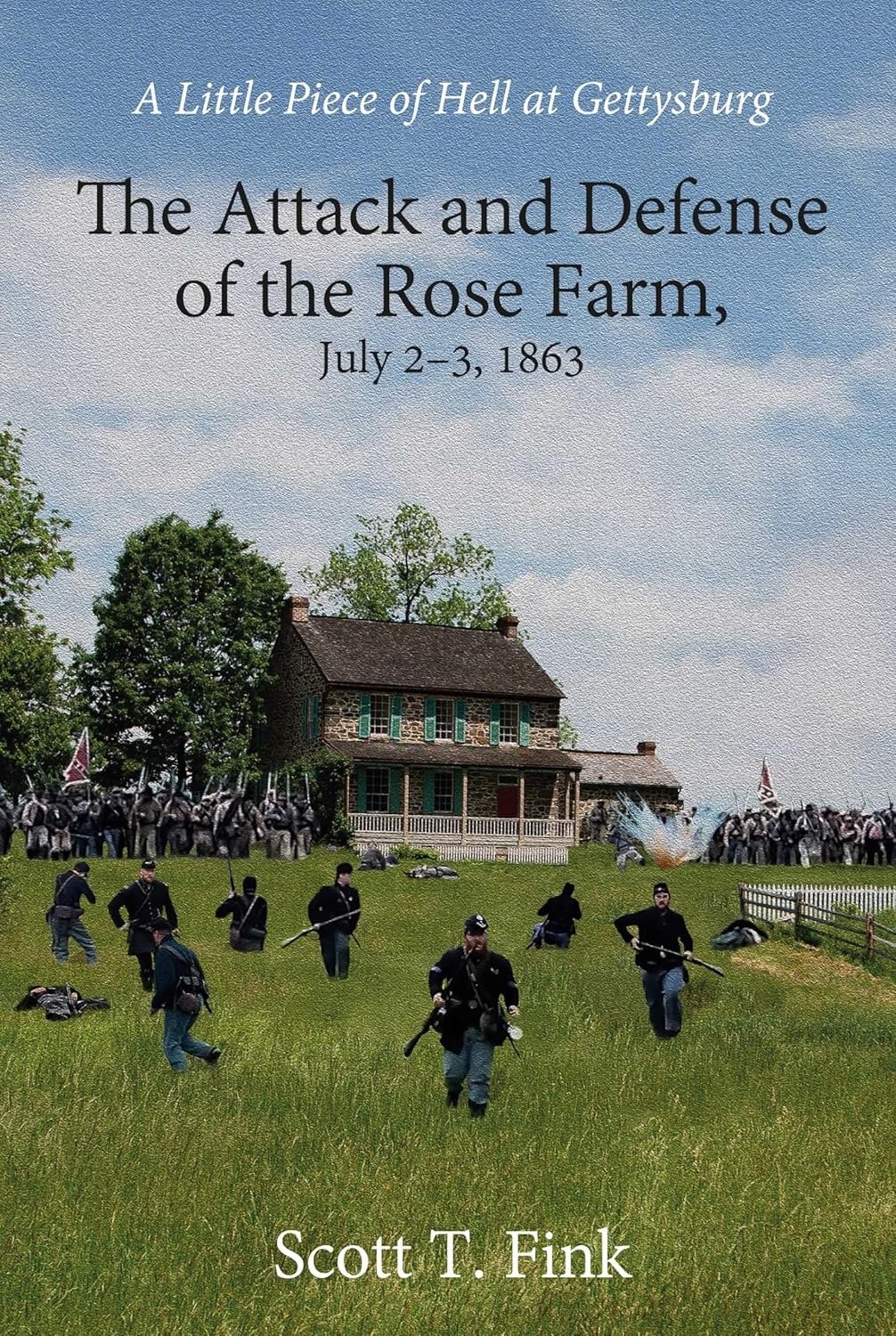
A Little Piece of Hell at Gettysburg: The Attack and Defense of the Rose Farm, July 2-3, 1863. By Scott T. Fink. El Dorado Hills, CA: Savas Beatie, 2026. Hardcover, 364 pp. $34.95.
Reviewed by Codie Eash
For those diving into a Gettysburg book that discusses the Wheatfield and its environs who have even the slightest prior knowledge, they would doubtless agree that rarely can a book’s topic be summarized by a single line as effectively as one describing how “quite a bit of confusion ensued.” (62) But such was, indeed, the case for Scott T. Fink’s subject in the fresh installment A Little Piece of Hell at Gettysburg: The Attack and Defense of the Rose Farm, July 2-3, 1863. Contrary to the confusion, though, Fink aids his readers in establishing some sense of this Civil War site’s perplexing nature.
Several influential studies have shed light on what Fink has called “the bloodiest farm in American history” (xi), including William Frassanito’s Gettysburg: A Journey in Time (Thomas Publications, 1975), Harry Pfanz’s Gettysburg—The Second Day (University of North Carolina Press, 1987), and James Hessler’s Sickles at Gettysburg (Savas Beatie, 2009). Each tackled aspects of the ravaged property, including photography, tactical significance, and divisive personalities. In this addition to the historiography, Fink provides a community history of the farm, a military study built on his own Army and National Guard experience, and a harrowing portrayal of post-battle life.
Fink supplies ample context and demonstrates an expert grasp on hundreds of sources, including dozens of unpublished accounts stemming from distinct archives across several states. Notably, this is not a volume for novices, as tactical details assume readers have a solid baseline understanding of intricate elements. Nevertheless, Fink encapsulates a history of high-ranking officers, but also enlisted men, noncommissioned officers, and color bearers; famous battlefield landmarks, but also underrecognized locales and nameless features that played obvious roles; and soldiers, but also noteworthy Adams County families, with the farm itself becoming a character in the story.
Fink explores controversies involving prominent players, but also lesser-known frictions about Rose Farm tenants, command decisions, and mysteries surrounding several officers’ deaths. Likewise, he acknowledges mythologies and “narratives of faulty memory.” (142) Fink’s writing provides some clarity, as does the style of the book, including descriptive bottom-of-page footnotes, cartographer Edward Alexander’s maps, bountiful images, and references to modern landmarks like monuments and National Park Service avenues to orient readers (all common for publisher Savas Beatie).
Fink’s writing is gripping. In one passage he describes, “Dark figures splashed with golden flecks of waning sunlight filtered through the trees, steadily closing the gap as the Union men to their front braced themselves for yet another onslaught.” (135) When the shooting started thereafter, Fink expressively writes, “The hapless men were like chum in shark infested waters and something like a feeding frenzy began.” (172)
Among Fink’s most effectively written passages are haunting dawn scenes, as wounded soldiers screamed, unscathed comrades searched, survivors buried the dead, and stray shots streaked overhead. Afterward, Fink reminds readers (perhaps informing some for the first time) that action on the southern end of the Gettysburg battlefield did not cease with the culmination of the second day’s fighting. Rather, attacks and defenses of the Rose Farm and its vicinity consumed the evening of July 3rd, as well, in the hours following Pickett’s Charge.
Fink’s battle coverage concludes with 100 pages remaining, appropriately leaving room to cover its aftermath on the farm. He explores burial details, uninterred corpses, Alexander Gardner’s famed battlefield photographs, damage claims, and other macabre (but essential) realities that soldiers and civilians faced together. One could argue that interpretation of these matters and their legacies remains even more significant than the tactical study of the battle itself.
Fink’s storytelling and analytical skills particularly shine in these last chapters, drawing on the work of past scholars. He has produced an updated examination of the property’s period photographs, alongside features on many of the fallen soldiers pictured therein. Additionally, he dedicates two full chapters to the story of the locating, gathering, and reinterring hundreds of graves, analyzing farmers’ and families’ struggles for several years after the battle.
The book’s final chapter details the long, complicated history of the Rose Farm up to the present. Fink laments that today, “visitors rarely visit this location on the battlefield. Even on busy days, you rarely see a visitor traversing the property.” (335)
Underrecognized though it may be on America’s most famous battlefield, Fink has made a strong case that the Rose Farm is among the nation’s most significant rural landscapes on any historic fighting ground—and thanks to his impressively researched, sharply written, and tensely stirring volume, Gettysburg aficionados now have a new tool to build their appreciation, sharpen their understanding, and create some semblance of understanding out of chaos and confusion.
Codie Eash serves as Director of Education and Interpretation at Seminary Ridge Museum and Education Center in Gettysburg, Pennsylvania, where he has been part of the staff since 2012. Having earned his undergraduate degree in Communication/Journalism at Shippensburg University of Pennsylvania in 2014, as of 2024 he is pursuing a Master’s in American History at Gettysburg College through The Gilder Lehrman Institute of American History.


This sounds like a very interesting, well-written micro history, but woo boy, that cover design needs some work …
Excellent review! Looks like I’m adding this one to the library.
This review makes me want to get the book. It sounds like everything a reader would want to know about the Rose Farm!
Loved this book.
Codie Eash, thank you for the review of my book. I think you covered everything incredibly well.
Great review Codie. This book reminds us how the Rose farm property, as well as the owners, tenants, and soldiers were impacted by so many different engagements during the battle of Gettysburg. I look forward to reading it!
I really enjoyed Fink’s book, and learned a great deal.