The Ulster Guard and New York’s Mobilization
ECW welcomes back guest author Leon Reed.
The 20th New York State Militia (NYSM) was one of the longest serving New York militia regiments, tracing its legacy back to service under the Dutch in 1660.[1] In 1860, its commanding officer was Col. George W. Pratt, a former state senator.
The 20th was one of the first militia regiments to commence preparations for the upcoming civil war. On January 7, 1861, as it was becoming evident that multiple southern states would join South Carolina in the next few days, Pratt hosted a meeting of his officers, where he stated his opinion that war was inevitable and that he would participate, preferably as head of the 20th militia. He also predicted that the government would be forced to rely initially on the militia and observed that the 20th could quickly be made ready for action. At 4 a.m. on January 8, the officers authorized Colonel Pratt to offer the regiment’s services in the event of a conflict.[2]
In his regimental history, Col. Theodore Gates, later commander of the 20th, reported that, “From this time the work of preparation went quietly forward and by judicious recruiting the companies had been considerably strengthened by the beginning of April. Company drills were frequent, and the regiment had perceptibly improved in numbers and efficiency.”
Early morning Sunday April 28, 1861, the regiment gathered on Academy Green in Kingston, attended religious services, received a Bible from the local Bible society, and took the oath of loyalty. They then boarded a steamer and proceeded down the Hudson River to New York City to await further orders. It quickly became evident that there were no such orders. “It was found that no provision had been made for sending the regiment forward, and it soon became apparent that trouble was brewing for the 20th at the Adjutant-General’s office in Albany.”[3]
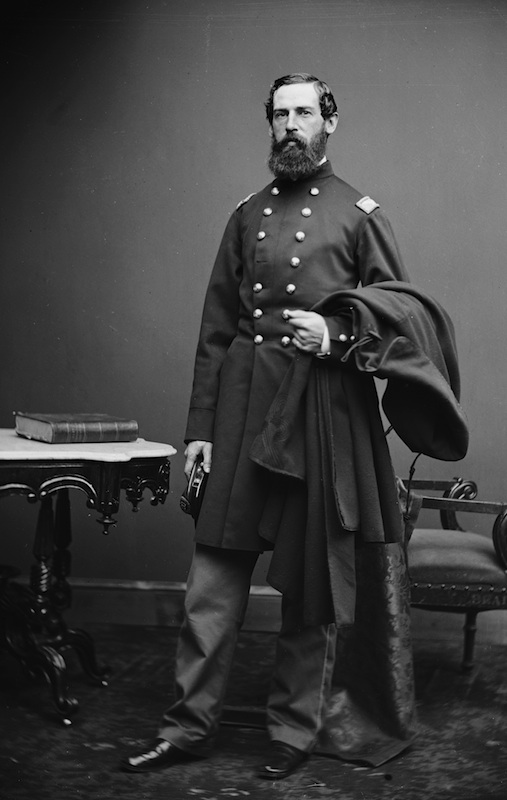
The Ulster Guard inadvertently got caught up in a growing tug of war between the Union Defense Committee (UDC), a private group of business leaders, which saw its job as organizing regiments, and the governor, who had to approve their acceptance into state service. The emphasis increasingly was shifting to two-year volunteers.
Major Gates traveled to Albany on April 30 to plead the regiment’s case. Governor Morgan agreed to accept the 20th into state service, but then reversed his decision on May 3 and ordered them to return home, stating,
“The prompt obedience of orders by the organized regiments of the State militia, and the alacrity of the volunteers, fully meeting the wants of the National Executive …, no more regiments of such organizations can be received into service at this time. Accordingly, the Twentieth Regiment, commanded by Colonel Pratt, now in New York City en route to Washington, is hereby relieved from that duty, and it will be ordered to repair to Kingston, in Ulster County, whence the several companies will return to their respective districts.”[4]
An article reprinted in the Rebellion Record stated that, “This order caused great consternation among the rank and file. They had enlisted in the hope of being engaged in the impending conflict and expected to see actual service. Many of them had given up lucrative positions, left homes and families for the purpose of manifesting their patriotism for their country.”[5]
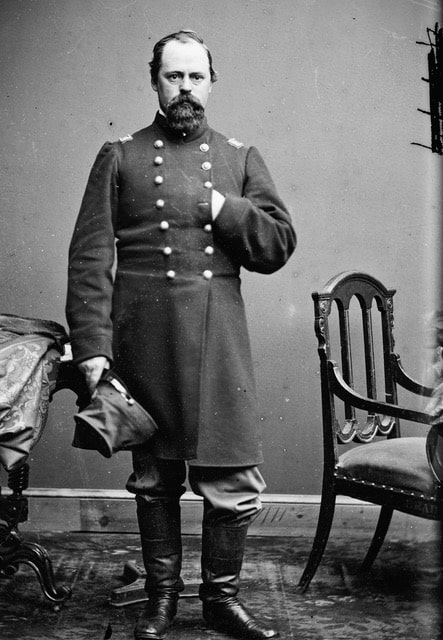
But Governor Morgan had tangled with the wrong regimental commander. Pratt was also a man who could get the attention of important men and who had favors he could call in. As Gates said in his unit history, “The corps had made many friends during its sojourn in New York.” The next day, Pratt appealed to the UDC, which after hearing him out sent a message to the governor urging him to accept the Ulster Guard.[6] Realizing that sending the Ulster Guard home might discourage further recruiting efforts, Morgan finally on May 6 telegraphed his authorization for the 20th to proceed.[7]
“When this news was imparted to the troops, a scene of genuine enthusiasm ensued; cheer upon cheer rang upon the air: the President, the Governor, General Scott, Colonel Pratt, and in fact every name the troops could think of, was wildly cheered.”[8]
The 20th became the first regiment not from either New York City or Brooklyn to leave for the front lines. Upon arriving in Annapolis, they found the 13th NYSM in command of the post; the 6th New York across the Severn; and the 5th New York Volunteers guarding the branch railroad connecting Annapolis to the main line to the capital. After a few days, the 20th was ordered to march to the junction and relieve the 5th New York.[9] Now the security of the vital rail connection – the main route for reinforcements to the capital – was the Ulster Guard’s responsibility.
After a month of duty at Annapolis Junction, now Lt. Col. Gates traveled to Washington on June 24 to request the regiment’s transfer to Virginia. As he said in the regimental history, “It was getting to be very dull and monotonous at the Junction, and we were anxious to leave.”[10] But Gen. Winfield Scott refused, arguing that they were performing important work and that any regiment assigned in their place wouldn’t do the job as well.
But five days later, the regiment received orders from Gen. Nathaniel Banks, commanding in Baltimore, to proceed to that city. Apparently, with the start of combat imminent in northern Virginia, authorities wanted to beef up their forces in Baltimore to deal with any renewed unrest.
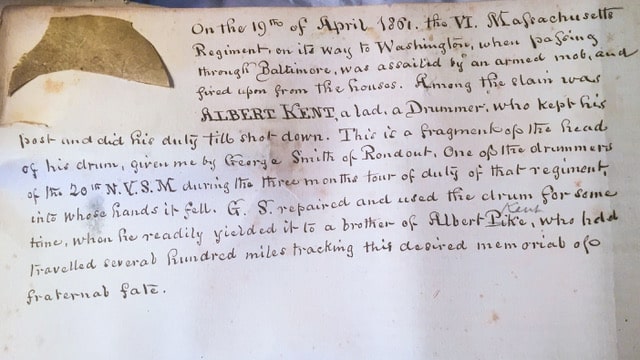
One of the 20th’s main duties was conducting periodic searches for concealed arms. On one occasion they found a drum that belonged to the 6th Massachusetts, taken during the April 19 riots.
When the regiment’s three-month term expired, the soldiers, though most ultimately re-enlisted, were eager to get home for their promised furlough. But the disaster at Bull Run provoked fears of renewed trouble in Baltimore, so the members of the 20th were told they would be staying around a bit longer. Colonel Pratt assembled the men to convince them to stay. Not receiving an entirely favorable reaction, one of his captains suggested the men go with their companies where perhaps they could receive a more intimate message. Gates reported that this officer assembled his men and gave a rousing patriotic speech about the risk the country was facing, the need for their continuing service, etc., and then put it in easy-to-understand terms: “If there are any men here who are in favor of going home before this emergency is over, let them step three paces to the front, and I warn you to be careful in doing so, lest your comrades shoot or bayonet you.”[11]
Gates reported that, with that clear explanation from their company commander, “by a unanimous and enthusiastic vote,” that company agreed to stay.
According to the history of the regiment, the leading Baltimore paper gave the regiment high marks for its time in Baltimore: “While in this city the regiment has under the strict discipline maintained by the officers, attained an enviable reputation, there being no such cases of interference on their part with citizens or their property as unfortunately has been exhibited by those belonging to other regiments about the city. The officers … have made a very favorable impression. Not only on those who are loyal to the Government, but also on those who are more favorable to the Confederate cause, by reason of their scrupulous desire not to interfere with private rights.”[12]
The regiment also was gratified when “the ladies of East Baltimore” presented the regiment “a beautiful silk national flag.”
The 90-day regiment’s last duty consisted of a detachment of three companies who were assigned to escort Marshal Kane, the police commissioners, “and a number of other Baltimore rebels,” who had been arrested by Banks. This detachment joined the rest of the regiment in New York City, and they made their way back to Kingston. On their arrival, they were met by an enthusiastic crowd of family and friends as well as the local fire departments and various militia units. After a short break, almost every member re-enlisted in the new 80th New York Volunteers.
Leon Reed the author of four books on Gettysburg monuments, No Greater Calamity for the Country: North-South Conflict, the Secession Crisis, and the Onset of Civil War, and co-author of the forthcoming On Fames Immortal Scroll: Alabama Troops at Gettysburg. He lives in Gettysburg.
Endnotes:
[1] Colonel Frederick P. Todd, “State Regiments Were Varied, Colorful Lot,” New York and the Civil War, Vol. 2, No. 9, Albany, New York Civil War Centennial Commission, 1963, p. 14.
[2] Seward Osborne, “The Three-Month Service of the 20th New York State Militia, April 28-August 2, 1861,” Hightstown, Longstreet House, 1998; Theodore Gates, The Ulster Guard (20th NY State Militia) in the War of the Rebellion, New York, Benj. H. Tyrrel, 1879, p. 73.
[3] Gates, Ulster Guard, p. 79.
[4] Quoted in Gates, Ulster Guard, p. 80.
[5] “Departure of the 20th Regiment of Ulster County, NY, May 7, 1861,” in Moore, The Rebellion Record, vol. 1, p. Doc. 198.
[6] Stevens, The Union Defense Committee of New York: Minutes, Reports …, p. 71.
[7] Osborne, Three Month Service, p. 15.
[8] “Departure of the 20th Regiment” in The Rebellion Record, p. Doc. 198.
[9] Gates, Ulster Guard, pp. 86-90.
[10] Ibid., p. 95.
[11] Gates, p. 107.
[12] Baltimore American, quoted in Gates, Ulster Guard, p. 107.


I loved Mr. Reed’s colorful report on the Ulster Guard and the mobilization of New York militia troops at the start of the war. Thank you. One small correction: The 20th wasn’t the first New York regiment to deploy to the theater of war. The 25th New York, from Albany, left New York City on April 25 on the steamer Parkersburgh, and arrived in Annapolis the next day.
I only know this from the research in my own book, Twelve Days, published by Potomac Books in 2023.
https://www.amazon.com/Twelve-Days-Union-Nearly-Washington/dp/1640125485/ref=asc_df_1640125485/?tag=hyprod-20&linkCode=df0&hvadid=631955730387&hvpos=&hvnetw=g&hvrand=9108490007615286372&hvpone=&hvptwo=&hvqmt=&hvdev=c&hvdvcmdl=&hvlocint=&hvlocphy=9003347&hvtargid=pla-1918033103991&psc=1
* Rufus W. Clark, The heroes of Albany A Memorial of the Martyrs of the City and County of Albany who Sacrificed Their Lives During the Late War in Defence of our Nation, 1861-1865, S. R. Gray, Publisher, 1866, Page 195
* Lockwood Doty, Chief of Bureau, Third Annual Report of the Bureau of Military Record, State of New York, February 2nd, 1866, Documents of the Assembly of the State of New York, C. Wendell, Printer, Pages 301-302; New York Herald, April 24th, 1861, Page 6
I meant non Manhattan or Brooklyn. Apologies.
Thanks for your kind comment and your correction. Your “Twelve Days” was outstanding.
Thanks, sir. I appreciate that.