Like Oil and Water: The Civil War Relationship Between Daniel Harvey Hill and John Bankhead Magruder
One colonel was a carping dyspeptic with a sharp tongue, a caustic hater of all things Northern, and an avid critic of whatever displeased him anywhere at all. The other colonel was a flamboyant, irrepressible spirit of restlessness, prone to outrageous behavior, and spurred by heavy drinking. They were like mixing oil and water but they would fight side by side.
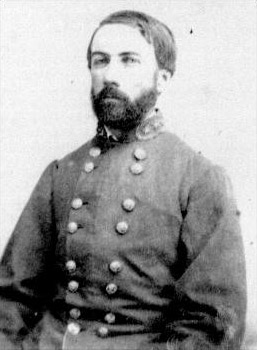
On April 11, 1861, Col. Daniel Harvey Hill and his 1st North Carolina Infantry were transferred by rail and water from Richmond to reinforce the forces at Yorktown. Most thought Yorktown to be “a post of honor and danger.”[1] Upon landing, Hill sent his adjutant to report his regiment’s arrival to Col. John Bankhead Magruder. The Virginia-born Magruder was charged with defending Virginia’s lower Peninsula.
The two colonels had some things in common. They were both graduates from West Point and veterans of the Mexican-American War. They fought together at the Battle of Chapultepec. Both were married.[2]
But their differences were glaring. Magruder, 54-years-old, was a career army officer. Hill, 14 years younger, resigned from the military in 1849. He taught mathematics at Washington College, Davidson College, and North Carolina Military Institute before the outbreak of war.
Hill was a family man devoted to his wife Isabella and their nine children. During the war they frequently corresponded in which he confided his thoughts to her, besides inquiring about his children. When Hill became sick during the Civil War, Isabella traveled to care for him and took him home to help in his recovery. The Hills’ marriage was a happy one.
Magruder married a rich heiress by the name of Esther Henrietta von Kapff and they had three children. Magruder saw his wife and kids infrequently. He would rather fight all day and party all night. His heavy drinking, coupled with the high life style, led to his crumbled marriage. They agreed to live apart except for brief interludes. Esther and the children visited Magruder after the war in Mexico before she moved to Europe with the children. That short meeting was the last time Magruder saw his wife and family before he died.[3]
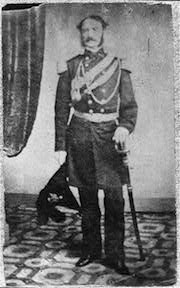
Physically, Hill and Magruder could not have been more different. Hill was unpretentious, low-keyed and slightly built. He stood five feet, ten inches but sometimes seemed shorter as pain from a back injury caused him to stoop over slightly. Magruder was theatrical, ostentatious, and seemingly towered over Hill despite being six feet in height and well formed. Hill was an avid critic of whatever displeased him. Magruder was a bon vivant and obliging host who loved to have a good time. Magruder, known by his contemporaries as “Prince John,” loved the pomp and ceremony of the military. He enjoyed being attired in flashy military regalia. In his full dress uniform he looked “every inch a King.” Anyone standing next to him was drab in comparison. And a king must have his court. As one historian pointed out, “The man [Magruder] wanted five or six aides and dozens of orderlies and never stopped talking,” and acted like the lord of the Peninsula.[4] Hill, in comparison, was non-descript, careless in dress, and wore regulation attire. His staff was small with only one or two aides.
From the first, Hill was put off by Magruder’s expansive personality and popularity. Hill’s personality was a polar-opposite. He was a God-fearing Presbyterian, a “model of a Christian soldier,” with a penchant for being “ceaselessly critical.”[5] While Hill just wanted to do his duty, kill Yankees, and go home to his family, Magruder yearned for rank and fame. Unlike Magruder, who was fond of drink, Hill was “a doctrinaire teetotaler” and was soon writing to his wife Isabella complaining that, “Col[onel] Magruder in command is always Drunk [sic] and giving foolish and absurd orders. I think that in a few days, the men will refuse to obey any orders issued by him.”[6]
At Yorktown, Magruder’s forces numbered 5,000 men compared to the 15,000 Gen. Benjamin Butler had at Fort Monroe. Magruder’s biographer explained that the overwhelming Federal force, which could attack at any time, so stressed the high-strung colonel that “he fell back on the only available palliative,” alcohol, to deal with the stress.[7]
With their differences, the question was whether Magruder and Hill could work together on the Peninsula. Without outward displays of jealousy, Hill began to question Magruder’s rank and fitness for command.
Hill was a proud man who had a high opinion of himself and his abilities. In Hill’s view, Magruder’s defenses were weak and he misused his forces. Hill complained that Magruder was wasting the use of his cavalry. By scattering the poorly disciplined horsemen and using them as orderlies, he was not effectively screening his forces and gathering intelligence on the enemy. Hill also thought that Magruder was not utilizing the best talents of his officers. Hill had no qualms about recommending to Magruder that he promote Lt. John Bell Hood as his cavalry commander. Magruder had previously assigned Hood to an artillery battery. Hill pointed out Hood’s experience as a cavalry officer in the antebellum army. Listening to Hill’s advice, but without authorization from Richmond, Magruder promoted Hood to major commanding his cavalry. Soon the cavalry was effectively picketing and gathering intelligence. This just reinforced Hill’s opinion that Magruder lacked the ability to perceive the quality of leadership in others that Hill was able to recognized.[8]
What rankled Hill the most was that Magruder outranked him. In fact, Hill did not believe that Magruder truly did outrank him. While Magruder outranked Hill in the pre-war army, the date of their commissions as colonels was only one day apart. Hill thought his North Carolina commission predated Magruder’s Virginia commission by a day. He questioned why the authorities in Richmond put him beneath a man who, in his mind, was not equal in either rank or ability. Magruder sensed Hill’s disdain and wrote the War Department in Richmond about the tiff: “There is some difference of opinion here as to the rank of Colonel Hill, of the North Carolina regiment, and myself. I think I rank him, but am of the impression that it is a subject of some feeling on his part. He has, however, obeyed my orders so far, and presume will continue to do so.”[9] As a result, Magruder gave Hill a wide berth and put him in charge whenever he was away inspecting his lines or at dinner parties in the neighborhood, which was often.[10]
From Yorktown, Magruder delegated Hill and his regiment to occupy Big Bethel, Virginia near Fort Monroe. This created space between the two men, yet seemed to almost dangle Hill’s regiment as bait to Gen. Butler’s forces at Fort Monroe. Once there, Hill’s men were busy constructing fortifications and patrolling the area.
Butler decided to send a force to attack Big Bethel. Hill sent word to Magruder of increased Federal activity and on Saturday, June 8, 1861 Magruder arrived personally with reinforcements. Scouts kept the colonels informed of the Yankee advance, and on June 10, the bluecoats appeared before their works and attacked. Magruder relied on Hill to manage most of the battle. The Confederates successfully repulsed each attack at various points along the Confederate entrenchments. Hill expertly shuffled his men where they were needed the most. Taking casualties and unable to dislodge the Confederates after 4 hours, the Yankees broke off the action and were soon retreating back to the safety of Fort Monroe.[11]
This victory was one of the first for the Confederacy and it proved that, despite their differences, the two colonels worked together quite well in battle. That night, despite this success, Magruder ordered a withdrawal to Yorktown. Hill was astonished and mortified by the retreat.[12]
As news of the victory spread, both colonels were praised. Magruder received a message of congratulations from Confederate President Jefferson Davis and his military advisor Robert E. Lee. Hill garnered praise as well. One newspaper reported, “Colonel Hill deserves all the honor that can be heaped upon a noble soldier. His experience, as well as bravery, placing him in the foreground of command.” Magruder, in his report of the battle, heaped praise on everyone. He mentioned Hill saying that “Col[onel] Hill’s judicious and determined action was worthy of his ancient glory.” In contrast, Hill’s report praised the victory to his men and God.[13]
One week after the battle, on June 17, Magruder received a promotion from the government to brigadier general along with ten other Confederate colonels. Hill’s name was not among them. Believing he won the battle at Big Bethel, Hill could not understand why eleven men were promoted ahead of him. Hill was rewarded a promotion to brigadier general on June 17 but it was from North Carolina Governor John Ellis. This did nothing in Hill’s mind to resolve the issue or the slight, intended or not, by the government. Frustrated and angry, Hill wrote to the War Department for clarification. He was answered by Assistant Adjutant General Robert H. Chilton who explained that the state appointment had no standing in the Confederate army. Hill then wrote directly to Gen. Lee but did not receive a favorable response.[14]
Hill’s pride was hurt. “I have no idea that the Confederate states will recognize my appointment as Brigadier, I am doing the duty without the honor or the pay,” Hill wrote to his wife. “If recognition is refused, I will be compelled to resign & go home.” As D. H. Hill’s biographer Chris Hartley wrote, “It all stung.”[15]
Hill received his promotion to brigadier general in the Confederate army three weeks later to rank from the date of his appointment on July 10, 1861. The promotion, however, would not be officially confirmed by the Confederate Congress until late summer. This affair bothered him for some time.[16]
Hill continued to serve with his brigade under Magruder’s command at Yorktown until he fell ill, probably from malaria. He was first hospitalized at Yorktown, transferred to Richmond, and then home to North Carolina to recover.
While recovering, Hill was assigned on September 24, 1861, to the forces in North Carolina. Magruder and Hill during this time continued to exchange “curt communications.”[17]
Around this time, the question of Magruder’s drinking resurfaced, but what prompted this is unknown. President Davis and Gen. Lee were aware of rumors to that effect and of Magruder’s reputation in the antebellum army. One historian pointed out that “Surely, D. H. Hill had specific negative feelings about Magruder.” Confederate Secretary of War, George Wythe Randolph began to investigate Magruder’s sobriety. Randolph was a friend of Hill’s and had commanded his artillery at Big Bethel. Whether he was acting on a prompt by Hill is unknown.[18]
As rumors swirled, a member of Magruder’s medical staff wrote in November to the editor of the Richmond Examiner and tried to dispel the rumors:
“I saw Gen. Magruder probably twenty times at different places within his command. I have seen him in his headquarters and partaken of his hospitality when he was unreserved in his manners and I declare I have never seen him intoxicated.”
He went on to challenge Magruder’s detractors and questioned their motives:
“If it is a fact that he is addicted to this vice, why not court martial him? Why attack a generous and gallant soldier at night with a stiletto? . . . I am aware of officers who would like to have his position. I know there are parties who would rejoice to have him superseded.”[19]
Was he referring to D. H. Hill?
Once recovered, Hill was ordered to Northern Virginia to join Gen. Joseph Johnston’s army. Hill, who was assigned to Leesburg, Virginia, was probably relieved to be away from Magruder. When Union forces marched toward Manassas, Johnston ordered all Confederate forces to retreat south to the Rappahannock/Rapidan River line. Then information arrived about Gen. George McClellan’s Army of the Potomac landing at Fort Monroe on the Peninsula, Johnston ordered Hill, now a major general, to take his division there to aid Magruder.
It is not recorded if Hill had any thoughts regarding the assignment. On April 11, 1862, Hill and his division reported to Maj. Gen. Magruder who assigned Hill’s division to the Yorktown area of the Warwick line. While unspoken, the animosity between the two had not changed. Hill assessed his position and was displeased. “As I am once more in charge of Yorktown and General Magruder is at the other end of the line,” Hill wrote to Secretary of War Randolph in Richmond, “I find this place totally unprepared for a siege.” (One wonders if Magruder learned that his subordinate was writing directly to the War Department, and if so, how he felt about that.)
In addition, there were rumors that Magruder was self-medicating by mixing alcohol with opium for his nerves. One soldier wrote of Magruder, “Does he leave the whiskey alone now? That was a very serious failing with him on the Peninsula. . . He is not one of our great generals.” Another said, “Something has got ole Magruder stirred up, probably whiskey.” As far as Magruder’s opinion of the cantankerous Hill, one witness said, “I never heard Magruder abuse but one man and that was Hill.”[20]
As McClellan’s army arrived and began the siege of Yorktown, Johnston arrived to take overall command much to Hill’s relief. Relegated to commanding Johnston’s right flank along the James River, Magruder and Hill began to squabble about swapping artillery pieces.[21]
Before the issue was resolved, Magruder became sick and he was soon “incapacitated during the last phases of the siege, probably from overwork, anxiety, and renewed drinking,” according to his biographer.[22] When Johnston ordered his army to pull out of Yorktown before McClellan could attack, Magruder was too ill to lead his men.[23]
As McClellan’s army drew nearer to the Confederate capitol, on May 23, Magruder was summoned on May 23, 1862 to President Davis’s office in Richmond. Davis was upset with Magruder’s drinking and ordered him to Texas. Magruder begged the president to let him stay until Richmond was safe and Davis relented.[24] There is no record of Hill’s reaction.
McClellan’s army was now five miles from Richmond, divided by the Chickahominy River. Gen. Johnston decided to attack the part of McClellan’s army south of the Chickahominy River at Seven Pines. The actions of Hill and Magruder during this battle were polar opposites. Hill and his division opened the battle and broke through the Union lines at Casey’s Redoubt, whereas Magruder, held in reserve, saw no action. Hill’s conduct during the battle made him the hero of the day. Magruder was MIA.
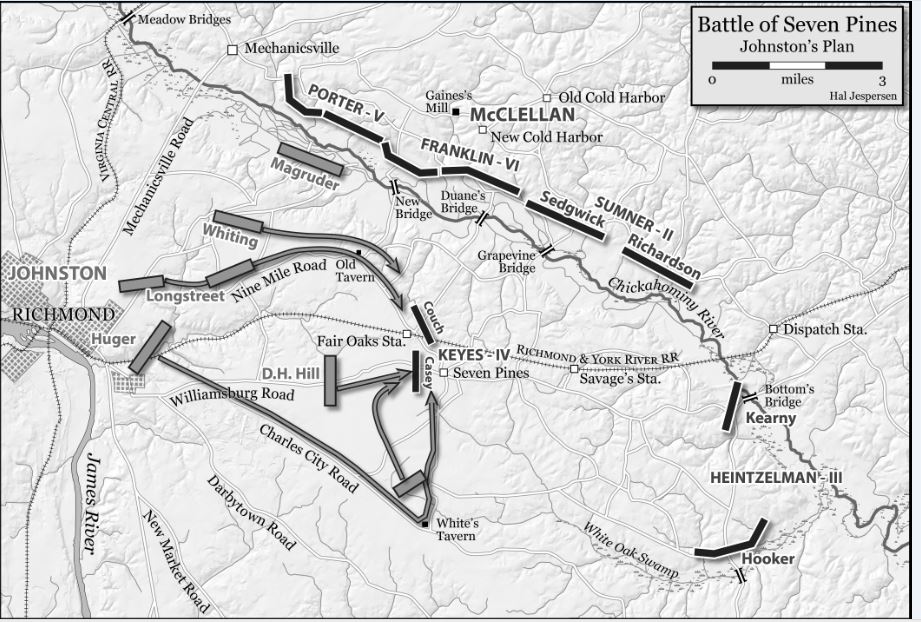
When Gen. Johnston was wounded, Gen. Gustavus Smith assumed immediate command of the Confederate forces. Needing reinforcements, Smith sent three couriers to find Magruder and bring his men forward. Two of the couriers returned, stating they failed to locate Magruder. President Davis, who had been with Smith, records that he went looking for Magruder and also couldn’t find him. Smith’s third courier did find Brig. Gen. Richard Griffith with Magruder’s men but did not find Magruder. Giving him Smith’s orders, Griffith moved forward without Magruder. Where Magruder was no one knew. The results of the battle were inconclusive as darkness ended the battle.[25]
That night the Army of Northern Virginia withdrew back to Richmond’s defenses and Gen. Smith was replaced by Gen. Robert E. Lee. According to historian Chris Hartley, Hill was upset that all his gains were not properly supported and later quarreled with Magruder, blaming him over what happened at Seven Pines.[26]
With Lee now in command, he was determined to strike at “those people.” He met with some of his generals on June 13 on Nine Mile Road to get their views of the best way to accomplish that goal. Among those officers were Hill and Magruder. Observing this meeting was Col. Thomas R. R. Cobb, a bright, clean-shaven, 39-year-old former lawyer. Studying Hill closely, Cobb later recorded: “I don’t like Hill, much to my surprise, for I was ready to love him for his Christian character.” He went on to observe, “There is much bad blood among these high officers, jealousies and back-biting.”[27]
As a result of that meeting, as well as information from his cavalry chief, J.E.B. Stuart, about the Union army’s right flank north of the Chickahominy River “being in the air,” Lee attacked that flank on June 26 starting the Seven Days’ Battles.
Magruder’s erratic behavior continued through the Seven Days’ Battles, but Hill’s remained solid. While the majority of Lee’s army attacked Gen. Fitz John Porter’s corps north of the Chickahominy, Magruder and a numerically reduced force faced the might of McClellan’s army south of the river. This tenuous situation made Magruder a bundle of nerves, and because of that, he constantly shifted his troops, which led to Hill writing that each of McClellan’s corps commanders was expecting “a special visit from the much-plumed cap and the gaudy attire of the master of ruses and strategy.”[28]
As the Confederate army forced Porter to retreat across the river, Lee ordered Magruder to advance along the Williamsburg Road and the Richmond & York River Railroad to attack the retreating Yankee columns at Savage’s Station. Lee was hoping to block the enemy’s escape route. Facing the Yankee fortifications, Magruder hesitated to attack and instead asked Lee for reinforcements. Astonished, Lee repeated his order to storm the works, but cautioned Magruder to exercise care not to injure Gen. James Longstreet’s two engineer officers who already occupied the abandoned fortifications. Chagrined, Magruder moved forward and finally engaged the retreating Union forces. When he did, Magruder’s attacks lacked conviction, and ended in failure.
McClellan’s army retreated closer to the James River and stopped at a prominence named Malvern Hill. There, Lee ordered D. H. Hill to attack the Federal position with support from Magruder’s troops.
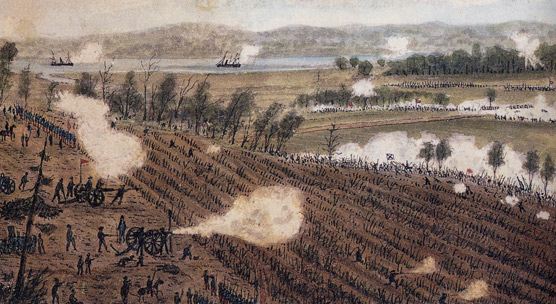
At Malvern Hill, Magruder earned Hill’s ire when Magruder got lost and confused as to the correct road to march to support Hill. As a result, Magruder’s men arrived late. To soften up the Federal position prior to attacking, Hill ordered his artillery to bombard the position. Outgunned, Hill was angry that the superior Federal artillery was knocking his cannons to pieces. He was also upset that of the 16 batteries with Magruder only two arrived to lend support. Magruder’s infantry began to trickle onto the battlefield as Hill’s infantry charged. The masses of Union cannons and infantry, tiered on the slopes of Malvern Hill, cut Hill’s men to pieces.
Desperate for support, Hill could not find Magruder for reinforcements. Hill turned the air blue with verbal abuse on the few of Magruder’s troops who were on the field. When Magruder finally arrived, Lee asked why he failed to attack, only to receive an unsatisfactory answer. Magruder’s problem was pulling enough men together for an assault. When his men did finally attack it was too late and in piecemeal fashion. Never wanting to make the attack, let alone without supports, Hill thought his men were sacrificed. He lamented afterward that “It was not war – it was murder.”[29]
Magruder’s confusion, nervousness, and halting performance during the campaign from Seven Pines to Malvern Hill was caused by a specially prepared medication consisting of alcohol and morphine which was an age-old remedy for drunken stupors. He confessed to Maj. Joseph Brent, one of his staff officers, that he was not only ill, but also the narcotics were aggravating his condition.[30]
Malvern Hill was the last time D. H. Hill and Magruder were on a battlefield together or ever saw each other during the war. Magruder was shuffled off to Texas while Hill, according to Douglas Southall Freeman, emerged from the campaign “among the first of Lee’s Lieutenants.”[31]
Ironically, both Magruder and Hill ended up serving in the West. As commander of the Texas district, Magruder brilliantly re-captured Galveston, captured the USS Harriet Lane -temporarily lifting the Union blockade- and achieved a modicum of success. On the other hand, while serving under Gen. Braxton Bragg’s army at the Battle of Chickamauga, Hill’s performance was as questionable as his caustic opinion of Bragg’s ability. Hill was soon relieved. Like oil and water, the personalities of Magruder and Hill never did mix despite their success at Big Bethel.
[1] Bridges, Hal, Lee’s Maverick General: Daniel Harvey Hill, New York, NY: McGraw-Hill, 1961, p. 17.
[2] Cobb, J. Michael, Hicks, Edward B., Holt, Wythe, Battle of Big Bethel: Crucial Clash in Early Civil War Virginia, El Dorado Hills, CA: Savas Beatie, 2013, p. 94.
[3] Hartley, Chris. Confederate General D.H. Hill: A Military Life, El Dorado Hills, CA: Savas Beatie, 2026, pp. 130, 483. Casdorph, Paul D., Prince John Magruder: His Life and Campaigns, New York, NY: Charles Scribner’s Sons, 1946, pp. 2, 30, 305-206.
[4] Hartley, D.H. Hill: A Military Life, p. 111. Freeman, Douglas Southall, Lee’s Lieutenants: A Study in Command, 3 vols., New York, NY: Charles Scribner’s Sons, 1946, p. 15, 167. Casdorph, Prince John Magruder, p. 2. Richmond Dispatch, July 10, 1861, p. 3, col. 2.
[5] . Southern Historical Society Papers, 52 vols. Richmond, VA: Southern Historical Society, 1876-1959. Vol. 19, pp. 219-221. Freeman, Lee’s Lieutenants, vol. 1, p. 166.
[6] DHH to Isabella Morrison Hill, May 30, 1861, DHH Papers, U.S. Army Heritage and Education Center, Carlisle Barracks, Carlisle, Pennsylvania. Cobb, et.al., Battle of Big Bethel, p. 95.
[7] Casdorph, Prince John Magruder, p. 121.
[8] Hartley, Confederate General D.H. Hill: A Military Life, p. 114.
[9] Official Records of the Union and Confederate Armies, 128 vols., Washington D.C.: Government Printing Office, 1880-1901. Hereafter cited OR. Series 1, Vol. 2, p. 876. Magruder’s date of commission by the State of Virginia to colonel was April 25,1861and Hill’s commission from North Carolina Governor John W. Ellis was April 24, 1861.
[10] Lafayette McLaws to his Wife, February 7, 1862, McLaws Papers, Southern Historical Collection, Chapel Hill, NC: University of North Carolina. Riedel, Leonard W., John Bankhead Magruder and the Defense of the Virginia Peninsula, 1861-1862, Master’s Thesis, Old Dominion University, August, 1991, p. 69. John_Bankhead_Magruder_and_the_Defense_o (4).pdf McLaws commented on a party held by Magruder for his commanders: “The dinner was magnificent and would have graced a New Orleans’ restaurant. A great many toasts were given and speeches made in reply.”
[11] For a complete discussion of the Battle of Big Bethel see: Cobb, et. al., Battle of Big Bethel: Crucial Clas in Early Civil War Virginia, El Dorado Hills, CA: Savas Beatie, 2013 and Quartstein, John V., Big Bethel: The First Battle, Charleston, SC: The History Press, 2011.
[12] Hartley, Confederate General D.H. Hill: A Military Life, p. 126.
[13] OR, Series 1, vol. 2 p. 925. Western Democrat, June 25, 1861. Hartley, Confederate General D.H. Hill: A Military Life, pp. 124-125.
[14] R.H. Chilton to DHH, July 4, 1861, Letters and Telegrams Sent by the Confederate Adjutant and Inspector General, 1861-1865, Microcopy 627, Roll #1, Vol. 35 & Index. Record Group 109, National Archives and Records Administration, Washington D.C. Knight, Charles R. From Arlington to Appomattox: Robert E. Lee’s Civil War Day by Day, 1861-1865, El Dorado Hills, CA: Savas Beatie, 2021, p. 40.
[15] DHH to Isabella Morrison Hill, July 7, 1861, DHH Papers USAHEC. Hartley, Confederate General D.H. Hill: A Military Life, p. 128.
[16] Gallagher, Gary, “Daniel Harvey Hill,” Editor, William C. Davis, Confederate General, vol. 3, National Historical Society,1991, p. 104. Hartley, Confederate General D.H. Hill: A Military Life, p. 129.
[17] Riedel, John Bankhead Magruder and the Defense of the Virginia Peninsula, p. 76. War Department, Confederate Correspondence and Orders, pp. 44-45, 48. Record Group 109, Vol, 2, chapter 227. Magruder to Hill, September 17, 1861. John_Bankhead_Magruder_and_the_Defense_o (4).pdf
[18] Ibid. pp. 68-69.
[19] Letter to the Editor, The Richmond Examiner, November 27, 1861. Riedel, John Bankhead Magruder and the Defense of the Virginia Peninsula, pp. 68-69. John_Bankhead_Magruder_and_the_Defense_o (4).pdf
[20] Hartley, Confederate General D.H. Hill: A Military Life, p. 167. “Charles Trueheart to Dear Mother, February 21, 1862,” Charles W. Trueheart Papers, Alderman Library, University of Virginia, Charlottesville, Virginia. Richard H. Watkins to his Family, October 25, 1861, Watkins Family Papers, Virginia Historical Society, Richmond Virginia.
[21] O.R., Series 1, Vol. 11, part 3, p. 451.
[22] Casdorph, Prince John Magruder, p. 153.
[23] H. T. Douglas to S. T. C. Bryan, February 29, 1909, Guy Morrison Bryan Papers, Center for the Study of American History, University of Texas, Austin, Texas. Casdorph, Prince John Magruder, p. 154.
[24] Gallagher, Gary W., “The Fall of Prince John Magruder,” Civil War, August 1989, p. 19.
[25] Smith, Gustavus W., The Battle of Seven Pines, New York, NY: C. G. Crawford, Printer and Stationer, 1891, Reprint, Morningside Books, Dayton, OH, 1974, pp. 101-102, 104.
[26] Davis, Jefferson, The Rise and Fall of the Confederate Government, New York, NY: D. Appleton and Co., 1881, vol. 2, p. 123. Smith, The Battle of Seven Pines, pp. 101-102. Hartley, Confederate General D.H. Hill: A Military Life, p. 215.
[27] Southern Historical Society Papers, 52 Vols., Richmond, VA: Southern Historical Society, 1876-1959. Vol. 28, pp. 292-293.
[28] Hill, Daniel H., “Lee’s Attack North of the Chickahominy,” Johnson, Robert Underwood and Buel, Clarence Clough, editors, Battles and Leaders of the Civil War, 4 vols., New York, NY: Thomas Yoseloff, Inc. 1956, Vol. 2, p. 362. Sears, Stephen W., To the Gates of Richmond: The Peninsula Campaign, Boston/New York: Houghton Mifflin Company, 1992, pp. 216-217
[29] Hill, Daniel H., “McClellan’s Change of Base and Malvern Hill,” Battles & Leaders, Vol. 2, pp. 383-396.
[30] Casdorph, Prince John Magruder, pp. 156, 180-182. Brent, Joseph L., Memoirs of the War Between the States, New Orleans, LA: Fontana Printing Co., 1949, pp. 191-192.
[31] Freeman, Lee’s Lieutenants, Vol. 1, p. 629.


Enjoyed your descriptive comparison and sources. Thank you very much for a fun read!
Thanks for the well-researched post! Hill and Magruder were definitely NOT cut from the same cloth. Their first meeting, a story I tell in my new biography of D.H. Hill from Savas Beatie, took place at Fort Kent, Maine shortly after Hill’s 1842 graduation from West Point. Then Lt. Magruder fetted that the American officers’ mess at that remote outpost had no crockery worthy of comparison with the British officers’ mess just over the border in Canada, so he tried to levy a “tax” on his fellow officers to fund a silver service set. Magruder also introduced a special, formal jacket for the officers to wear. Hill would have none of such foppery. It was not an auspicious start for their relationship.
It looks like Longstreet, A.P. Hill, and Jackson were not the only senior Confederates engaging in interpersonal disputes in the Eastern Theater’s early days. Given their personalities, I suppose it is little surprise that Hill and Magruder had a tenuous relationship at best.