Book Review: The First Pariah State: How The Proslavery Confederacy Menaced the World

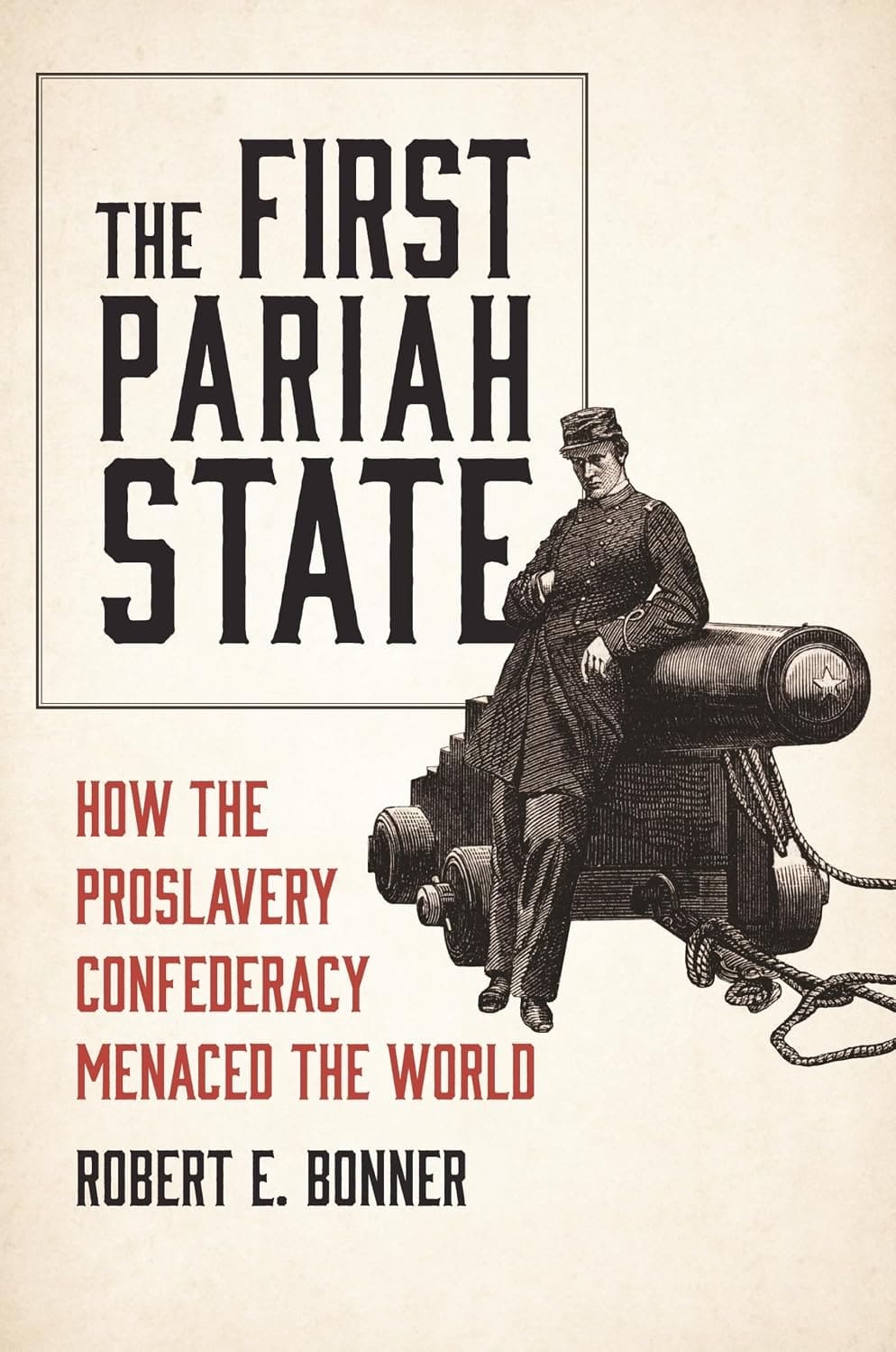 The First Pariah State: How The Proslavery Confederacy Menaced the World. By Robert E. Bonner. Princeton: Princeton University Press, 2026. Hardcover, 240 pp. $39.99.
Reviewed by Aaron Stoyack
Robert E. Bonner’s The First Pariah State demonstrates that the Confederacy’s diplomatic efforts were hampered chiefly by its position on slavery. The peculiar institution was becoming extinct across the globe, and comparatively few wished to taint their hands by supporting the rebellion. Just as some saw Union victory as success of republican government, others saw a Confederate victory as a success of the institution of slavery.
Bonner stipulates that today’s concept of a pariah or rogue state was not in use at the time. Even in the modern era, there are no universal qualifications for this label. Although European powers often did not recognize the governments of “uncivilized” countries, this is not a term that they could apply to the Confederacy.
Despite publicly proclaiming that the Confederate States of America would demonstrate the success of slaveocracy, CSA government officials feared diplomatic ramifications in private. Some Europeans hoped the Confederacy would ban slavery after the war. The Davis administration rejected this, winning fans at home but making enemies overseas.
The need to placate the homefront often clashed with diplomatic ventures. Aware of this, Northerners made a concerted effort to publish Confederate government speeches that reflected continued support for slavery and have them delivered to interested parties overseas.
Additional factors led to further alienation. Confederate privateers captured foreign ships and thousands of prisoners. Many Europeans saw the government’s use of scripture to justify its causes and existence as heretical to Christianity’s true ideals.
To support his argument, Bonner pulls heavily from European newspapers to gauge public opinion. Correspondence between officials is another chief source of information, demonstrating a more cooperative relationship expressed toward the Federal government. These sources lead to an uncommon perspective, examining more of how the South was viewed overseas than any specific initiatives they attempted.
This work slots into a body of academic literature examining the Confederacy’s statesmanship. King Cotton Diplomacy (2008) and Blue and Gray Diplomacy (2010) set the stage for more focused studies such as Between King Cotton and Queen Victoria (2025). Bonner’s book falls more in line with the former two as a comprehensive study rather than holding a specific focus on a certain empire. Nevertheless, examination is constrained to European nations. Little to any attention is given to relations with countries in South America or elsewhere.
Six chapters divide varying aspects affecting international perception. The positions of the Confederate government, privateering, religion, and international law are all given careful study. The last chapter examines how the Confederacy is remembered on the international stage to this day, from statues to the big screen. It is quite the departure from the preceding subject matter, but makes for a nice conclusion.
The First Pariah State offers insight into how the actions of the seceding states were received in Europe. Bonner showcases how the Confederacy’s inherent values, coupled with wartime measures of necessity, significantly hampered its chances of gaining overseas support. Specific documentary examples are cited throughout, and the temptation to go down rabbit holes when introduced to new events is strong. Well-paced with chapters of around twenty to thirty pages, The First Pariah State can be a quick read or one that invites the reader to further explore certain topics. This makes a strong contribution to the growing body of work on Civil War diplomacy and offers a valuable outside-looking-in perspective.


Haven’t read the book, but Britain was no angel in the slavery discussion, as pointed out in depth by Nancy Spanneus, “Defeating Slavery”, 2023, from American System Now, if I may put a link in this comment https://americansystemnow.com/busting-the-myth-of-the-abolitionist-british-monarchy/ Further, it’s well known that Davis was clandestinely negotiating with Britain, or some in Britain, on the basis of gradual emancipation in exchange for recognition (Charles Adams, “Slavery, Secession, and Civil War”, p. 304 plus the entire book). The fact that didn’t gain traction was a result of many things, but among those things was that there was division among those in control on the subject. Being a pariah with regard to slavery wasn’t confined to the South, where there were divided opinions, and was especially true of the hypocrits of the North and Europe, for whom any concern was over competition to wage labor, not humanitarianism.
I thought this book had some interesting points regarding the success of Confederate commerce raiders, and how that success threatened the European norms developing about free trade in the maritime domain. Definitely something to think about.
They have GOT to be kidding us. The FIRST pariah state? Has anyone ever read the Bible? Yeah – Egypt and Babylon enslaved God’s Chosen People, and then Rome enslaved them. And then African Arab and Persian Muslims enslaved anyone they could get their hands on for centuries, even causing the young United States to make war on them for their actions, including enslaving hundreds of thousands of white Europeans and selling the white women into slavery – from which zero ever returned alive. The Muslims then raided Sub-Saharan Africa, bringing with them the two worst scourges the world has ever known: Islam and slavery. They found the African blacks were already enslaving each other, but now they enslaved them, forced Islam on them, and got them to capture each other to be sold as slaves to the English, Dutch, French, Spanish and Portuguese, who brought them to the New World.
Well! There’s a couple dozen “pariah slave states” for you before the United States of America even began and inherited the slave system brought to North America by the English, French, Dutch and Spanish and, just for good measure, slavery was not just practiced by the Confederate States of America, but throughout the American Civil War – and six months beyond – it was legal and practiced by – wait for it – the United States of America. The FIRST pariah state? The Confederacy was just about the last.
Do you understand what “pariah” means? It means outcast or rejected. The point of the book is that the Confederacy was rejected by the rest of the globe (or at least Europe) because it was founded explicitly to preserve and expand chattel slavery at a time when the rest of the world was advancing towards abolition.
I think the point is that the CSA was hardy the *first* pariah state. The title does have the word “first” in it.
Tom
The title and apparent theme of this book remind me of a 1992 book titled “Guns of the South” by Harry Turtledove. It is an “alternate history” of the last year of the Civil War in Virginia. The cover immediately gets your attention, with General Lee holding an AK-47! The gist of the plot is that in the modern era, with South Africa being an apartheid state, a few radical South African whites discover time travel (remember, this is a novel) and show up at Lee’s headquarters just before the Overland Campaign with a wagonful of AK-47s and ammunition. Their intention? To help the Confederacy win the war so that in the future, South Africa will have an ally and won’t be the only “pariah” in the world. I won’t give away any of the plot in case you want to read it. For a while it sparked an interest for me in the genre of alternate history. But I eventually lost interest in the genre- and Turtledove- since by their very nature these stories lose any basis in reality. It’s somewhat in the same vein as the many “what if?” questions Civil War enthusiasts enjoy pondering.
What a weird but fun book. I’ve been meaning to reread it — obviously the premise is intentionally absurd, but I wonder how it holds up otherwise.