Book Review: The Political Writings of Abraham Lincoln

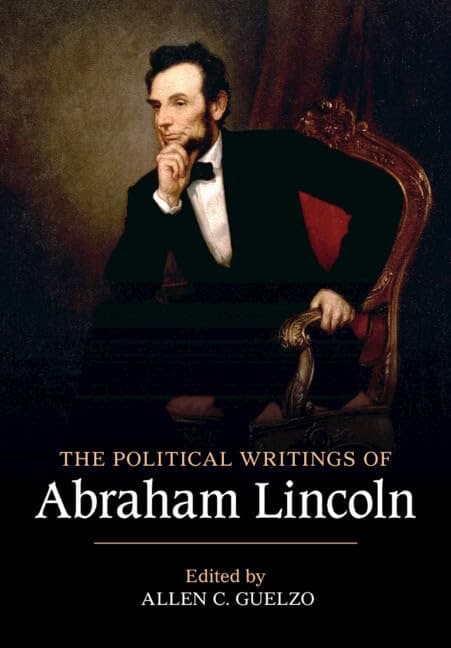
The Political Writings of Abraham Lincoln. Edited by Allen C. Guelzo. Cambridge, UK: The University of Cambridge Press, 2026. Hardback, 802 pp. $150.00.
Reviewed by Hunter Haskins
Somewhere, in the vast thicket of Abraham Lincoln apocrypha on the Internet, there likely exists an Honest Abe quote, doubtlessly misattributed, concerning the necessity of attention when a matter of great import arrives. When Allen C. Guelzo, one of the nation’s foremost scholars on Lincoln, offers a new curation of the sixteenth president’s political thoughts, that sage bit of digital frontier wisdom, whether real or made up, becomes a mandate for the student of American Civil War studies.
Axioms aside, Guelzo’s The Political Writings of Abraham Lincoln is the most recent addition to Cambridge’s “The Political Writings of American Statesmen” series of primary source readers. It is a welcome addition to the copious canon already focused on Lincoln, curating political writings and speeches from across Lincoln’s life that display in extraordinary depth his erudite and cultivated worldview.
Guelzo’s central thesis and guiding principle in editing this work is that Lincoln was, above all else, a deeply political man whose life was defined by the art of politics and a “ravenous intellectual curiosity” for political theory and economy. (1) This anthology seeks to rescue Lincoln from the realm of simple stereotypes and present him as a sophisticated product of the “moderate Enlightenment,” a classical liberal influenced by the likes of Adam Smith and John Stuart Mill. (2) Due to the careful structure and selections of this work, it without a doubt succeeds.
The book is organized into ten distinct parts that follow a chronological and thematic arc. It begins with Lincoln’s debut as a Whig state legislator in the 1830s and progresses through his devotion to Henry Clay’s American System, his rise as a Republican candidate, his presidency, and finally contemporary eulogies for the assassinated leader. This organizational strategy is informed by a sincere appreciation for the historiographical stepping stones of the past, especially acknowledging this text’s direct lineage to Roy P. Basler’s monumental Collected Works of Abraham Lincoln, first issued in 1953. Basler’s work, the very soil from which so many branches of Lincoln scholarship have sprung, served as a “baseline” for this single-volume curation of political thought and writings. (xxviii)
But Guelzo does not rest upon Basler’s laurels; he actively expands the ambit by unearthing “entirely new items” that eluded Basler and his team, most notably a summation of an 1844 speech on immigration and an 1862 interview with Roman Catholic activist and intellectual Orestes Brownson. (xxviii-xxix) By frequently prioritizing contemporary newspaper accounts and published documents over manuscript drafts, Guelzo manages to capture the definitive, polished word that Lincoln “wished people to read.” (xxviii) Furthermore, mistakes that have persisted for decades in punctuation, capitalization, and other errata in the Basler text, especially for the “House Divided” speech and Cooper Institute address, have been cleaned up.
Guelzo is quick to tell us “no shattering new discoveries” await the reader in this text. (xxviii) But if the editor’s careful selections do anything, they re-expose to the reader a man deeply in touch with the profound political and moral questions of his time. In his 1838 Lyceum Address, the young prairie lawyer identifies a rising “ill-omen” of lawlessness, warning that if the American experiment in self-government should ever fail, “we must ourselves be its author and finisher.” (39) In an 1845 correspondence with Williamson Durley Lincoln’s devotion to supremacy of law and reason remains strong as he navigates the thorny intersection of political duty and moral conscience on slavery. By the time of his 1854 Peoria Speech Lincoln’s moral calculus had evolved into a “hate” for the “monstrous injustice of slavery itself,” which he believed forced “good men amongst ourselves into an open war with the very fundamental principles of civil liberty.” (212-213) Finally, in his 1864 letter to Albert G. Hodges, the President offers a profound meditation on the “indispensable necessity” of his wartime measures. (537) In the end, he submits his great political struggles during the War to the “justice and goodness of God.” (537)
However, the book’s focus is also its primary limitation. As an anthology rather than a “variorum edition or ürtext,” it intentionally excludes documents that do not directly bear on Lincoln’s political life. (xxix) But by not directly defining what he means by “political,” Guelzo exposes himself to critics who might feel that any number of missives Lincoln sent to friends, supporters, and colleagues discussing with them any manner of so-called “political” or “political-adjacent” topics (social engagements, judicial clerkships, etc.) should have been included. This reviewer can be persuaded to occasionally agree with those critics, as letters showing a younger, more emotionally charged Lincoln’s electioneering efforts could have better punctuated Guelzo’s broader thesis (see Abraham Lincoln to Andrew McCormick [January 1839], readily found online, for just one example of this).
Guelzo anticipates this commentary, however, and clarifies this tome’s purpose is to provide “usefulness and clarity for a modern reader.” (xxix) Anything not to do with the “smaller-grained stubble” of Lincoln’s political existence, consequently, is left on the cutting room floor. (1) For a researcher or Lincoln enthusiast seeking the granular details of his law practice or day-to-day personal correspondence, be it “political” or “political-adjacent,” consultation of other selected speeches and writings is required.
Ultimately, The Political Writings of Abraham Lincoln provides a wonderful opportunity to rediscover Lincoln in his own words. Sometimes humble, other times stubborn, occasionally humorous, and always engaging, Guelzo’s curation of sources reveals the sophisticated engine of Lincoln’s political thoughts that made this “backwoods Jupiter” into the indispensable civic figure we cherish today. (3)
————
Hunter Haskins is the Assistant Director of the Salem Museum & Historical Society in Salem, Virginia. A graduate of Roanoke College, he double majored in History and Political Science while pursuing a concentration in Public/Applied History. Before joining the Museum, Haskins taught history and epistemology at the Carlisle School in Axton, Virginia, and worked as a guide, interpreter, and blacksmith for Ferrum College’s Blue Ridge Institute and Museum. He is an active member of the Fincastle Company Living History Interpreters. He lives in Salem.


The American Library already did this, and better, many years ago.