Book Review: The Sewards of New York: A Biography of a Leading American Political Family

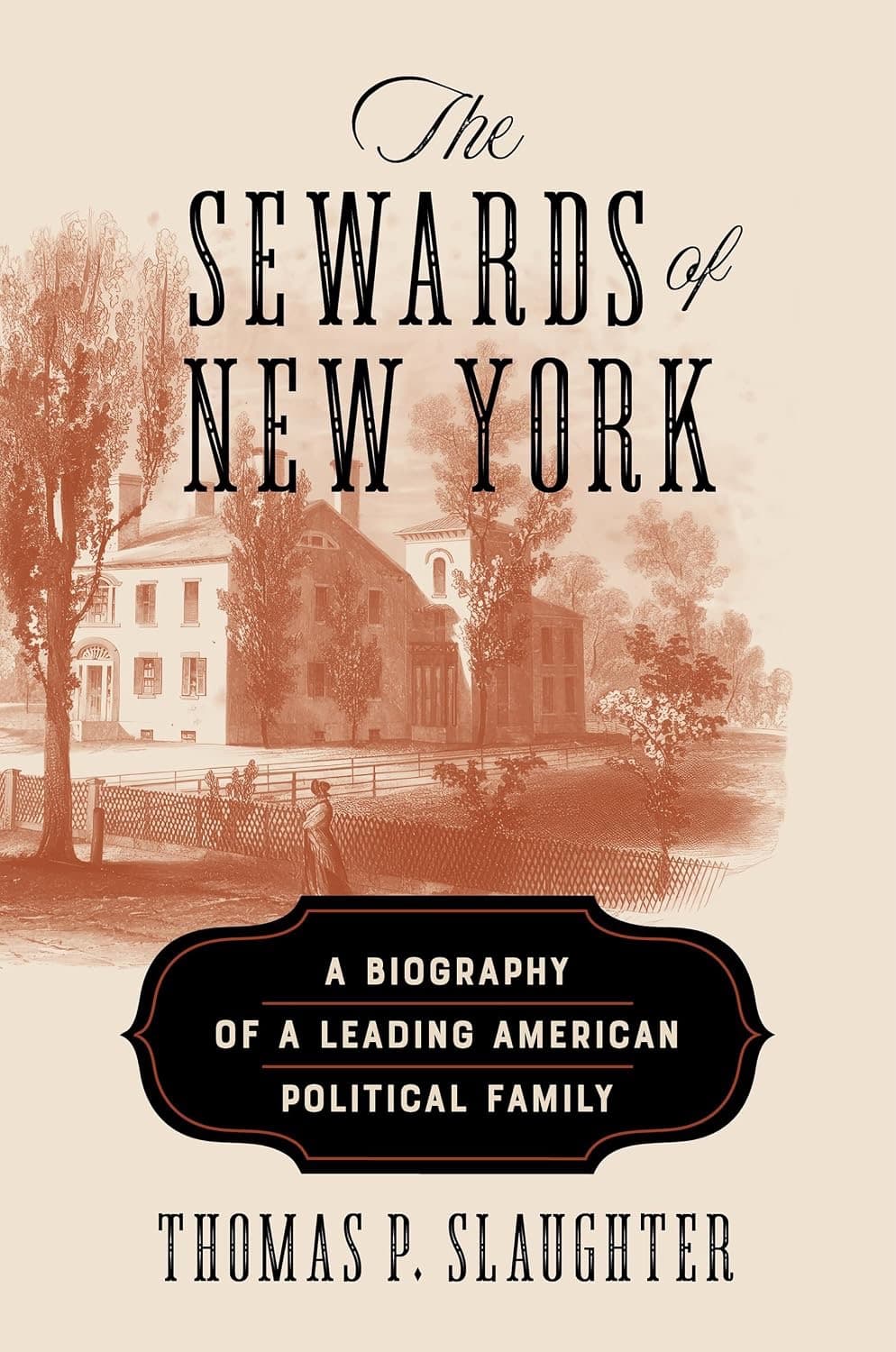
The Sewards of New York: A Biography of a Leading American Political Family. By Thomas P. Slaughter. Ithaca: Cornell University Press, 2025. Hardcover, 475 pp. $37.95.
Reviewed by Zachery A. Fry
Armed with a trove of recently unearthed family letters, Thomas P. Slaughter’s latest book presents a candid view of New York political giant William H. Seward, the future secretary of state, and his wife Frances Miller Seward. We have seen Seward political biographies before—most notably Walter Stahr’s magisterial Seward: Lincoln’s Indispensable Man(2012)—but Slaughter, professor emeritus at the University of Rochester, takes a different tack by contextualizing the New York politico within the intimate concerns of his family. It is a study, as the author notes, that examines “the links between public and private spheres” for a politician who often forsook one to succeed in the other. (420)
As Slaughter chronicles, William Seward’s rise in New York politics reflects the ambition of a principled, yet pragmatic man. Avowedly antislavery and opposed to the excesses of Jacksonian democracy, his path to the Republican Party of the mid-1850s passed through the Anti-Masonic and Whig parties, in the process carrying him from state senator to governor and then to the United States Senate. Despite opposing slavery’s extension, Seward was, as Slaughter notes, no radical abolitionist. By 1856, when the Republicans fielded their first presidential candidate, Seward “had moved too far and too quickly on slavery for those who supported Frémont and too little and too slowly for the abolitionists.” (309) It was his moderate place in the party that made him a favorite for the 1860 nomination—until the party dumped him for a similarly-moderate westerner.
The central character in Slaughter’s story is Frances, Seward’s scrupulous wife who maintained the family home while “Henry” (as he was known to them) exercised his duties in Albany and Washington. While privately advocating abolitionist principles of her own, Frances, like many in the mid-nineteenth century, equated “politics” with selfishness and shameless public scheming. “I believe [politicians] are all heartless and selfish, nay avaricious sometimes,” she chided her husband. (88)
The Seward story featured fame and fortune alongside the perennial problems of life in the mid-nineteenth century. Their financial interests in western New York reflected the emerging possibilities of the Market Revolution. Likewise, Seward’s political rise in the Empire State resulted from his association with one of the new kingmakers of mass political journalism, Thurlow Weed. Domestically, though, the family battled traumas more typical of Victorian life. Frances fretted over the fate of their son Augustus at West Point and later when he served in the Mexican War. Poor health stalked them at every turn, from opioid-induced migraines and recurring miscarriages to fatal tonsil infections, all treated with dangerous homeopathic remedies described in enough detail to make the reader wince. These are Slaughter’s best insights, bringing to life the oil portraits and staged daguerreotypes of an affluent family.
One of the more privileged dimensions of the Seward home, which Slaughter uses to situate his subject in the intellectual history of their time, was the family’s love of books. Slaughter reconstructs their library from literary references in their correspondence, highlighting that Henry and Frances employed melodramatic language “as if they lived in a Gothic novel with the full range of tragic outcomes in play.” (92) This penchant for high literature informed Seward’s “keen eye for his legacy,” desiring to write correspondence not just for his wife but also for posterity. (362)
Despite their candid correspondence, as Slaughter pointedly notes, “the Sewards were not a compatible couple.” (117) The husband devoted all his waking hours to duty as statesman and politician, while the wife, overwhelmed at times with the responsibilities of their home at 33 South Street in Auburn, resented Henry’s ability to shrug off family woes in favor of social functions and partisan ladder-climbing.
Slaughter’s book on the Seward family is definitive and accessibly written. It is hard to imagine anyone delving more deeply or productively into the ponderous correspondence they left behind. By spotlighting Frances Seward and her efforts to hold the family together despite her husband’s political ambition, the author has given us something fundamentally new. The Sewards of New York is ultimately a work of social and intellectual history, though, not political biography in the traditional sense. Slaughter’s choice to end the book with Lincoln’s election in 1860 is bound to disappoint many, even as the author claims the decision is “because that brought one chapter to a close and began another for the family.” (2) Perhaps we can look forward to a second volume tackling Seward’s years at the State Department and his family’s role alongside him.
Zachery A. Fry is the author of A Republic in the Ranks: Loyalty and Dissent in the Army of the Potomac (2020).


I wonder how events would have gone differently if Seward was nominated and became president rather than Lincoln.