War Is Hell, But Even Hell Has Rules: Establishing the Scope of Military Jurisdiction Per the Lieber Code
This post is part of a series.
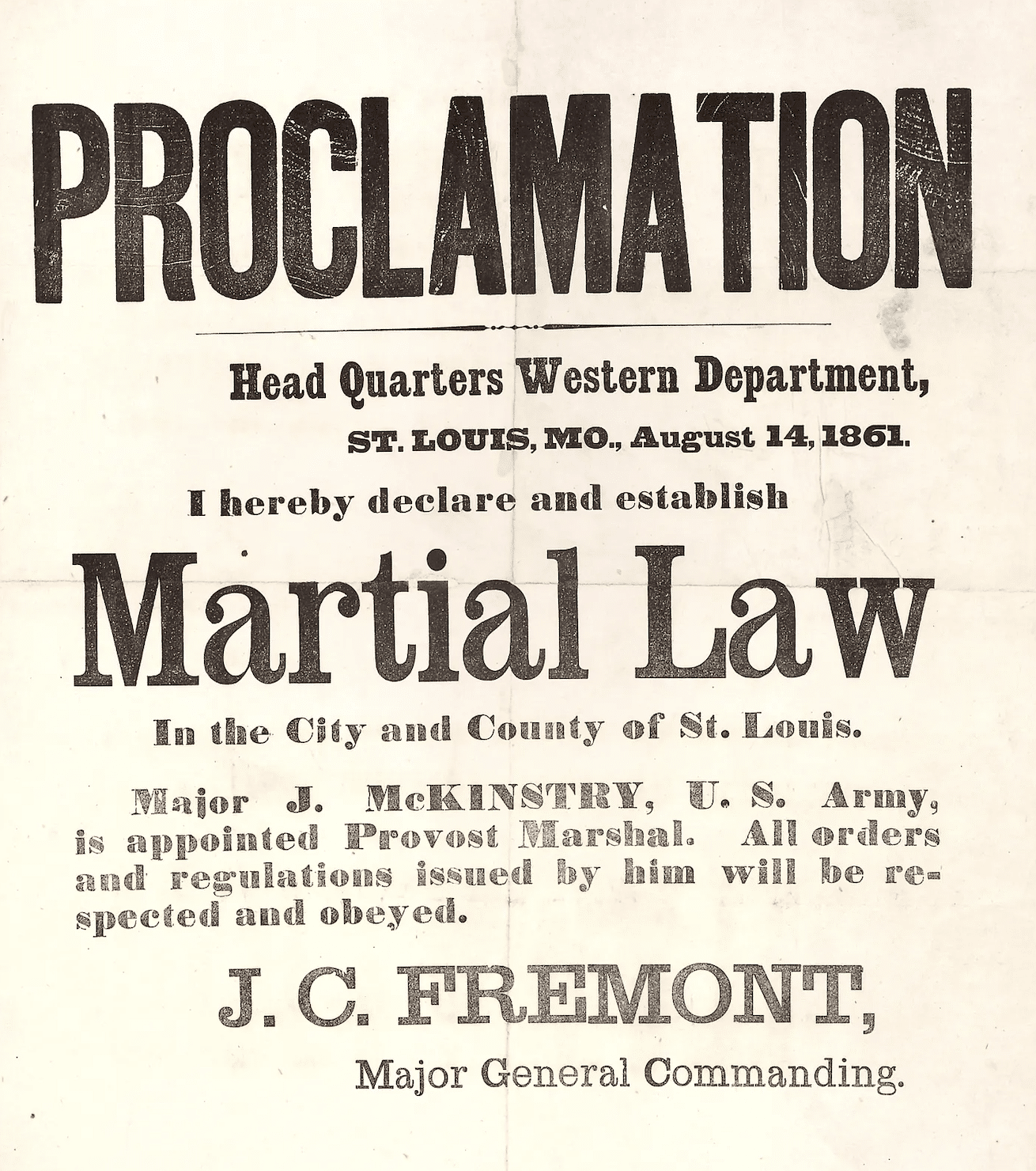
The first post in this series introduced the Lieber Code[1] and its goal: to establish rules governing U.S. Army conduct during the Civil War. This post addresses the imposition of martial law, including its definition, and what it meant for civilians falling under its jurisdiction.
Martial law was the first subject addressed by Abraham Lincoln’s General Orders No. 100 (the Lieber Code). The need for guidance on this subject was obvious. The army frequently found itself among hostile civilian populations throughout those regions occupied by federal forces. How should those populations be governed?
Quotes from the Code below are set forth in italics.
Section I (Martial Law – Military jurisdiction – Military necessity – Retaliation)
Article 1.
A place, district, or country occupied by an enemy stands, in consequence of the occupation, under the Martial Law of the invading or occupying army, whether any proclamation declaring Martial Law, or any public warning to the inhabitants, has been issued or not. Martial Law is the immediate and direct effect and consequence of occupation or conquest.
The presence of a hostile army proclaims its Martial Law.
Article 3.
Martial Law in a hostile country consists in the suspension, by the occupying military authority, of the criminal and civil law, and of the domestic administration and government in the occupied place or territory, and in the substitution of military rule and force for the same, as well as in the dictation of general laws, as far as military necessity requires this suspension, substitution, or dictation…
Comment: Articles 1 and 3 provide that the U.S. Army was authorized to enforce martial law within the borders of the Confederate States of America (where the U.S. army would constitute the “enemy”), but not in U.S. territory. This same limiting principle would later be relied upon in a successful challenge to the operation of a military tribunal which condemned a man to death in Indiana. In Ex Parte Mulligan, 71 U.S. 2, 128 (1866), the Supreme Court held that “Martial rule can never exist where the courts are open and in the proper and unobstructed exercise of their jurisdiction. It is also confined to the locality of actual war.”
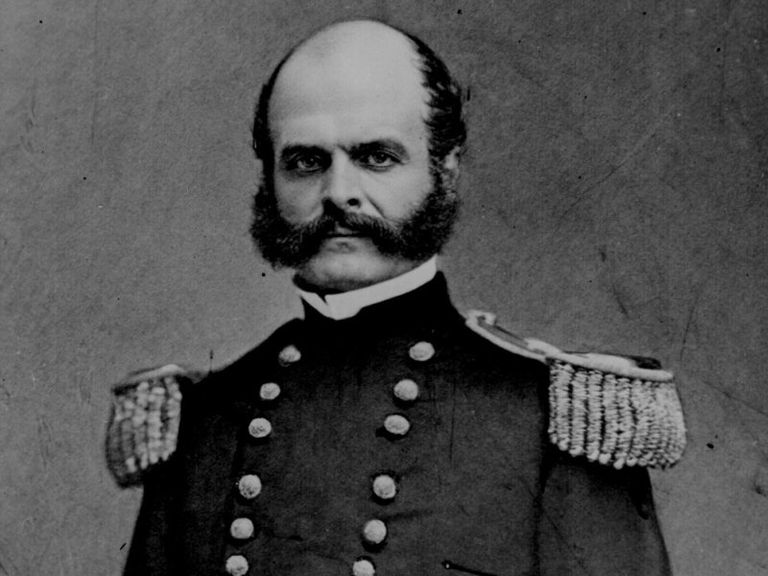
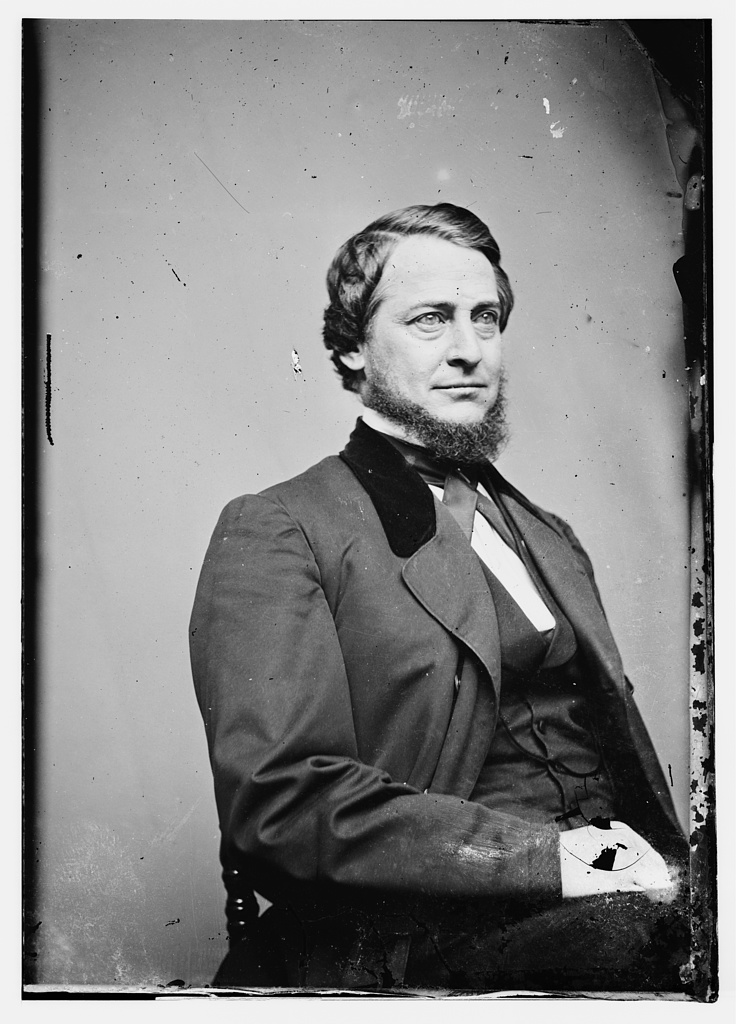
Nevertheless, on May 5, 1863, Maj. Gen. Ambrose Burnside, then serving as commander of the Department of the Ohio, based in Cincinnati, had the infamous Copperhead Clement Vallandigham arrested for a disloyal speech
had made in Ohio. Vallandigham was tried by a military commission and sentenced to prison. Burnside effectively extended martial law to U.S. territory. Burnside had seen, and relied upon, an unpublished draft of Lieber’s Code, which he used as justification for his action.[2]
By the time Vallandigham’s appeal made its way to the U.S. Supreme Court, the Code had been completed and issued. The Supreme Court quoted from Lieber’s work on the subjects of martial law and military tribunals but ultimately denied Vallandigham’s appeal on procedural grounds.[3]
Article 4.
Martial Law is simply military authority exercised in accordance with the laws and usages of war. Military oppression is not Martial Law: it is the abuse of the power which that law confers. As Martial Law is executed by military force, it is incumbent upon those who administer it to be strictly guided by the principles of justice, honor, and humanity – virtues adorning a soldier even more than other men, for the very reason that he possesses the power of his arms against the unarmed.
Article 5.
Martial Law should be less stringent in places and countries fully occupied and fairly conquered. Much greater severity may be exercised in places or regions where actual hostilities exist, or are expected and must be prepared for. Its most complete sway is allowed – even in the commander’s own country – when face to face with the enemy, because of the absolute necessities of the case, and of the paramount duty to defend the country against invasion.
To save the country is paramount to all other considerations (all emphasis supplied).
Comment: In these Articles, Leiber first teaches that martial law is to be “guided by the principles of justice, honor, and humanity.” Yet he also makes clear that strong measures are permitted when deemed necessary by military authority. Certainly, those thousands of Missouri civilians who were forced to abandon their homes within 15 days by General Thomas Ewing’s infamous General Order No. 11 might have questioned the “justice, honor, and humanity” of Ewing’s action. Yet Ewing believed that depopulating entire counties would deprive infamous guerrilla leader William Quantrill of citizen support.[4]
Also, contrary to Articles 1 and 3, Lieber here asserts that martial law may be proclaimed even in a Union state when that state is being threatened by the enemy.
In the final analysis, military necessity (saving the country) matters more than anything, including the rights of U.S. citizens.
Article 12.
Whenever feasible, Martial Law is carried out in cases of individual offenders by Military Courts; but sentences of death shall be executed only with the approval of the chief executive, provided the urgency of the case does not require a speedier execution, and then only with the approval of the chief commander.
Comment: Martial law sentences of death require approval by the President. Thus, Maj. Gen. Benjamin Butler’s 1862 action in executing New Orleans civilian William Mumford for tearing down the U.S. flag from the federal Mint building would have violated this Article (had it then been in force).[5]
The Article, however, permits immediate executions—including of civilians—whenever the military authority believes it warranted. That is quite a large loophole in the Code’s “principles of justice, honor, and humanity.”
Summary: These sections on martial law illustrate what will be revealed as a defining feature of the Lieber Code. On one hand, the Code contains high-sounding injunctions to apply military power sparingly and with humanity and justice. Yet such pleas often are coupled with broadly-worded guidance that arguably could justify virtually any action that the army deemed necessary under the circumstances.
[1] The War of the Rebellion: A Compilation of The Official Records of The Union and Confederate Armies, Series III, Vol. 3 (U.S. Government Printing Office, Washington, D.C., 1880 – 1901), pp. 148 – 164.
[2] John Fabian Witt, Lincoln’s Code: The Laws of War in American History (Free Press, New York, NY, 2012), pp. 271 – 273. Lincoln converted the sentence to banishment from U.S. lines. Id. at 273.
[3] Ex Parte Vallandigham, 68 U.S. 243, 248-249 (1863).
[4] William Fischer, Jr., “General Orders No. 11, A State Divided: The Civil War in Missouri,” The Historical Marker Database, https://www.hmdb.org/m.asp?m=54013.
[5] Christopher G. Pena, General Butler, Beast or Patriot, New Orleans Occupation, May-December 1862 (1st Books, Bloomington, IN, 2003), pp. 54 – 56, 66, 83 – 85.


Thanks Kevin, another terrific piece.
The Lieber Code notwithstanding, another “defining feature” of this time was the egregious extra-legal behavior of some Union general officers … it’s also worth noting these actions occurred before the Code was officially issued … although it’s likely they would have occurred nonetheless.
Butler (a lawyer) and Burnside didn’t exploit loopholes … they fabricated military jurisdiction to punish civilian dissent in areas where civil courts were fully open and intact … Butler didn’t find a legal vacuum in New Orleans; he created one by suspending the local courts and inventing military tribunals to act as judge, jury, and executioner … both Butler and Burnside knew they entering extra-legal territory, yet they went there anyway.
Ewing, on the other hand, wasn’t out-of-bounds as his order was technically lawful under martial law — his order was just plain dumb … General Order 11 was an operationally bankrupt exercise in overkill … by securing permission from his chain of command to burn down four counties … Ewing used a meat cleaver to solve a localized guerrilla problem, destroying the lives of thousands of loyal Union families while letting Quantrill slip away.
This leaves me interested where you take the next post … will you argue the finalized Lieber Code actually closed these legal loopholes, or did it merely codify them by giving commanders a “military necessity” caveat to justify the same heavy-handed actions? Looking forward to more.
Mark,
Thank you. You will have to wait and see.
Really enjoying your series on the Lieber Code.