Book Review: Lincoln’s Minister of Mystery: Henry Shelton Sanford and Civil War Intelligence

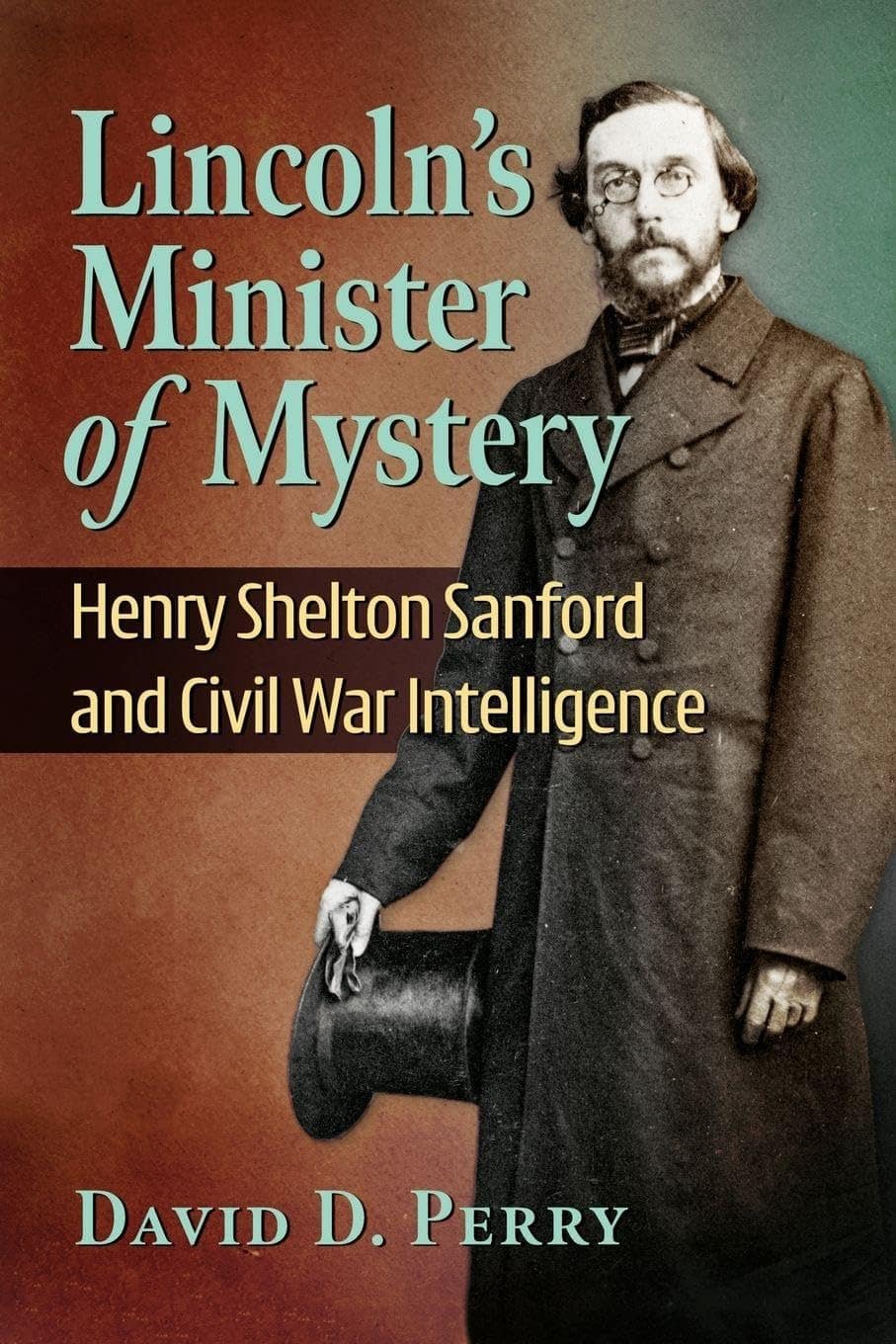
Lincoln’s Minister of Mystery: Henry Shelton Sanford and Civil War Intelligence. By David D. Perry. Jefferson, NC: McFarland & Company, 2026. Paperback, 203 pp. $39.95.
Reviewed by Phillip S. Greenwalt
Sanford, Florida. You may have passed the town and county seat of Seminole County when traversing Interstate-4 between Orlando and Daytona Beach. Cruising past on the way to a NASCAR race or to visit Disney World, the town may not have registered a second thought. However, the municipality’s namesake played an important role for the United States during the American Civil War.
Just not in said United States, though. The gentleman whose last name graces this Florida city hailed from New England as well. His name was Henry Shelton Sanford. Earlier this year, David D. Perry, a retired university lecturer in American history and a resident of Florida, penned this work on Sanford, titled Lincoln’s Minister of Mystery, Henry Shelton Sanford and Civil War Intelligence. His goal, as the back matter aptly reads, was to bring ‘back the power and the mystery of this important figure and give the credit due for his “secret service” work during the American Civil War.’
Personal touch connected Perry with Sanford, as both were natives of Connecticut and had attended Trinity College in Hartford, and the need for this publication grew when the author saw ‘references to “secret service work” appearing in the Sanford correspondence with Secretary of State Seward and others…’ (1) It also helped that Perry also resides in the Sanford area and that Henry Sanford’s “papers were organized and cataloged in 1960 by a senior archivist at the Tennessee State Library by the name of Harriet Owsley.” (1-2) What comes out of this meticulous research is the compelling case that Henry Shelton Sanford was one of the Union’s most important and unintentionally obscured figures in the intelligence and international diplomatic fields during the Civil War period. His contributions, rightly argued by Perry, were essential to the North winning the war.
The first part of the book sets the foundational biographical information needed to understand who Sanford was and, from the distance of time from when he lived, how his personality was geared toward intelligence, foreign policy, and political work abroad. Perry weaves in diary accounts and letters from Sanford that capture his restless spirit, yearning for education, knack for languages, and his constant rebuffing of settling for a tried-and-true path, the latter causing continued angst for his mother. This will be a recurring theme throughout Sanford’s life, contradicting his success during the war. Extravagant spending and political rivalries eventually led to financial decline and historical obscurity.
However, that should not mar his contributions to the Federal war effort. Working closely with Secretary of State William Seward, Sanford provided valuable service to the Lincoln Administration. Through his efforts to develop a network of agents, detectives, and informants, he had a steady reading of Confederate missions and activities throughout the European continent. This included tracking arm shipments that violated neutrality laws, which, by extension, stopped more weaponry from reaching Confederate field armies. By being in Europe and undertaking the various tasks outlined above, Sanford can be credited with being one of the foremost reasons the United States was able to prevent foreign recognition of the Confederate States of America. His insight, insistence, and ingenuity in uncovering Confederate machinations in Europe aided Seward and the State Department and, by extension, Lincoln’s entire government. Thus, with Sanford on that continent, Lincoln and his cabinet could focus more directly on defeating the rebellion on their continent.
Overall, this work is a much-needed addition to the literature on a particular intriguing subset of Civil War history. Although after Sanford’s time, the composer and author Ned Rorem once said, “intelligence is silence, truth is being invisible” (Ned Rorem, The Later Diaries of Ned Rorem, 65). This sums up Sanford and gives more weight to why Perry’s book fills this void.


