Book Review: Lincoln’s Speechwriter: John Hay and the Friendship that Inspired American Eloquence

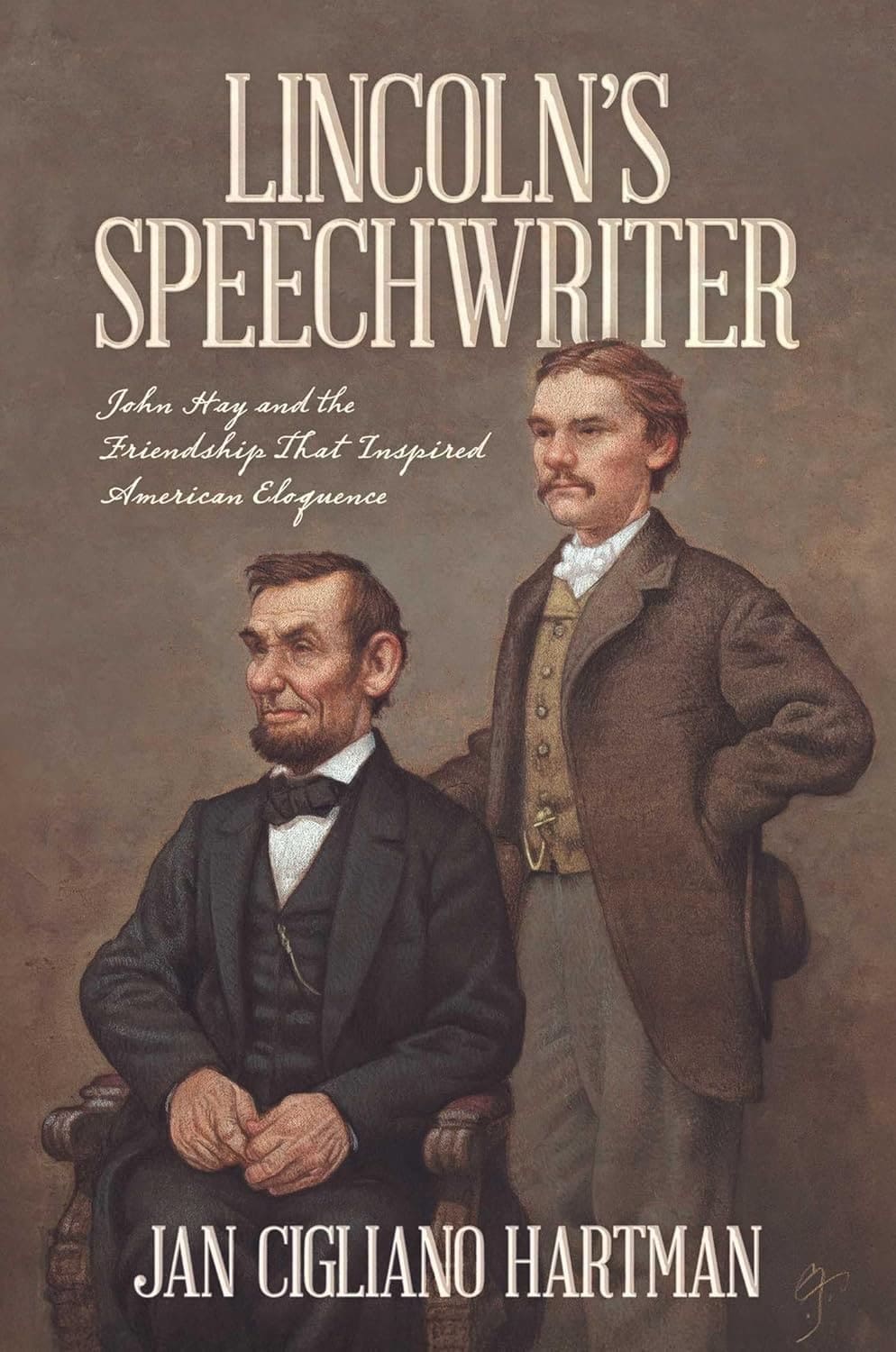
Lincoln’s Speechwriter: John Hay and the Friendship that Inspired American Eloquence. By Jan Cigliano Hartman. New York: Post Hill Press, 2026. Hardcover, 382 pp., $35.00.
Reviewed by Harold Holzer
Sometimes you can tell a book by its cover, and the dust jacket for Jan Cigliano Hartman’s Lincoln’s Speechwriter tellingly features a cropped adaptation of Alexander Gardner’s famous 1863 photograph of Abraham Lincoln with his private secretaries, John G. Nicolay and John Hay. But Nicolay is excised, Lincoln’s face contorted into a grimace, and his arms much reduced from their gorilla-like reach as if to declare: the President was shorthanded; he needed John Hay!
The title is even blunter: Hay wrote Lincoln’s speeches, it avers, even the iconic ones long credited to the sixteenth president alone—and a great many of Lincoln’s masterful letters as well. That’s quite a claim. And between the covers, the author provides little more than imagination and innuendo to support her case.
True, Lincoln scholars have been debating for years about Hay’s connection to one of the great works long universally attributed to Lincoln alone: his magisterial condolence letter to Lydia Bixy, who had reputedly lost five sons fighting for the Union, a claim that turned out to be untrue. Aside from its use of a few words unseen in other Lincoln writing, the principal argument for Hay’s authorship is that Hay kept a copy of the letter in his scrapbook. The original has never been located. Some speculate that Bixby, a Democrat, tossed it into the fire—so we may never know its authorship for sure.
Lincoln’s Speechwriter goes further to argue that Hay was also responsible for the biggest oratorical triumphs of Lincoln’s presidency because he kept copies of these gems in his scrapbook, too. The problem is, aside from the rank absurdity of the claim, is that we do have originals of these great orations in Lincoln’s own hand—in the case of the Gettysburg Address, several drafts along with copies he wrote out afterwards as souvenirs for fundraising fairs. Would he really write out these texts if he had a full-time speechwriter to do so?
Then there is the equally weak case for the Second Inaugural. Cigliano Hartman forgets that Lincoln may have given a copy to Hay because the young man was more his chronicler than his ghostwriter—and concurrently served loyally and usefully as a pseudonymous pro-Administration journalist.
Remember, Lincoln had his second inaugural set in type, then cut each line horizontally and pasted them, one by one, onto a large sheet of paper so he could read the text more easily in public. Yet like the Gettysburg Address, the pristine final handwritten draft does survive—complete with the great, hand-scrawled (by Lincoln) edit of those final words, brilliantly altering “peace among ourselves and with the world” to “with all nations.”
I will admit I enjoyed the sections of the book describing Hay’s upbringing and his experience at Brown University, and had not realized the young man was such a depressive—like his future boss. But I was jolted by some of the errors—Macbeth was Lincoln’s favorite Shakespeare play, for example, not Lear. (103) And to give Hay credit for Lincoln’s February 1860 Cooper Union Speech (a claim that cites my own 2004 book) is a leap of chronology and logic alike.
By the way, the book inexcusably lacks an index, for which the author and publisher should share blame. I would have welcomed the chance to connect the dots in this story by consulting and comparing entries under “A” for “Assumptions, unsupportable,” “E” for “Evidence, scant,” and “L” for “Leaps, giant.”
Decades ago, I worked as an occasional speechwriter for New York Governor, and acclaimed orator, Mario Cuomo. He enjoyed beginning many of his public remarks by declaring (to my embarrassment, if I was present), “I have a speech here, but I’m not going to read it,” and then proceeding without a script. Sometimes he even tore up the typescript or let it float to the ground for emphasis.
In 1980, Cuomo did ask me to compose an outline and, if I wanted, suggest some text, for a major address he was to give on February 12, 1986, before the Abraham Lincoln Association in Springfield. Cuomo knew a great deal about Lincoln, but knew I knew more. Unsatisfied with my first attempt, he made me do the outline a second time. But the final script he took to Springfield, printed in bold 16-point type, bore almost no resemblance to what I had drafted.
Eventually, I saw the final draft he had given his staff to type: nearly all of it hand-written in blue ink, with the occasional surviving excerpt from my original submission (bearing his corrections) scotch-taped between loose-leaf papers filled with his own writing.
Later, he gave the stack to me as a gift. Not in acknowledgment that I had written the speech, but as a reminder that I hadn’t.
Harold Holzer is Director of The Roosevelt House Public Policy Institute at Hunter College in New York City, a post he assumed in 2015 after 23 years as senior vice president of The Metropolitan Museum of Art. He also served for 10 years as co-chair of the U. S. Lincoln Bicentennial Commission, appointed by President Bill Clinton. In 2008, Holzer was awarded the National Humanities Medal by President George W. Bush. He currently serves as chairman of The Lincoln Forum.
Holzer is the author, co-author, or editor of 55 books on Lincoln and the Civil War era. His 2014 Lincoln and the Power of the Press: The War for Public Opinion won the Gilder-Lehrman Lincoln Prize and several other awards. In 2025 he was awarded a Guggenheim Fellowship. His most recent book is Brought Forth on This Continent: Abraham Lincoln and American Immigration (Dutton, 2024).


What a treat to read a review of a Lincoln book by America’s preeminent Lincoln scholar. More please.