Chaos on the Prairie: Thompson Raids Sedalia
ECW welcomes guest author William M. Koch.
On October 15, 1864, 1,200 Confederate cavalrymen under the command of M. Jeff Thompson, a brigadier general in the Missouri State Guard, charged into the prairie town of Sedalia, Missouri and were gone by the end of the day.[1] The event was marked by panicked militiamen, looting, and dubious paroles.
The raid on Sedalia was part of a larger incursion into Missouri made by Confederate troops in fall 1864. Under the command of Gen. Sterling Price, three cavalry divisions entered Missouri from Arkansas, aiming for the valuable city of St. Louis. Price’s cavalry’s first major encounter with Union forces was at Fort Davidson, at the town of Pilot Knob.[2] Despite having a substantial numerical advantage, a Confederate attack was repulsed on September 27, and the fort’s garrison escaped at night, coming within 80 yards of some of the Confederate camps.[3] This poor showing against a small garrison did not bode well for the rest of the campaign.
Abandoning the attempt on St. Louis, Price moved his troops westward, where he also decided against attempting to take the state capital of Jefferson City.[4] Price’s army was strengthened by the addition of many recruits in the Confederate-sympathizing areas west of Jefferson City, but these would-be soldiers were green farm boys, not veteran troops. Price sent a portion of his command to the Missouri River town of Glasgow to capture a reported cache of weapons. Around this same time, Thompson’s strike to Sedalia was also authorized.[5]
Sedalia, previously known as Sedville, had been platted in 1860. The following year, the Missouri Pacific Railroad was extended to Sedalia, which brought prosperity to the new town.[6] War came to Sedalia in 1861 in the form of Union troops passing through the town, and men from the area were mustered into militia units in 1861 and 1862.[7] Such militia forces were now Missouri’s primary defenders, with other troops having been transferred out of the state.[8] When Thompson struck, Sedalia was defended by an estimated 600 to 800 men, described as “citizens and home guards”, under the command of militia Col. J. D. Crawford.[9] These men were reinforced shortly before the attack by Capt. Oscar B. Queen and his 33 men of the 7th Missouri State Militia Cavalry.[10]
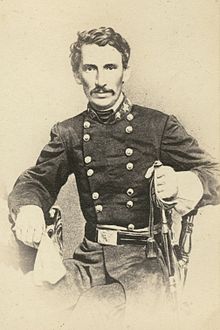
Queen described Sedalia as “well fortified,” and Thompson mentioned “two redoubts at opposite angles of the town, and continuous lines of rifle pits all around.”[11] Crawford, Queen, and the Union forces had to hold these lines against Thompson’s force, the core of which was composed of a Missouri cavalry brigade known as the Iron Brigade, Price’s most elite unit.[12] Along the way, Thompson had picked up Alonzo Slayback’s battalion of Missouri cavalry; this unit had been formed during the course of the campaign from new recruits, and the men had occupied some of the camps that Ewing had slipped by so closely at Fort Davidson.[13] To make matters more unusual, Thompson’s commission was from a pro-Confederate Missouri militia organization, and he was not actually a member of the official Confederate armed forces.[14] Price was sending his best troops on a detached raid under the command of a man who was not even a formal Confederate soldier!
What happened when the Confederate raiders struck the Union lines depends on which reports are consulted. Queen reported that Thompson’s attack hit shortly after Queen’s troops took up defensive positions within Sedalia, and that after the first Confederate artillery shot, “one general stampede of citizens and home guards took place.” Queen stated that Crawford had ordered the evacuation of the town, and that he had not been informed of this decision, instead finding that the city’s other defenders had fled and his men were in an isolated position. Queen and most of his men were taken prisoner.[15] Queen’s regimental commander, Col. John F. Philips, reported a similar tale, adding a jab towards the militiamen by stating that Queen had been “supposing it was [the duty] of the militia forces to defend it” when he took up his defensive positions, only to find that “the garrison had precipitately” fled.[16]
Thompson reported a more multi-stage battle. According to the Southerner, the leading regiment of his command scattered some Union pickets who were stationed about a mile from town, chased them across the open prairie to Sedalia, and breached the line of rifle pits before being driven out, an episode that doesn’t fit anywhere in Queen’s and Philips’ retelling of the events. Thompson then reported bringing up the rest of his forces and shelling the town, which caused the defenders to flee. He reported that since the United States flags over the defenses were not taken down in the flight, the Confederates assumed that the position was still held and continued the artillery barrage for several minutes after the position was abandoned.[17] A 19th-century local history notes that the bombardment was preceded by an unsuccessful attack by roughly 100 Confederates; this aligns more with Thompson’s report than Queen’s claim that the militia did not put up any real fight.[18]
What followed was clearly a chaotic scene of looting, although Thompson appears to have attempted to downplay the effects in his report. While admitting that “considerable plundering of the stores” happened, he was also “proud to say that no outrage or murder was committed” and that he was “confident the private houses were respected.”[19] Not mentioned by Thompson but found in later tellings of the raid by participants are the looting of the local post office and two instances of robbery of private citizens.[20] Other eyewitnesses reported Confederate raiders riding around barefoot carrying whiskey-filled boots, and Thompson was apparently compelled to “spank” a few of his soldiers with his sword while trying to restore order.[21] Thompson’s report includes the statement that Slayback’s men were used as the provost guard because his other units “having been broken in their charges, were less manageable.”[22] It is astonishing that Slayback’s green recruits, who had been derelict at Fort Davidson, were still more reliable for provost guard purposes than the vaunted Iron Brigade soldiers, given the rather minimal stand made by the militiamen.
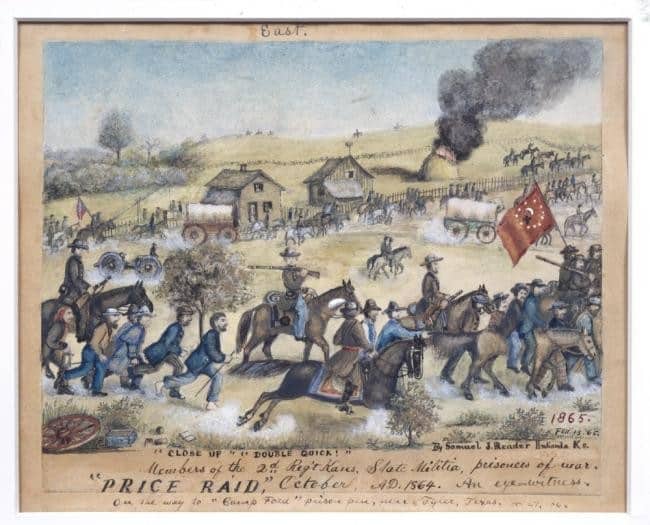
Queen’s men were given paroles and released. The Union authorities considered the paroles to be irregular and non-binding, and the departmental commander issued an opinion that they were non-binding.[23] Philips, evidently disgusted with the whole affair, referred to Thompson as a “mock general” while reporting the invalid paroles.[24] Thompson’s men left Sedalia after dark, moving to rejoin Price, whose army was defeated at Westport on October 23, shattered at Mine Creek on October 25, and retired into Texas and Arkansas in destitute condition.[25]
Arguably one of the more successful aspects of Price’s campaign, the raid on Sedalia had little long-term effect. The captured goods were soon more of a hindrance than a help to an army running for its life, and the Confederates left Missouri in worse condition than they arrived. Thompson’s raid, like Price’s larger effort, saw a triumphal entry, a short stay, and a hasty retreat.
William M. Koch has had a strong interest in the Civil War since a childhood visit to Wilson’s Creek National Battlefield. He is a certified public accountant and resides in southwestern Missouri.
Endnotes:
[1] Kyle S. Sinisi. The Last Hurrah, Sterling Price’s Missouri Expedition of 1864 (Lanham, MD: Rowman & Littlefield, 2020), 135-138.
[2] Frank J. Welcher. The Union Army, 1861-1865: Organization and Operations. Volume II: The Western Theater (Bloomington, IN: Indiana University Press, 1993), 739-740.
[3] Sinisi, 84-86.
[4] Welcher, 740-741.
[5] Howard N. Monnett. Action Before Westport, 1864 (Niwot, CO: University Press of Colorado, 1995), 29-31.
[6] The History of Pettis County, Missouri, Including an Authentic History of Sedalia, Other Towns, and Townships (n.p., 1882), 404-405.
[7] History of Pettis County, Missouri, 410-413.
[8] Charles D. Collins, Jr. Battlefield Atlas of Price’s Missouri Expedition of 1864 (Fort Leavenworth, KS: Combat Studies Institute Press, 2016), 27.
[9] The War of the Rebellion: The Official Records of the Union and Confederate Armies, Series I, Volume XLI, Part I, 364; Sinisi, 136.
[10] OR, Series I, Volume XLI, Part I, 364
[11] OR, Series I, Volume XLI, Part I, 364, 665.
[12] Collins, Jr., 39, 63.
[13] Sinisi, 84, 135; James E. McGhee, Guide to Missouri Confederate Units, 1861-1865 (Fayetteville, AR: University of Arkansas Press, 2008), 131.
[14] Bruce S. Allardice, More Generals in Gray (Baton Rouge, LA: Louisiana State University Press, 1995), 219-220.
[15] OR, Series I, Volume XLI, Part I, 364.
[16] OR, Series I, Volume XLI, Part I, 356-357.
[17] OR, Series I, Volume XLI, Part I, 665.
[18] History of Pettis County, Missouri, 389.
[19] Official Records, Series I, Volume XLI, Part I, 665.
[20] Mark A. Lause, The Collapse of Price’s Raid: The Beginning of the End in Civil War Missouri (Columbia, MO: University of Missouri Press, 2016), 37.
[21] Paul B. Jenkins, The Battle of Westport (Kansas City, MO: Franklin Hudson Publishing Co., 1906), 52-53; Sinisi, 137.
[22] OR, Series I, Volume XLI, Part I, 665.
[23] OR, Series I, Volume XLI, Part I, 364-365.
[24] OR, Series I, Volume XLI, Part I, 357.
[25] OR, Series I, Volume XLI, Part I, 665-666.


This was a nice read!
Great contribution! I’ve never heard of this before – I assumed Hood was the only Confederate who went on the offensive in the Western Theater in late 1864