John Adams Elder, Tom Lovell, Henry Kidd, and Don Troiani Tackle the Crater
The Crater has provided artists then and now with a subject seemingly fit for the canvas. Four in particular who tackled it are John Adams Elder, Tom Lovell, Henry Kidd, and Don Troiani. Each in their way tells one much about the artist and the times.
The most famous depiction was finished by John Adams Elder in 1869. Elder was born in 1833 in Fredericksburg, Virginia, and studied under Daniel Huntington in New York City and the famed Emanuel Leutze in Dusseldorf. Elder did not join the Confederate army until after Union forces bombarded his hometown during the battle of Fredericksburg.
The painting was commissioned by William Mahone, whose division played a crucial role in the Rebel victory at the Crater. Mahone was consolidating his railroad empire after the war and wanted to remind the skeptical of his role in the battle. Kevin Levin noted the painting was a strike at “Black assertiveness,” which “was much more pronounced in the former capital of the Confederacy, as the delegates debated provisions for the disfranchisement of high-ranking rebels, the confiscation of rebel property, the structure of taxation, and the improvement and integration of public facilities. In addition to advancement within the political realm, Virginia’s black population openly celebrated Emancipation Day, July Fourth, the fall of Richmond (known as Evacuation Day), and the surrender of Robert E. Lee’s Army of Northern Virginia.” The painting was, in a sense, a call to arms against the alliance that won the war and was now ruling Virginia. The call to arms came by showcasing one of the Union’s worst disasters.
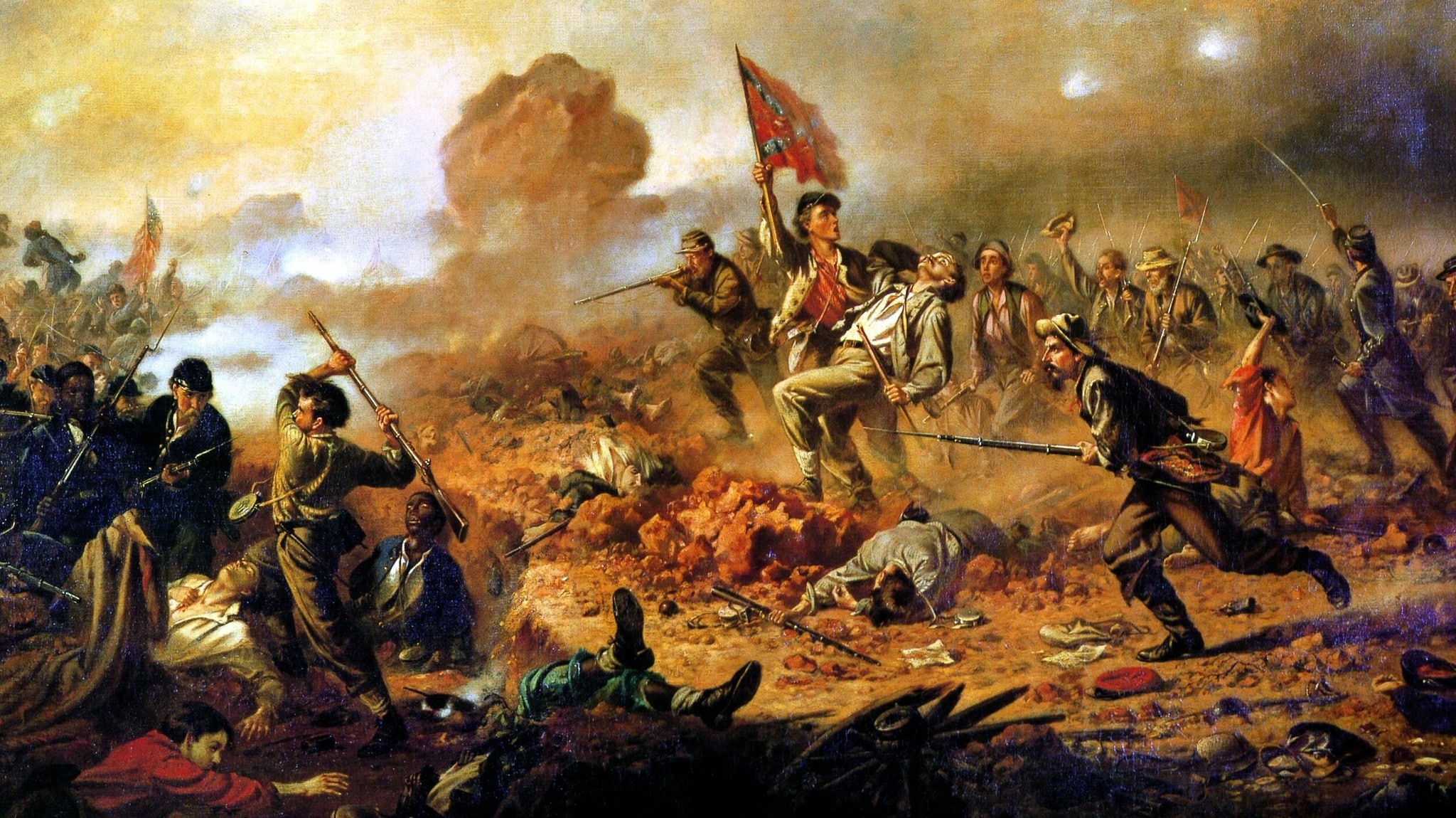 Yet, Elder’s work was also a celebration not of great leaders but common soldiers. The Lost Cause was noted for venerating Confederate leaders in statue and art, but often veterans meetings emphasized less Olympian heights. Gaines Foster argued in Ghosts of the Confederacy that the Lost Cause became much more popular around the 1880s once Southerners talked about Johnny Reb as much as they did Lee and Jackson. In Elder’s work, the 12th Virginia’s banner is held aloft by Sergeant William Smith, spliced in two. Smith counted 75 bullet holes in the banner. However, Mahone is not in the work, although “Mahone’s brigade” and indeed Mahone’s own beloved 12th Virginia are center stage. It places the emphasis on the soldiers of the Old Dominion; the regiments from Alabama, Georgia, North Carolina, and South Carolina have no place here.
In addition to the Crater, Elder completed studies of Stonewall Jackson, Robert E. Lee, and Jefferson Davis. A monument of a Confederate soldier that stood in downtown Alexandria, Virginia, based on his evocative painting “After Appomattox.” Other notable works included “Confederate With Captured Mount” and “Catching the Hare.”
While painting Davis in Biloxi, Mississippi, Elder caught malaria. Already weakened from alcohol abuse, Elder was incapacitated for the last five years of his life. He died in 1895 and was buried in Fredericksburg’s Confederate Cemetery in an unassuming grave.
While Elder was well regarded, I would venture that among the small cadre of Confederate veterans/artists, he is perhaps not as well thought of as Conrad Wise Chapman. It helps that Chapman did not craft “Eating Watermelon.” Yet, Elder’s Crater painting is striking. It was even made into postcards. Today the massive work, measuring 38 by 61 inches, hangs in the Westmoreland Club of Richmond, Virginia.
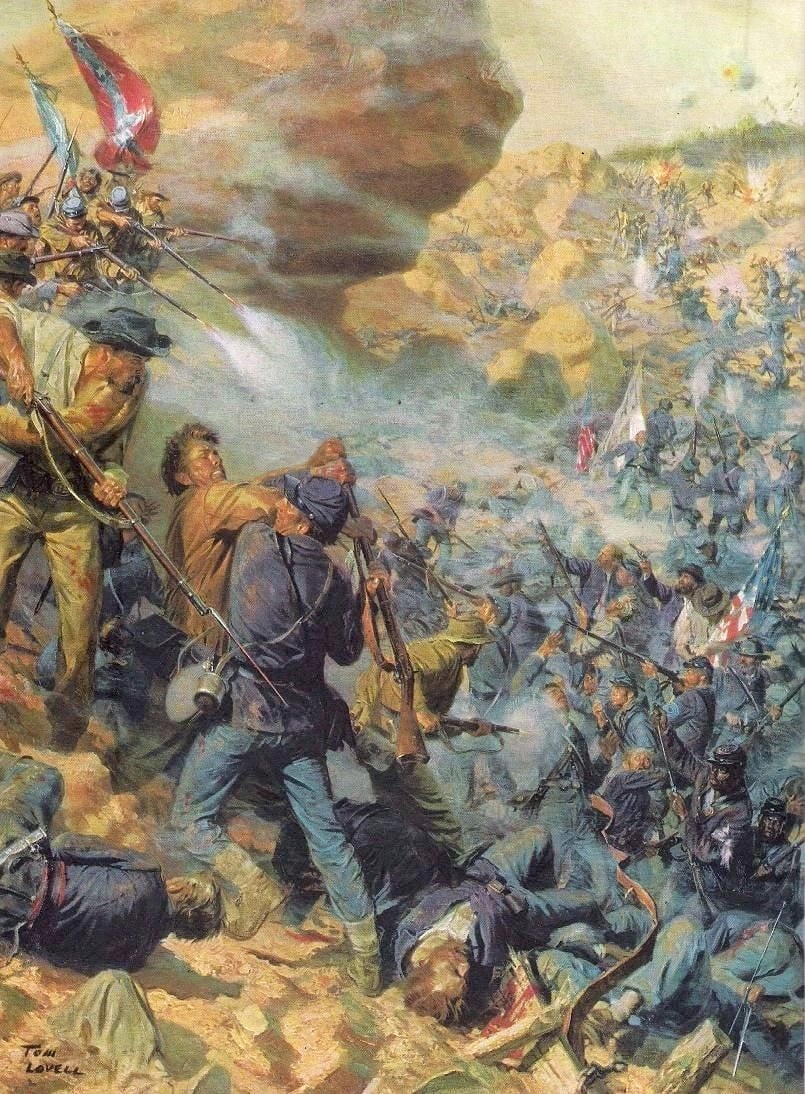
 In the 20th century, other artists took a crack at the Crater. The first would be Tom Lovell. He was a noted artist for those who enjoyed National Geographic magazine in the 1960s. He was by then an old hand; he first did pulp magazines before moving to more high-grade illustrations. Lovell did many works for the Civil War Centennial and often lesser-known engagements such as Battery Wagner (this was before Glory). For Gettysburg and Vicksburg, he did lesser-known scenes. His depiction of Appomattox is still the best. Compared to those who followed, Lovell was a bit more esoteric. He almost did a work on Sabine Pass and sketched it out but apparently did not paint it.
For The Crater, Lovell did not disappoint, and it was done in his signature style. There is both accuracy and high drama. The men look manly in that mid-20th-century way. That was even more obvious in his Battery Wagner work. His Robert Gould Shaw is more Errol Flynn than Matthew Broderick. His Marines entering Mexico City all appear more like tough movie stars than an army of marching veterans living on a simple diet. The Crater image is managed by Greenwich Publishing Group. Good luck getting them to answer about usage today. As such, while once common enough in publications, such as The Horrid Pit, it is absent now, and I could not put it in Unparalleled Horror nor use it as the book cover as I hoped.
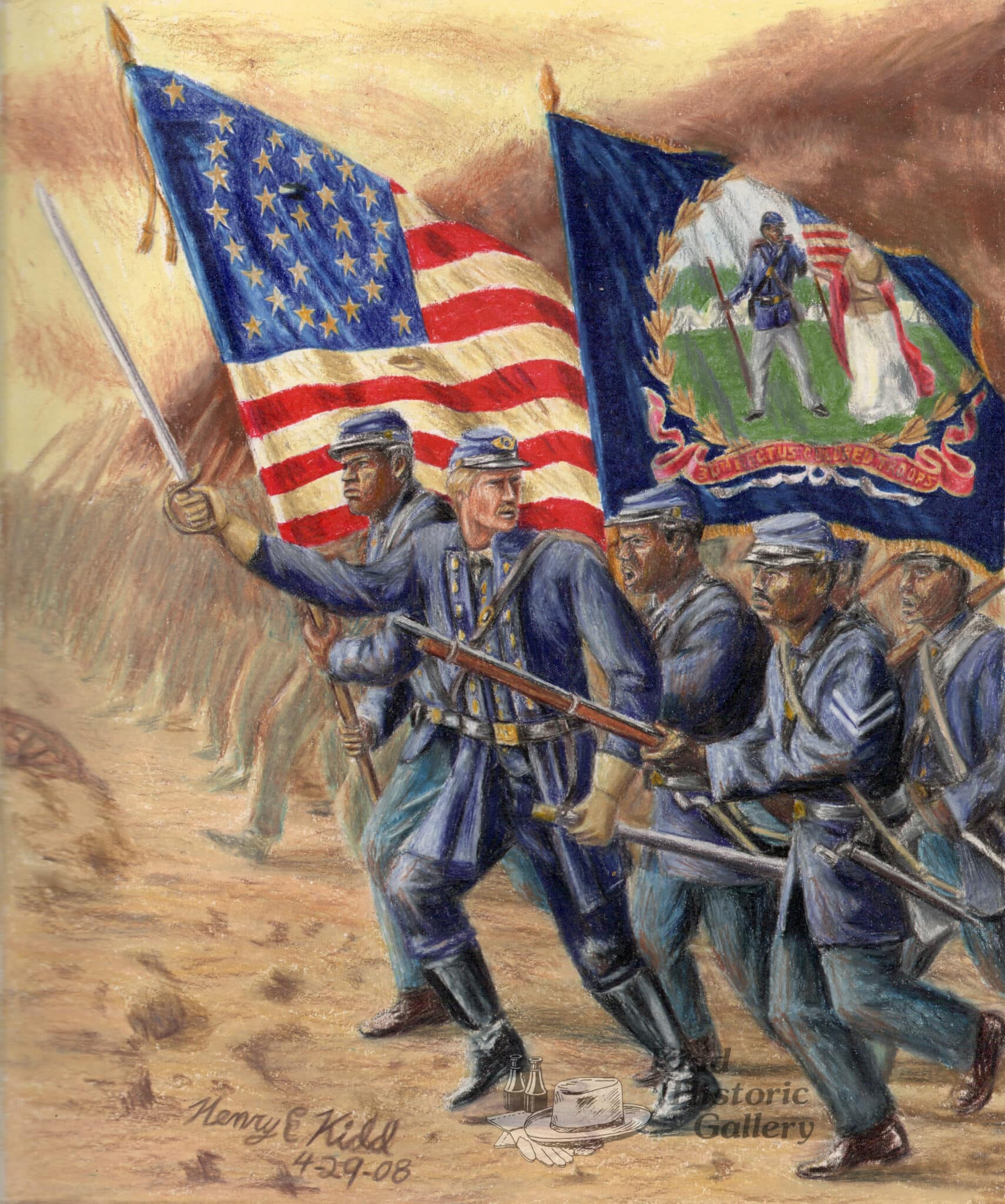
Next, there is Petersburg area resident Henry Kidd. He has done several works on the campaign, including a particularly good one titled “Iron Courage and Southern Chivalry.” That painting depicts Dennis Burke Dailey being captured by Johnson Hagood, a Confederate brigade commander at Globe Tavern. For the Crater, he did three works, but one with Lee hastening to the Crater is in black and white. Here are two color pieces: “Into the Abyss” and “Recapture the Crater.” The former shows the 30th USCT going into the fight, while the latter shows the battle’s last stages. While lacking in the blood and fury of Elder and Lovell, “Recapture the Crater” is a fine work by Kidd.
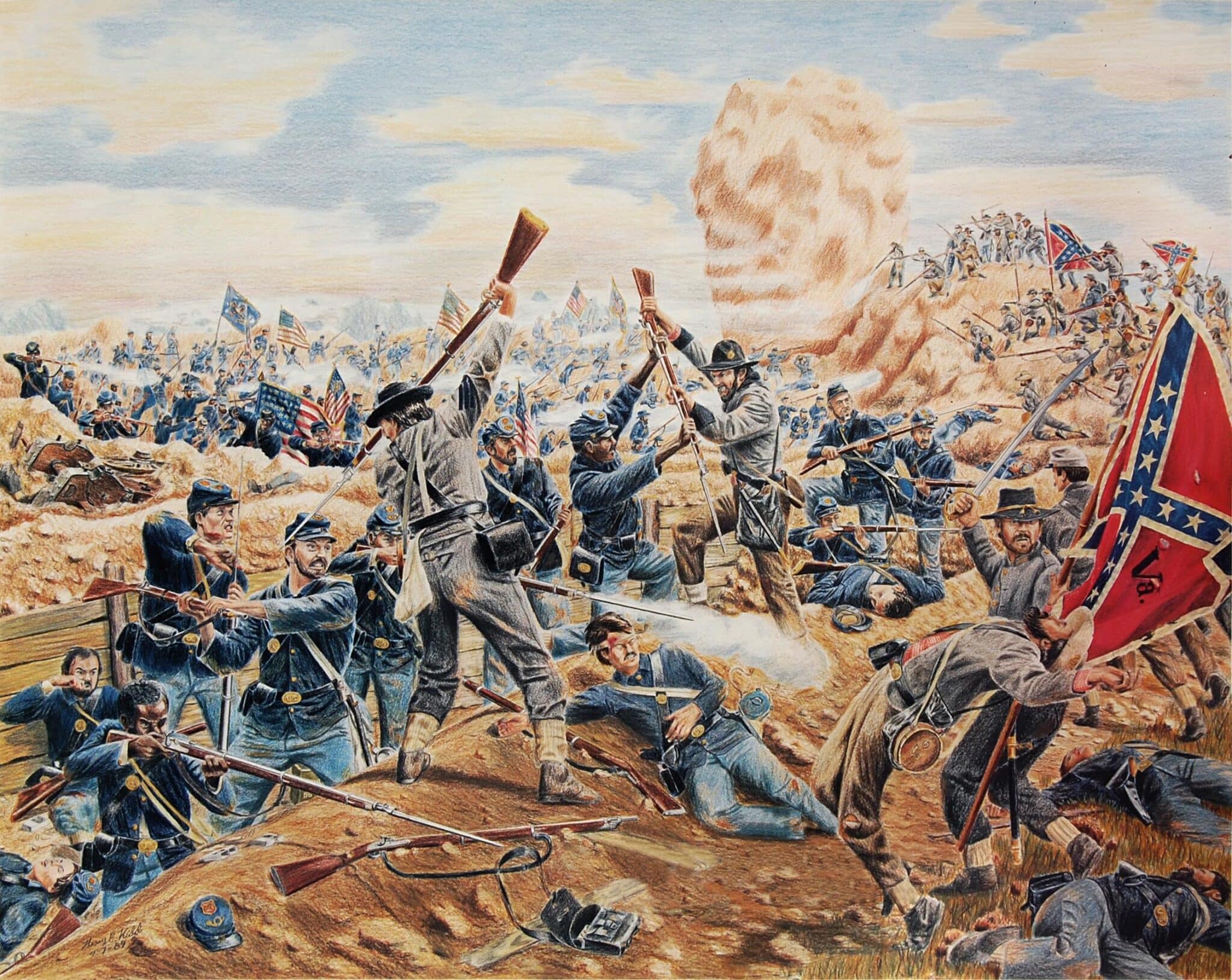 Kidd did much of his work in the high point of Civil War military genre painting. The era produced quite a few artists, with Don Troiani, Mort Kunstler, Rick Reeves, Keith Rocco, John Paul Strain, and Dale Gallon being particularly popular and successful. Each has garnered their share of respect and done some magnificent work. Each one, as well as Kidd, has made pieces I adore, although I confess my favorite Kunstler pieces are his pulpy World War II works. Yet, few tackled the Crater save Kidd and Troiani, the latter crafting “Mahone’s Counterattack.” It is like Elder’s work only reversed; from the point of view of the Federals, this time looking far more defiant, a USCT man holding a banner. One particularly good flourish is showing the Federals jammed inside the Crater, a major reason for the defeat that day.
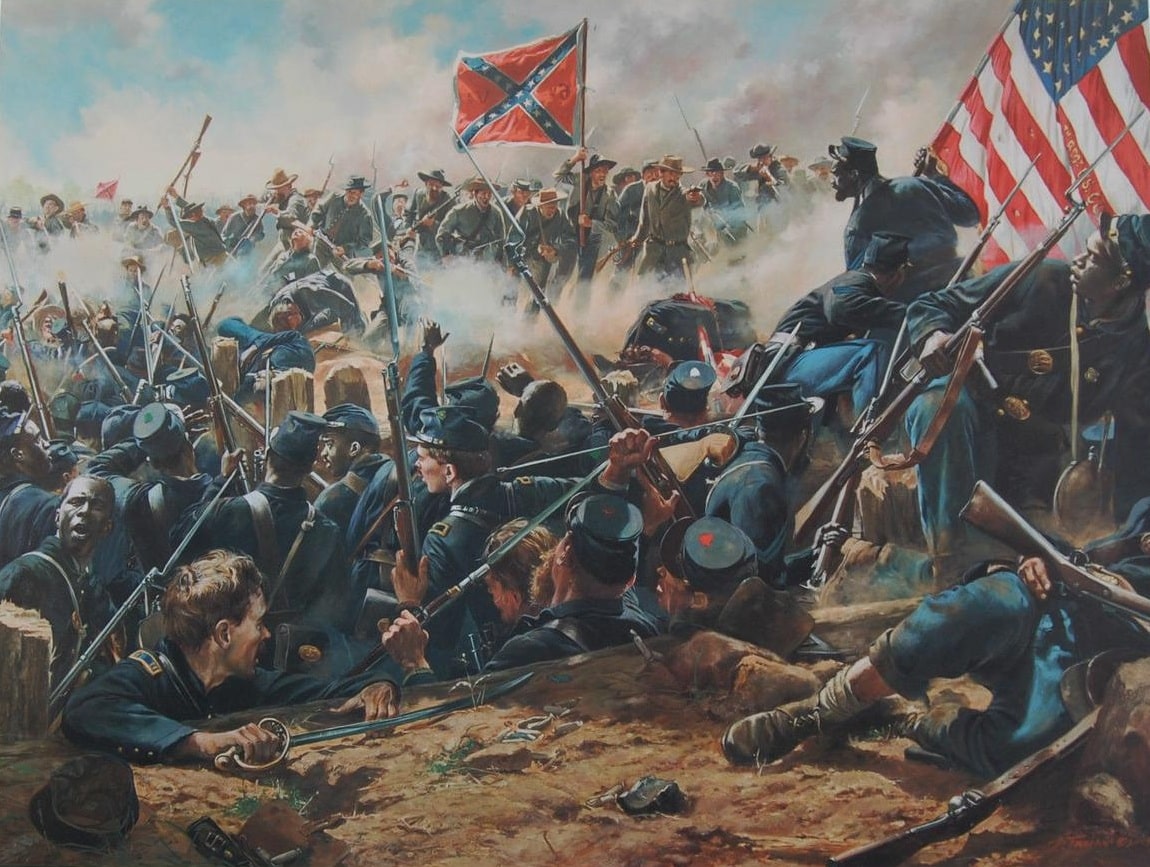
The Crater remains an underdeveloped subject. One reason is the horror of the battle and the murder of the USCT by both Confederates and even their white comrades. For myself, writing Unparalleled Horror with John Schmutz was difficult. Illustrating it sounds even more daunting.
And yet, we should have more because all battles are underserved next to Gettysburg. No other battle comes close, with seemingly every moment caught on canvas. Yet, it would be remiss not to mention obscure battles that did receive some attention during the heyday. Kunstler did a great piece on Fort Fisher; Troiani showed the 1st Maine Heavy Artillery at Petersburg. Rocco did Port Republic and Sayler’s Creek, and Strain took a stab at Brice’s Cross Roads. Gallon did one on Lexington and lesser-known vignettes from Gettysburg, such as the twilight attack at Cemetery Hill. I love his “Valley of Death.” Don Stivers gave Selma its due. Donna J. Near did North Anna.
Reeves might be the king here, having done work on Nashville, Mobile, and the Atlanta campaign. Then there is Andy Thomas’s excellent work for the Pea Ridge and Stones River battlefields. Sidney Eugene King (more a Lovell contemporary) did work on Fort Harrison and Petersburg. Henrico County Field of Honor features great bird’s-eye views by Henry Clow. In that work, you can see dramatic moments from Glendale, Fussell’s Mill, Fort Harrison, and others.
I applaud Kidd alone for doing so much on Petersburg. But more on the campaign should be made. Yet, in terms of quality, the Crater has certainly been at least well served.


Didn’t Mahone lead the Readjuster Party after the war, a populist state political party made up of a coalition that included black and white Virginians? The Readjusters funded schools for African Americans, including Virginia State, and abolished the poll tax.
Tom Lovell’s depiction of the Crater in the LIFE Magazine publication ‘Great Battles of the Civil War’ is nothing short of stunning, by far the best painting in that brilliant book, perhaps the best ever of a Civil War battle. My father bought me the book when I was five, not least because I was constantly asking questions about my two dozen ancestors who served, on both sides, in the war, and I was fortunate enough to have Bell I. Wiley go through the book with me and explain all the paintings and maps.
What were the other battles portrayed?
Given how often a mere handful of battle depictions shapes our memory of an engagement, it’s fascinating to explore the interplay between history and imagery. One shapes the other, and vice-versa, in a continual process.
thanks Sean … great piece … Lovell’s portrayal does the best job conveying the ferocity of the fighting … it’s also the only one that shows an actual crater … Lovell’s has some other good ones in the Life Magazine Mr. Shaefer mentions including Lovell’s portrayal of Dixon’s flotilla running the batteries at Vicksburg and the VMI cadets at New Market … a similar volume by National Geographic from 1969 has the Fort Wagner work that you mention and a lesser known Lovell painting showing Confederate troops trying to shoot down Dr. Lowes balloon during the Penisula Campaign.
“The painting was, in a sense, a call to arms against the alliance that won the war and was now ruling Virginia. The call to arms came by showcasing one of the Union’s worst disasters.”
Am always struck at how often some historians assign political motives, when other motives are even more likely. Yes, certainly, certain Southerners might well have been motivated by political angst when they point to significant battles or recall tales of glory. Was Mahone focused only on opposing modern politics when he sought such a painting? But, neither can it be ruled out that some veterans simply wish to recall some intense times of war. Dick Winters recalls war stories and he is not accused of rebelling against a new age.
In my business, my full-time job, I have to prove a person’s motive in firing or demoting a victim of discrimination everyday. Employment lawyers, we do that everyday. We are required to establish why someone did what they did. Just as historians wrestle with why Mahone wanted to record what was an unforgettable day for him – we also wrestle with why a manager fired a black, brown or white employee.
If I went into court and argued based on assumptions that the evil manager was motivated by race – based on nothing more than assumptions – the Judge would rightly fuss at me for lacking evidence. Assumptions are not evidence. But, when modern day historians do the same regarding Southerners after the Civil war, and what motivated them for memorializing a scarring, blood-filled day, the historians are lauded and seen as prescient and insightful.
Evidence in court, it appears, is much more demanding that evidence in history books.
Tom
I have a hard time understanding why Mahone would commission a painting “to strike at Black assertiveness,” when he was trying to appeal to those same black voters to join his political movement. To ascribe that motive to him makes no sense.
The Readjuster movement was, at the time, still ten years down the road. The commissioning of the painting took place just as Mahone was working on consolidating his rail lines. It was an incredibly explosive political issue. What I argue in my book, based on the available source material, is that Mahone used his wartime reputation to gain favor in Richmond and around the state. I go into all of this in my book REMEMBERING THE BATTLE OF THE CRATER: WAR AS MURDER.
In the wake of the Crater, Mahone was corrected by the Richmond Press for his attempts to curb the atrocities of July 31. For example, the Richmond Enquirer in the August 1-2, 1864 issue: “Let every salient we are called upon to defend be a Fort Pillow, and butcher every negro that Grant hurls against our brave troops, and permit them not to soil their hands with the capture of the negro.” And, “We beg [Mahone] hereafter, when negroes are sent forward to murder the wounded and come shouting ‘no quarter,’ shut your eyes, General, strengthen your stomach with a little brandy and water, and let the work which God has entrusted to you and your brave men, go forward to its full completion; that is until every negro has been slaughtered.”
I enjoyed the exploration of Crater art. Thanks, Sean.