They Look Like Men of War
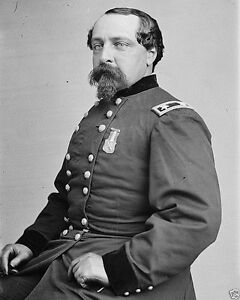
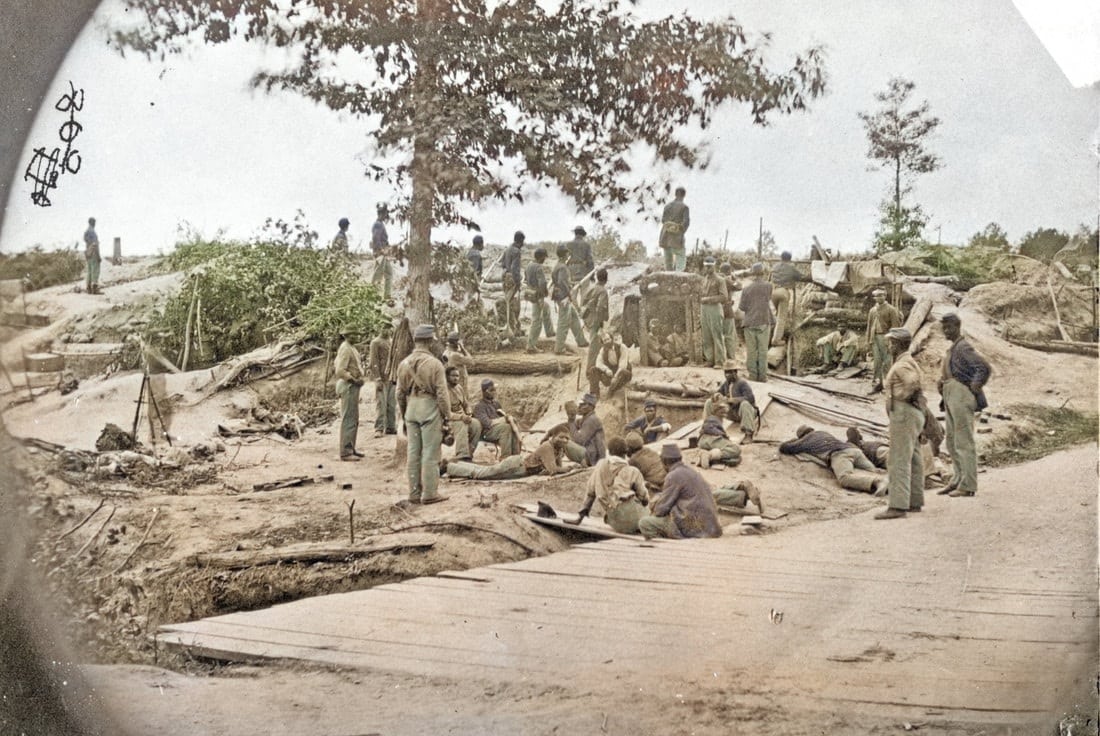
In the Overland campaign, the Army of the Potomac contained one division of United States Colored Troops (USCT), comprised of the 19th, 23rd, 27th, 29th, 30th, 31st, 39th, and 43rd USCT. Some were free people of color from the North, but most were escaped slaves now armed in a war to free their brethren. They paraded before Abraham Lincoln and then joined IX Corps for the 1864 campaign. Their two brigade division was led by Edward Ferrero. He fought under Ambrose Burnside throughout the war, earning accolades at Roanoke Island and Antietam. Burnside thought well of Ferrero and praised him for his skill at training the USCT. Ferrero also had an admirer in Robert E. Lee, who hired him to teach dancing at West Point. Indeed, Ferrero was the nation’s foremost dance teacher and famed for his 1859 book The Art of Dancing.
Ferrero’s division guarded the rear of the army, in particular the wagon train and later Rebel prisoners. The 23rd USCT was at the Chancellorsville ruins on May 15, 1864, when the 2nd Ohio Cavalry asked for assistance. They were under attack by Thomas Rosser’s cavalry brigade, and Ferrero wrote they “drove the enemy in perfect rout.” It was the first time the USCT saw major combat in Virginia.
Petersburg would see the most extensive use of the USCT in the Civil War. Their presence made IX Corps’s trenches the most treacherous in the Petersburg lines. Rebel soldiers vigorously sniped and often ignored the unofficial truces that were common elsewhere. They were also angered because this was where Federal cannon fired directly into Petersburg.
In the campaign’s opening days, William Johnson of the 23rd USCT was executed on charges of desertion and rape. Provost Marshal Marsena Rudolph Patrick decided to make the execution a spectacle and sited the gallows on Jordan House Hill in full view of the Confederates to show them that the Federals would not tolerate mistreatment of Southern women. Instead, Confederate artillery opened up as an attendant applied a blindfold.
Days before, George F. Polley carved on a wooden headboard the words, “Serg.-Major George F. Polley, 10th Mass. Vols.; Killed June ___, 1864,” telling his colonel, “I guess I’ll leave the day blank.” On June 19 their enlistments expired, and Polley split up the headboard to make coffee. Just as Johnson was hanged a shell killed Polley. The 10th Massachusetts left the front the next day. For them, the Petersburg campaign was the shortest of the war. For Ferrero’s USCT, it was only the beginning.
Ferrero was among the few in the high command who was optimistic about Burnside’s planned mine attack. He wanted his USCT to lead the assault. They were mostly untested in battle, but were well drilled and eager. Burnside readily agreed,
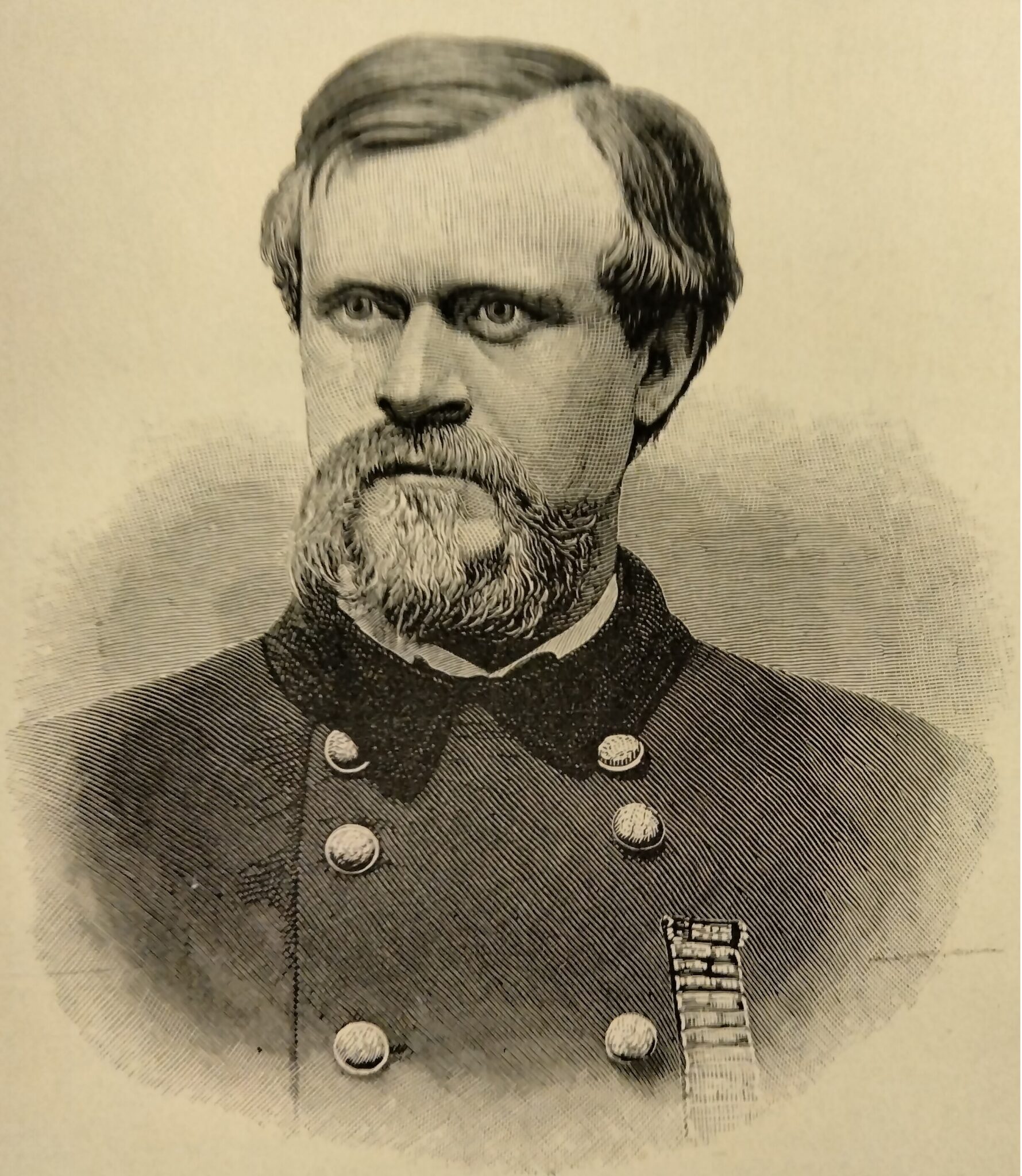
Henry George Thomas, commanding a USCT brigade under Ferrero, recalled in the article “The Colored Troops at Petersburg” in Battles and Leaders:
“The night we learned that we were to lead the charge the news filled them too full for ordinary utterance. The joyous negro guffaw always breaking out about the camp-fire ceased. They formed circles in their company streets and were sitting on the ground intently and solemnly. Then, aft er a long quiet a heavy voice began to sing.”
“We-e looks li-ike me-en a-a-marchin’ on,
We looks li-ike men-er-war.”
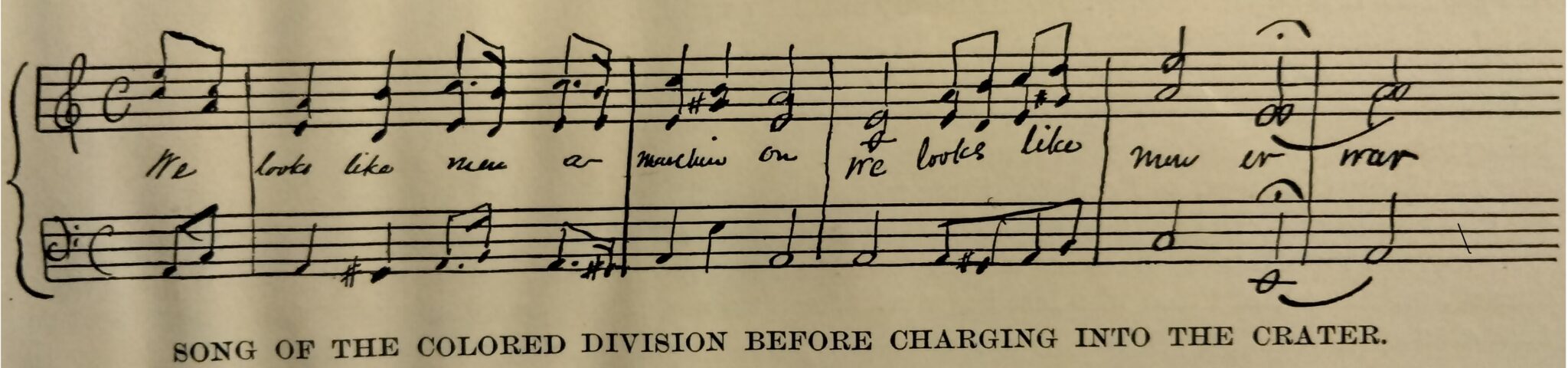
“Over and over again he sang it, making slight changes in the melody” Thomas noted. Thomas made a point to describe how such songs were crafted, writing that “important news such as that before us, after the bare announcement, was usually followed by long silence. They sat about in groups, ‘studying,’ as they called it. They waited like the Quakers, for the spirit to move; when the spirit moved, one of their singers would uplift a mighty voice, like a bard of old, in a wild sort of chant. If he did not strike a sympathetic chord in his hearers, if they did not find in his utterance the exponent of their idea, he would sing it again and again, altering sometimes the words, more often the music. If his changes met general acceptance, one voice after another would chime in; a rough harmony of three parts would add itself ; other groups would join his, and the song would become the song of the command.”
The song stuck, according to Thomas: “The rest listened to him intently; no sign of approval or disapproval escaped their lips or appeared on their faces. All at once, when his refrain had struck the right response in their hearts, his group took it up, and shortly half a thousand voices were upraised extemporizing a half dissonant middle part and bass. It was a picturesque scene – these dark men, with their white eyes and teeth and full red lips, crouching over a smoldering camp-fire, in dusky shadow, with only the feeble rays of the lanterns of the first sergeants and the lights of the candles dimly showing through the tents. The sound was as weird as the scene, when all the voices struck the low E (last note but one), held it, and with a portamento as sonorous as it was clumsy.”
The song was not new. It was written by Hattie Hill and John A. Granade, a white Methodist preacher in North Carolina. Usually titled “Hark! Listen to the Trumpeter,” and occasionally “The Trumpeters” or “The Volunteers,” it gained popularity with black Christians, showing up in 1837’s The African Methodist Episcopal Church Hymn Book. Its first documented appearance in the Civil War was December 1863 in the ranks of the 9th USCT, which by July 1864 was in Benjamin Butler’s Army of the James.
Ferrero’s men toiled and trained for the attack, but in the end George Meade and Ulysses S. Grant decided against using them in the first wave. Meade and his staff were cold toward the USCT. Meade noted their inexperience and was concerned it would appear the army was “shoving those people ahead to get killed because we did not care anything about them.” Grant had similar fears and backed up Meade over Burnside’s protest.
Thomas and the men received the news of their demoted position with trepidation. “I returned to that bivouac dejected and with an instinct of disaster for the morrow,” recalled Thomas. He added, “As I summoned and told my regimental commanders, their faces expressed the same feeling.”
They were right. The first wave at the Crater was mishandled, and by the time the USCT went in, the battle was effectively lost. They suffered terrible losses. Men were murdered, some by fellow Federals eager to prove to the Rebels they were no friends of the USCT. “Leaden hail poured for a long time almost incessantly about that spot, killing the wounded and mutilating the dead,” recalled Thomas, and the 31st USCT “were being mowed down like grass, with no hope of any one reaching the crest… My command was crowded into the pits, already too full, and were sandwiched, man for man, against the men of the First Division.”
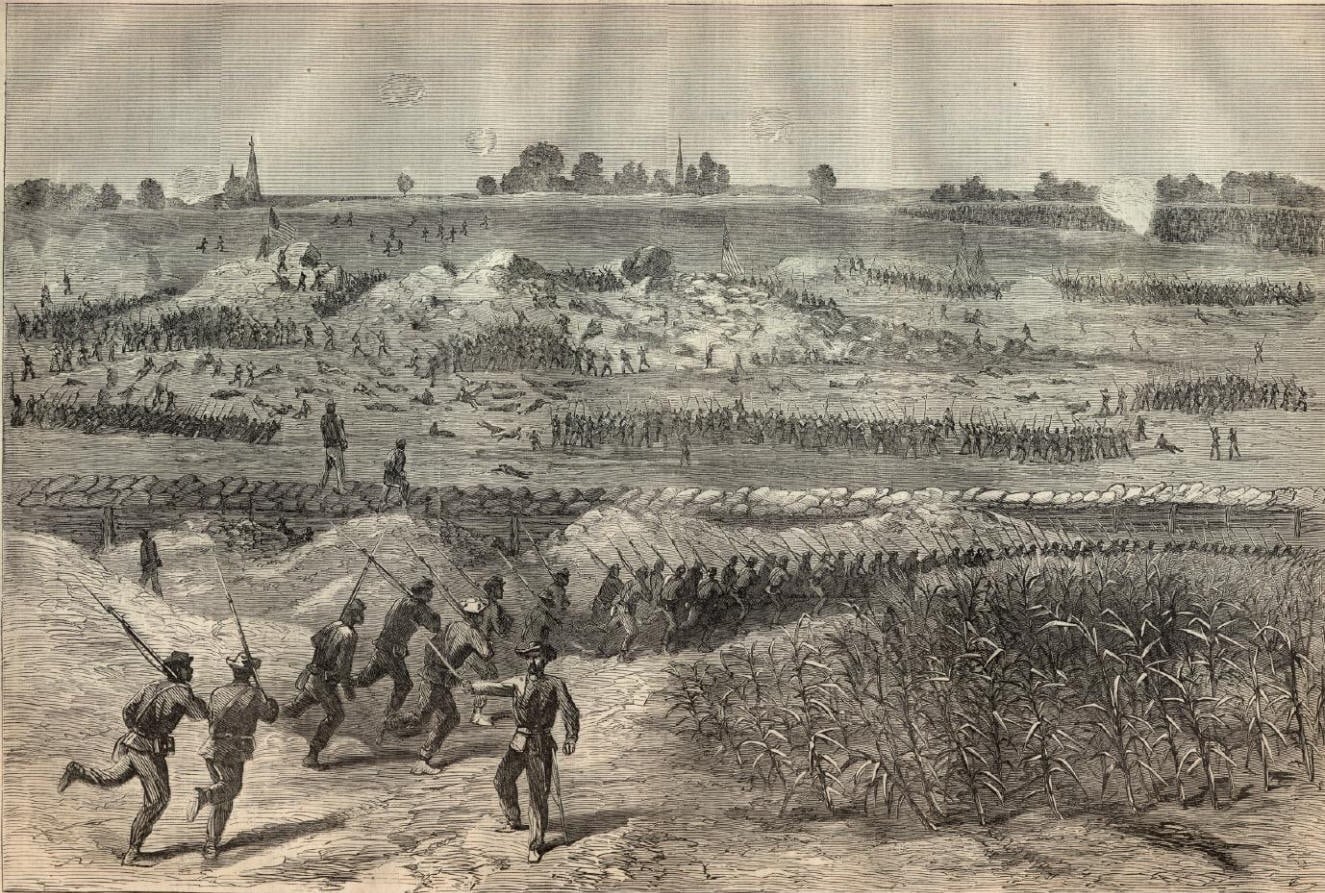
Thomas asserted that he lost “in all 36 officers and 877 men,-total, 913. The 23d Regiment entered the charge with eighteen officers; it came out with seven. The 28th entered with eleven officers, and came out with four. The 31st had but two officers for duty that night.”
For the USCT, it was not the end, although the regiments in Butler’s Army of the James saw more action: Fussell’s Mill, Fort Harrison, and Fair Oaks before the year was out. At Fort Harrison they would storm New Market Heights, fourteen USCT winning the Medal of Honor along with two of their officers. Yet, a cloud always hung over the USCT in Virginia. Many blamed them for the Crater fiasco. Theodore Lyman III, who was as close to Meade as any, concluded, “you never, in the long run, can make negroes fight with success against white men. When the whole weight of history is on one side, you may be sure that side is the correct one.” In December 1864 the Crater regiments were transferred over to Butler’s army to form the XXV Corps. The regiments entered 1865 in a way more segregated than they did in 1864.
And what of the song? Thomas recalled, “Until we fought the battle of the crater they sang this every night to the exclusion of all other songs. After that defeat they sang it no more.”
Yet, the song lived on. Samuel Chapman Armstrong, an officer with the 9th USCT, noted it. He was not with the 9th USCT at Petersburg; following Olustee, he was sent to lead the battered 8th USCT, which was at Petersburg but not the Crater. After the war he founded what became Hampton University, where it was sung well into the 20th century and recorded by the Deep River Boys. It can be heard here: https://www.youtube.com/watch?v=T6AaUsKMCP4&list=WL&index=121
This post was crafted with aid from Lucas Simmons. I also recommend this essay by Sandra Jean Graham, author of Spirituals and the Birth of a Black Entertainment Industry: https://www.loc.gov/static/programs/national-recording-preservation-board/documents/They-Look-Like-Men-of-War_Graham.pdf
“They Look Like Men of War” by the Deep River Boys:
Hark! Listen to the trumpeters!
They call for volunteers,
On Zion’s bright and flowery mount
Behold the officers!
Refrain:
They look like men, they look like men
They look like men of war,
All armed and dressed in uniform,
They look like men of war.
Their horses white, their armor bright,
With courage behold they stand.
Enlisting soldiers for their King
To march to Canaan’s Land
Refrain
They follow their great General,
The great Eternal Lamb;
His garments stained in His own blood,
King Jesus is his name.
Refrain
We want no cowards in our bad,
That will their colors fly;
We call for valiant-hearted men
Who’re not afraid to die.
Refrain


