Book Review: Death or Victory: The Louisiana Native Guards and the Black Military’s Significance in the Civil War

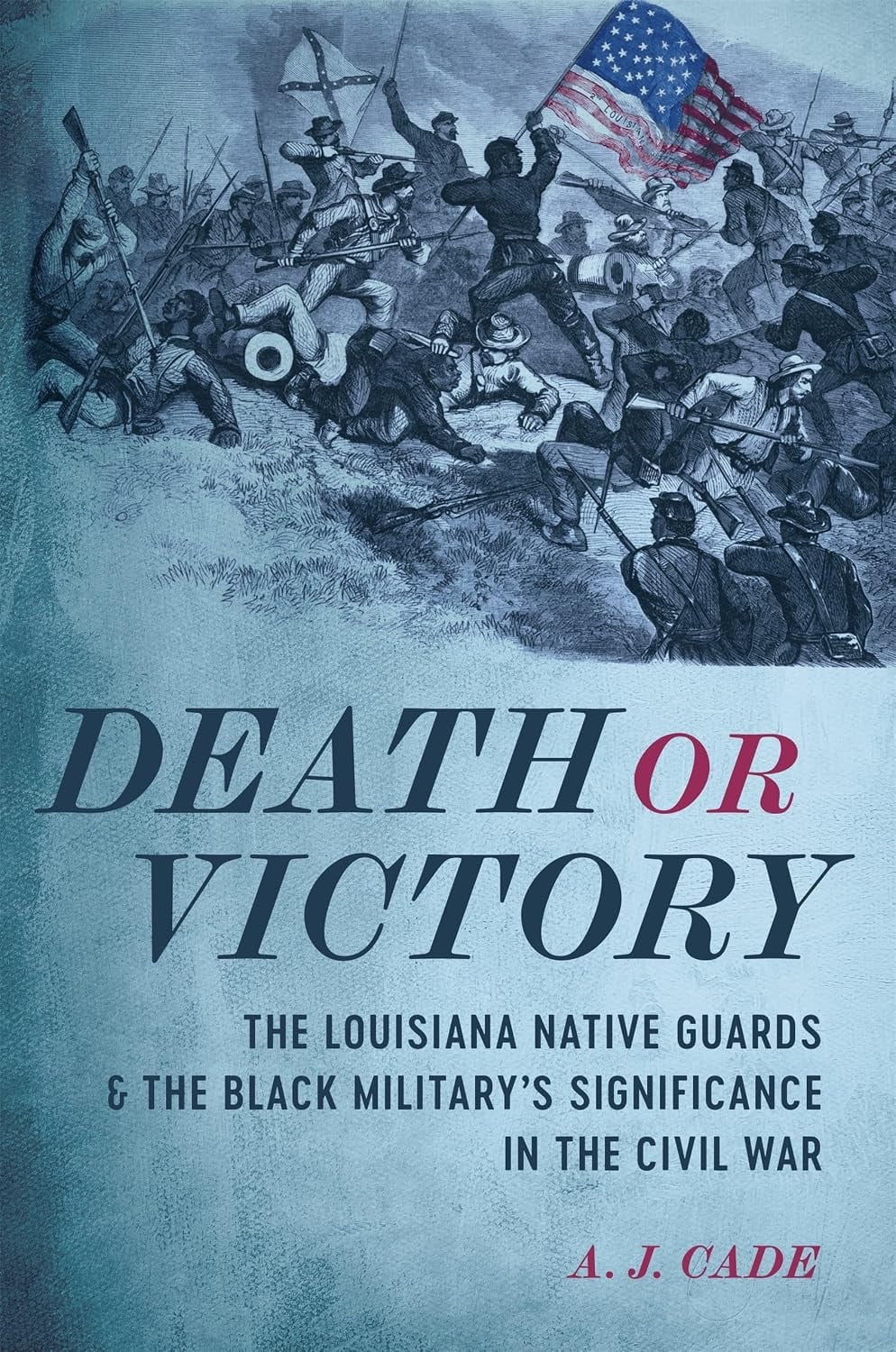
Death or Victory: The Louisiana Native Guards and the Black Military’s Significance in the Civil War. By A.J. Cade. Baton Rouge: Louisiana State University Press, 2026. Hardcover, 396 pp. $49.95.
Reviewed by Madison Smith
The historiography of African American military service during the Civil War has long centered on regiments such as the 54th Massachusetts Infantry, often relegating other Black units to the margins of scholarship. In Death or Victory, Andrew Cade seeks to correct this imbalance by placing the Louisiana Native Guards at the forefront of the story of Black military service, citizenship, and political transformation. Through extensive archival research and engagement with existing scholarship, Cade argues that the Native Guards were not only the first federally recognized Black regiment of the Civil War, but also its most consequential. Rather than treating enlistment as simply another chapter in the history of emancipation, Cade reframes the regiment as the experiment through which Black citizenship itself was tested, contested, and ultimately advanced through military service.
Rather than presenting a conventional regimental history, Cade situates the Native Guards within larger questions of race, freedom, memory, and political power. Drawing upon Michel-Rolph Trouillot’s concept of historical silences,[1] he argues that the regiment has remained understudied not because it lacked historical significance, but because its story became obscured through fragmented archives and racialized historical memory. This historiographical intervention elevates the work beyond the recovery of an overlooked regiment by demonstrating how historical narratives are constructed and preserved.
The book’s greatest strength lies in its archival foundation. Cade synthesizes military correspondence, official records, newspapers, diaries, plantation records, autobiographies, speeches, general orders, and personal letters to reconstruct the experiences of the Native Guards from both institutional and personal perspectives. His chronological organization effectively reinforces the book’s central argument, allowing readers to follow the regiment’s evolution while continually returning to the relationship between military service and Black citizenship. The opening chapters reject earlier interpretations that portrayed the original Native Guards as defenders of the Confederacy, instead demonstrating that their motivations were rooted in protecting their communities and creating opportunities for Black advancement. Cade further argues that the regiment’s formation pressured federal officials to reconsider the exclusion of African Americans from military service, making the Native Guards catalysts for broader changes.
The heart of the book emerges in chapters Five through Seven, where Cade traces the increasingly complex relationship between military service and citizenship. Native Guards soldiers understood that failure in combat would be interpreted not as individual shortcomings, but as evidence against the military capabilities of African Americans more broadly. Their battlefield performance therefore became a political statement as much as a military achievement. Cade convincingly demonstrates that military service functioned as an argument for Black equality, even as racism within the Union Army continued to undermine that very claim. As Cade himself writes, “…the true test for the Native Guards was not simply to show that they could be soldiers, but that they were men equal to everyone else in the army.” (285)
Equally compelling is Cade’s treatment of military leadership. Unlike many later United States Colored Troops regiments, the Native Guards initially possessed an unusually high proportion of officers of color. Cade demonstrates how this leadership structure deteriorated under Gen. Nathaniel Banks, whose administration oversaw the removal of many Black officers. Rather than portraying their white replacements as a monolithic group, Cade identifies a range of motivations, from genuine commitment to opportunism and incompetence. This nuanced discussion reinforces one of the book’s central tensions: while the Native Guards proved Black men’s capabilities as soldiers and leaders, institutional racism continued to limit the extent to which military service translated into genuine equality.
Perhaps the book’s greatest contribution is its refusal to treat military success as the endpoint of the story. Cade follows the Native Guards beyond the battlefield, examining how discrimination, the removal of Black officers, and unequal treatment shaped veterans’ postwar political activism. In his telling, the regiment emerges not simply as a military unit, but as a group of political actors whose fight for citizenship extended well beyond Appomattox. If the book leaves readers wanting anything more, it is a deeper exploration of the Native Guards’ influence during Reconstruction. Given Cade’s persuasive argument that military service became the foundation for continued claims to Black citizenship, additional discussion of the regiment’s long-term political legacy would have further strengthened an already compelling interpretation. This minor observation, however, does little to diminish the book’s significance.
Death or Victory successfully restores the Louisiana Native Guards to the center of Civil War historiography while fundamentally reframing the relationship between military service and Black citizenship. By demonstrating that the Native Guards became the federal government’s proving ground for Black military service—and, by extension, Black claims to citizenship—Cade moves beyond a traditional regimental history to offer a broader reinterpretation of emancipation, military service, and political equality. The result is an important contribution to Civil War, African American, military, and Reconstruction history that will be of interest to both scholars and general readers.
Madison Smith is a historian and educator whose research focuses on race, immigration, citizenship, and belonging in nineteenth-century America. She earned her graduate degree in history from Virginia Tech, where her work examined Chinese immigration during the exclusion era and the experiences of Chinese soldiers and sailors during the American Civil War. Her broader interests include Asian American history, legal history, public history, and digital humanities.
[1] Michel-Rolph Trouillot, Silencing the Past: Power and the Production of History (Boston, MA, Beacon Press, 1995).


I look forward to buying and reading this book. Some of these Louisiana Native Guards/USCT fought in a “skirmish” in my hometown of Jackson, Louisiana on the evening of August 3, 1863.
Union black and white soldiers (described as “mixed colors” by the Confederate commander), sent from Port Hudson to Jackson, Louisiana to “collect negroes for the Twelfth Regiment Infantry, Corps d’Afrique”, along with a number of “collected” black men from surrounding plantations stood shoulder to shoulder for a moment on the grounds of the old Centenary College campus (kind of similar to the Pennsylvania College grounds at Gettysburg). The Union men, numbering around 350, at least 250 being USCT soldiers plus 50 or so “collected” black men, were surprised and routed by a contingent of Confederates numbering around 500. Maybe 100 or so of the black soldiers and civilians, along with some white soldiers were killed, wounded, or captured by the Confederates. The Union commanding officer, West Point Brigadier General George L. Andrews of Massachusetts, reported that one or two of the captured black soldiers were hung and several more beaten. Andrews “sent two flags of truce to the enemy at Jackson, one to inquire about our wounded and one to demand explanations from [Colonel] Logan with regard to the treatment of colored soldiers when prisoners of war.”
The Confederate commanding officer, Arkansan Colonel John L. Logan reported “whipping [the enemy] handsomely, driving him from the town, capturing two Parrott guns, horses, ten wagons with commissary stores, killing, wounding, and capturing not less than 100 Yankees and a large number of negroes in arms. The enemy fled in the greatest confusion, leaving his dead and wounded behind him. It was a complete rout”. Also in his after battle report Logan queried Lieutenant-General Hardee, the new department commander, about what to do with the captured black soldiers — “What disposition shall I make of negroes captured in arms? Port Hudson is garrisoned by 7,000 Yankee troops and armed negroes.”
U.S. War Department, The War of the Rebellion (Washington, D.C.: GPO, 1880–1901), Series 1, vol. 26, pt. 1, p. 239-240.
Excellent review! I’ve heard Dr. Cade speak on this topic a couple of times and look forward to reading the book.