The Prony Incident
ECW welcomes back guest author Dean W. Chester.
Recently, I came across a newspapers.com article about the November 5, 1861, wreck of a French warship near Ocracoke Inlet, North Carolina. Having just finished reading This Great Contest Afloat, by author Neil Chatelain, I immediately recalled Neil’s discussion of the challenges faced by the United States after President Abrham Lincoln’s April 19, 1861, announcement of his naval “blockade of ports within the states” in insurrection.[1]
The proclamation by itself was insufficient to compel compliance. Per the 1856 Paris Declaration Respecting Maritime Law, to which the United States was not a signatory, a blockading nation had to demonstrate the capability to enforce it. After his proclamation Great Britain and France, the two most powerful signatory nations, routinely patrolled the coastal waters of the United States to observe and document whether the United States’ activities were “adequate to maintain effectively the Blockade.”[2]
On July 22, 1861, the French corvette Prony, a 1365-ton paddle wheel steamer, departed Toulon, France to join the French fleet in North America, stationed at Halifax.[3] The fleet operated along the coast of North America and in the waters of the West Indies and only had one standing order, “protect French interests if necessary.”[4] During the crossing Prony received instructions from Adm. Reynaud, commanding the fleet, to continue to Halifax, then to New York City, and then Charleston, South Carolina. She arrived at Charleston on Thursday, October 31, with dispatches for the French Consul in Charleston and two important passengers, “W. E. [Edmund] Molyneaux, the British Counsel in Savannah, Georgia and his lady,” who boarded in New York.[5]
Prony departed Charleston on November 2, delayed by late dispatches and weather. As Prony’s captain, Cmdr. de Fontanges was being escorted under a “privileged flag” to his ship outside the bar, three Union vessels approached, and one reportedly fired on the steamer in spite of the flag.[6] Prony dispatched a launch, and de Fontanges continued over the bar under the French tricolors. He later complained about this “‘mean Yankee trick,’ [which] gave him no favorable opinion of the morals of the Federal Navy.”[7] The corvette weighed anchor and headed north as storm clouds appeared on the horizon.
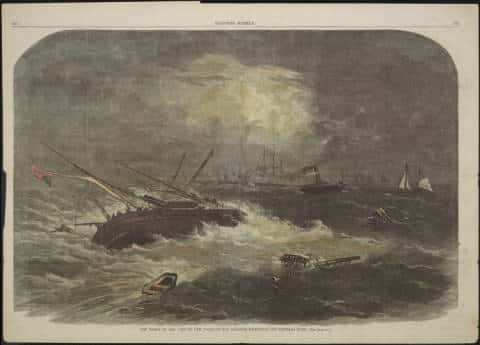
Early on November 4 Col. George B. Singletary, commander of the 27th North Carolina, ordered the steamer Albemarle and schooner Napoleon to proceed down the Neuse River from New Bern to Pamlico Sound.[8] The vessels were conducting a reconnaissance expedition around Hatteras to determine if the recent gale had damaged any of the Union fortifications and the conditions at Beacon Island near Ocracoke Inlet. Finding no opportunities to exploit, they anchored off Beacon Island that evening.[9] At about 3 a.m. on November 5, lookouts reported signal rockets from the bar. Daybreak revealed a warship aground and in distress. Believing the vessel was a U.S. Navy steamer, a shot was fired towards it. A French flag was quickly hoisted; it was Prony. Singletary and the ship captains changed their focus from capture to relief or rescue.[10]
For several hours launches and lifeboats traversed the breakers as the officers explored options to free the vessel. De Fontanges requested Albemarle and Napoleon move closer to the bar so he could transfer his 30-pounder guns and 150 tons of coal in the hopes a rising tide would lift Prony, so she could float or be towed free. Not willing to risk his soldiers, Singletary sent Napoleon back to New Bern to disembark the troops, then return to assist. As she moved around the Sound, Albemarle struck another bar about five miles from Prony and remained stuck till the next tide.[11]
Four Union gunboats appeared outside the bar and made brief contact, but did not assist Prony in any way. The gunboats remained off the bar till nightfall, then departed; two traveled north and the others sailed south.[12] At sunrise November 6, Albemarle again resumed efforts to remove Prony from the bar with no success. During the afternoon, Cmdre William Lynch, CSN, arrived with his squadron. Using launches and lifeboats, all 140 crewmen were safely transferred from Prony to Albemarle and CSS Curlew. The Confederates remained overnight, and at 2:30 p.m. on November 7 de Fontanges ordered the cannons tossed overboard and his ship blown up, to prevent her from being salvaged and used by either the Confederate or Union navies.[13]
The crew was taken to Roanoke, North Carolina where they were joined by several officers who had been taken to New Bern aboard Napoleon two days earlier. They were transported to Norfolk, Virgina. Under a flag of truce, they were handed over to the Union Navy.[14] While at Hampton Roads, Cmdr. de Fontanges met with Flag-Officer Louis M. Goldsborough to express his displeasure with the Navy for failing to respond to his distress signals. De Fontanges promised to submit a written report to Goldsborough once he was in New York.[15] The captain and crew were taken to Baltimore, then continued to New York City by train. In New York City they were moved around the harbor for several days until the French corvette Catinat arrived on November 16. Some of Prony’s crew were reassigned to Catinat, and others traveled to Boston, departing on the steamer Niagara for Halifax; from there some returned to France.[16]
On November 21, 1861, Secretary of the Navy Gideon Welles ordered an inquiry to determine the facts regarding the French accusations. Statements were submitted by the officers commanding the four vessels. Lieutenant Reigart B. Lowry, U.S. Navy, commanding the tug Underwriter, claimed that he sent the other vessels back to Hatteras because of the sea conditions and “stood off Prony” during the night. He claimed the sea conditions prevented his returning to the “Frenchman” on November 6 and suggested the rebels were responsible as they had extinguished all the lights on the coast, rendering it “the most unsafe in the world.” The inquiry cleared the commanders of ignoring Prony, but indicated more could have been done on November 6 to assist regardless of the presence of the Confederates.[17]
In the end, Secretary of State William H. Seward received a note from the French Minister to the United States, Henri Mercier, dated December 2, 1861, expressing France’s appreciation for the voluntary inquiry by the United States regarding the matter. He was pleased to learn “casualties of navigation alone interfered with the kind purposes of the American commanders and prevented them from carrying succor to the Prony.”[18] The French government was satisfied that the destruction of a light ship near the inlet prevented the gunboats from aiding the Prony.
————
Dean W, Chester supports battlefield preservation and education through local and national trusts and foundations. Mr. Chester lives in Northern Virginia.
Endnotes:
[1] Abraham Lincoln, Proclamation 81—Declaring a Blockade of Ports in Rebellious States | The American Presidency Project, https://www.presidency.ucsb.edu/documents/prlamation-81-declaring-blockade-ports-rebellious -states. Accessed 070326.
[2] Neil P. Chatelain. The Great Contest Afloat, (El Dorado Hills, CA: Savas Beatie, 2026), p 3-4.
[3] “The Wreck of the French Frigate Steamer Prony.” Newbern Progress (New Bern NC), November 12, 1861; “The French Fleet in North America.” New York Daily Herald November 3, 1861.
[4] “The French Fleet in North America.” New York Daily Herald November 3, 1861.
[5] “Visit of a French Man of War.” Charleston 20Daily Courier, November 1, 1861; Robert H. Welborn, The British Consulate in Georgia, 1824-1981, a paper delivered to the 1980 Georgia Studies Symposium, Georgia State University, Columbus State University Archives, https://www.columbusstate.edu/archives/_docs/gah/1982/1982/pgs105-111.pdf, accessed 07052026.
[6] “The French Man-of-War.” Charleston Daily Courier, November 4, 1861. The gunboats were USS Susquehanna, Flag. and Florida.
[7] Ibid.
[8] “The Wreck of the French Frigate Steamer Prony.” Newbern Progress (New Bern NC), November 12, 1861.
[9] “Col. Singeltary’s recent Reconnoitering Expedition.” Newbern Progress (New Bern NC), November 12, 1861.
[10] Ibid.
[11] Ibid.
[12] Ibid. The Union gunboats were USS Underwriter, Ceres, Ellen, and O.M. Petitit.
[13] Abstract log of the CSS Ellis, August 2, 1861, to February 7, 1862. Official Records of the Union and Confederate Navies in the War of the Rebellion, Series 1, Volume 4, 784-785.
[14] Letter from the Commandant Navy Yard, Norfolk, to Flag-Officer Goldsborough, U. S. Navy, commanding North Atlantic Blockading Squadron, November 11th, 1861. ORN S 1, Vol 4, 742.
[15] Report of Flag-Officer Goldsborough to Secretary of the Navy Gideon Wells, November 11, 1861. Ibid, 399.
[16] “The Crew of the French Corvette Prony,” New York Herald, November 28, 1861.
[17] Cmdre Smith’s report to Flag Officer Goldsborough, ORN S 1, Vol 4, 402.
[18] Letter from Secretary of State to the Secretary of the Navy, Transmitting letter from the French Minister at Washington, December 10, 1861. ORN S 1, Vol 4, 405.


A great piece – this story could be made into a movie. Interestingly, in my 15 years in Viet Nam I lived on ‘Rue Catinat’ in the center of Sai Gon, the street by then renamed ‘Dong Khoi’ by the Communists…
Thanks, Dean, for another great piece!
The Confederates actually lost a civilian vessel converted into a small warship (the Winslow) when she sunk on a submerged obstacle during the Prony incident.
Excellent article on a generally and personally unknown episode of the coastal war.