Book Review: A Hell Of A Regiment: To Gettysburg and Beyond with the Twentieth Maine

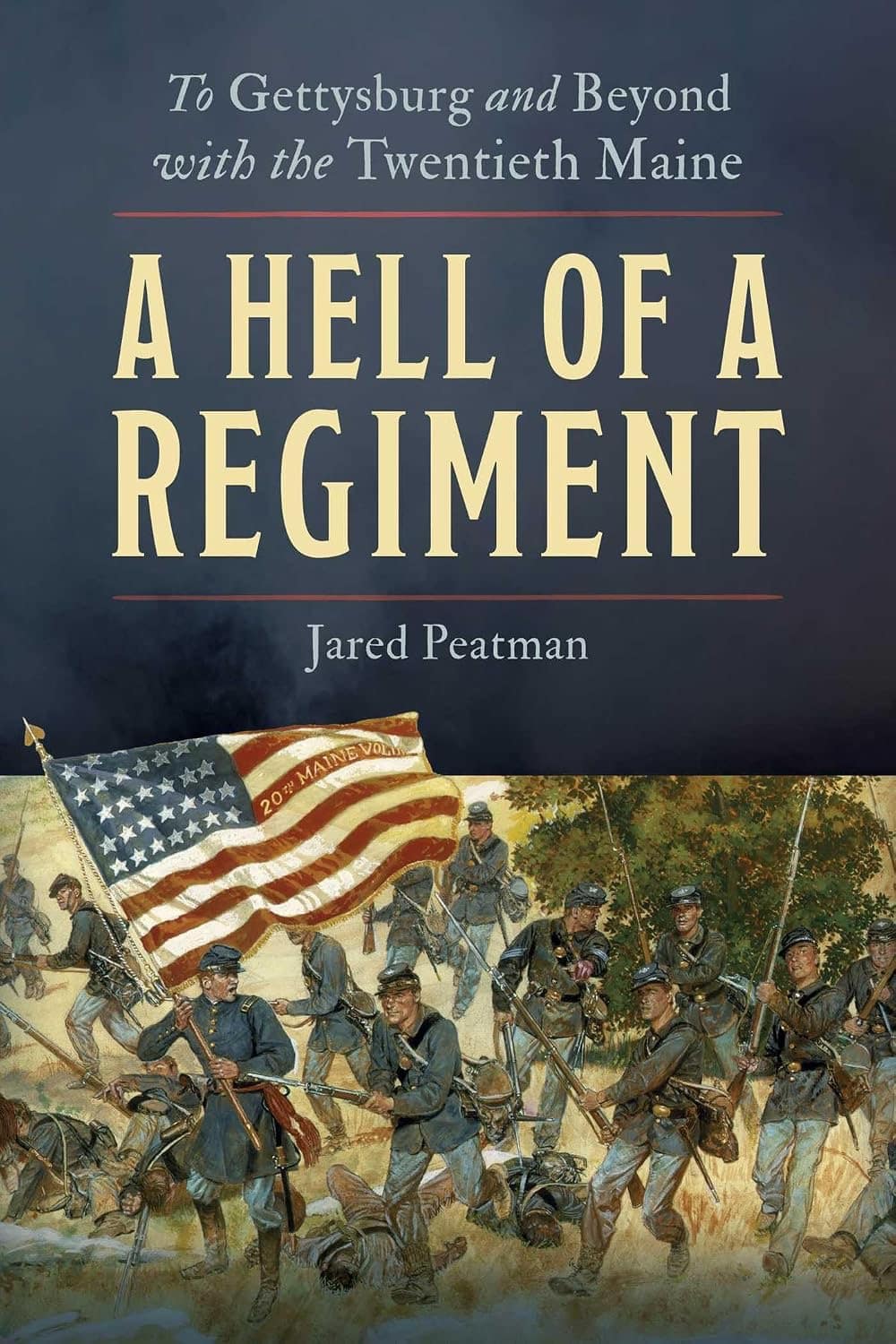
A Hell Of A Regiment: To Gettysburg and Beyond with the Twentieth Maine. By Jared Peatman, Mechanicsburg: Stackpole Books, 2026. Hardcover, 340 pp. $34.95.
Reviewed by Brian Swartz
Right on schedule with the generational book coverage devoted to the 20th Maine Infantry Regiment, author Jared Peatman has released his excellent examination of Maine’s best-known Civil War outfit.
John Pullen’s The Twentieth Maine: A Volunteer Regiment in the Civil War introduced the regiment’s wartime history to the nation in 1957. Thomas Desjardin’s 1995 Stand Firm ye Boys from Maine: The 20th Maine and the Gettysburg Campaign focused on the regiment’s role at Gettysburg. In his book, Peatman draws on “new questions and lines of inquiry” developed by historians since the late 20th century “to tell the story of the Twentieth Maine at Gettysburg and beyond in a new and deeper way.” (3)
He has certainly accomplished that goal, especially by bringing to life the officers and enlisted men who populated the 20th Maine. They are not just roster-roll names, but men whose ante- and postbellum lives Peatman often highlights.
He tells his story through the eyes and words of 20th Maine members. His sources range from privates (like Elisha Coan and William T. Livermore) to captains (Ellis Spear and Samuel Keene, for example) and colonels (Adelbert Ames and Joshua Chamberlain), plus other soldiers. So well does Peatman weave the tale that at times a reader almost hears a particular soldier speaking.
The author organizes his book with an introduction followed by six chapters that carry the 20th Maine’s lads through the war and into the future and the regiment into national memory. Chapter 1, “‘A hell of a regiment’: Becoming the Twentieth Maine,” tells how the regiment transitioned “from a bunch of civilians in the summer of 1862 to the highly effective fighting force that performed so well at Gettysburg just ten months later.” (3) Peatman gives the 20th Maine’s Gettysburg commander similar treatment in Chapter 2, “The Professor’s Education: Joshua Chamberlain’s Rise to Leadership.”
I particularly enjoyed Chapter 3, “‘So Clumsily Done’: The Second Maine Mutineers.” History usually folds the 120-odd 2nd Maine mutineers into the 20th Maine and leaves them there. Not Peatman: he covers the 2nd Maine’s history, why the three-year recruits mutinied, and how they wound up in the 20th Maine.
As throughout his book, Peatman provides the rich details relished by many historians; a sharp-eyed reader will realize the mutineers were not exactly the politely disgruntled veterans to whom Jeff Daniels (as Chamberlain) spoke quietly in the movie Gettysburg. When the mutineers arrived at the 20th Maine’s camp at bayonet point on May 23, 1863, Capt. Samuel Keene thought them “rather mutinous.” (105)
Peatman excels with pulling together the many facets of Little Round Top in Chapter 4, “‘With fixed bayonets and a yell’: Gettysburg.” The chapter utilizes “the dozens of accounts the men penned” (121) after Gettysburg to bring the 20th Maine from its longtime Stoneman’s Switch camp to Little Round Top. Readers meet the well-known personalities (William Oates gets his share of ink) and some lesser-known soldiers, such as the 2nd Maine’s top kick, Sgt. Andrew Jackson Tozier, unexpectedly made color sergeant by Chamberlain.
Rather than leave the story there, Peatman presents Tozier’s biography up to Gettysburg and, later in the book, his post-bellum life. Like other soldiers appearing in the book, Tozier seems almost three-dimensional.
Peatman argues convincingly in Chapter 4 that Little Round Top’s value to the Confederates was not as an artillery platform for enfilading the Union line, but because capturing the hill placed the Southerners “less than three hundred yards from the Taneytown Road,” (150) half of the Union army’s vital supply routes.
In chapter 5, “‘Almost worn out’: From War to Peace,” Peatman spends some time on the 20th Maine’s remaining war service, then follows particular soldiers as they return to civilian life. He writes about the effects of sickness and wounds and brings readers along as the Little Round Top veterans gradually fade away.
Chapter 6, “‘What you did, the world knows’: From History to Memory,” explores how the veterans’ disparate memories of Little Round Top coalesced into the overall tale that we know today. Peatman solidly addresses the circa early 1900s’ and modern criticisms of Chamberlain for what he did or allegedly did not do at Little Round Top.
The well-footnoted book ends with a short “Conclusion” and an extensive bibliography. Besides multiple photos, the book contains fourteen detailed maps. Gettysburg gets six, including four devoted to the Little Round Top fight. The lack of an index makes finding any of the numerous characters spread across the 298 text pages difficult, at best.
A Hell Of A Regiment is a welcome addition to the serious scholarship about the 20th Maine.


The lack of an index? A modern Civil War regimental history and the publisher released it without an index? I think you gloss past that way too quickly.
Agree with Ted. The lack of an index from a recognized publisher such as Stackpole is inexcusable.
Sounds like a great contribution. I’ve always been fascinated by the broader story of the 20th Maine, beyond Chamberlain.
I would have purchased this book, but glad I didn’t. I wouldn’t have thought to check to see if there was an index.
I believe Stackpole is also publishing the upcoming biography of Joseph Hooker. I will certainly do some research before purchasing that.
Don Hallstrom
While I agree that the lack of an index is unfortunate, the research that went into this book and the writing speak for itself. Jared is a fantastic historian and this book is well worth your time.