“Angel’s Glow” at the Battle of Shiloh
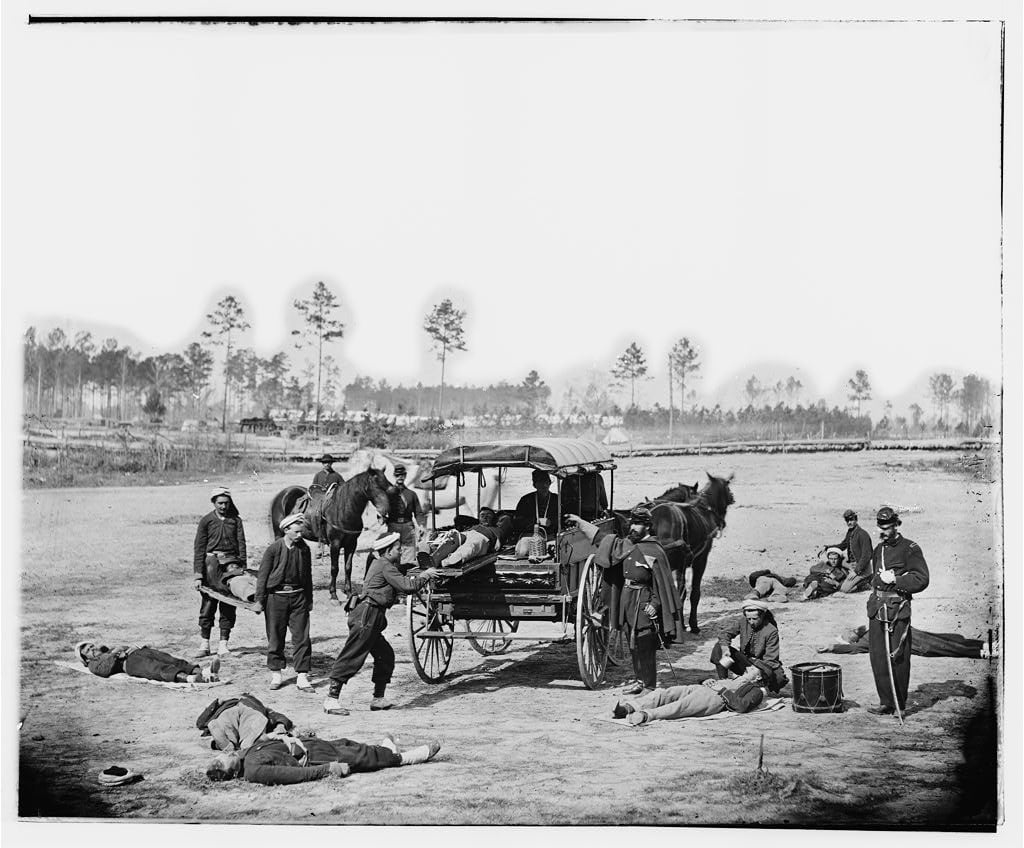
A friend of mine recently sent me an email with a link to an article published in Popular Mechanics. Authored by Elizabeth Rayne, the article was titled “Hundreds of Civil War Soldiers Were Destined to Die: Then Their Wounds Started Glowing.” While I possess limited mechanical ability (and I mean limited), the article intrigued me as I had never heard of this before. I was hooked and needed to know more.
Ms. Rayne described how over 16,000 soldiers lay wounded through the ravines, woodlands, and fields of the Shiloh battlefield. They lay where they had fallen that day in April 1862, shivering through a cold and rainy night before medical help could arrive.
When physicians reached the scene that night, they were taken aback by eerie, bluish lights that glowed in the darkness. Upon closer examination they discovered that the bluish lights were actually coming from some of the soldiers’ gaping wounds. They couldn’t explain it, but as time went by, it was noticed: “Even more strangely, the soldiers who had these eerie glowing wounds wound up having more of a fighting chance to survive.” Some began to believe that it was Divine Intervention and called the phenomenon “Angel’s Glow.”
It took until 2001 to get an explanation. Turns out two Maryland high school students by the names of Bill Martin and Jon Curtis learned about “Angel’s Glow” in their history class and decided to investigate. Luckily Jon’s mother was a biochemist.
They discovered that the glow came from bioluminescent bacteria named Photorhabdus luminescens that had invaded the soldiers’ wounds. Having a degree in biology, I was intrigued.
This bacterium lives symbiotically inside nematodes (flatworms) on the ground where they are taken up by insects. Once inside the insect, the bacteria secrete toxins and enzymes that are lethal to the insect causing the insect die and decompose so both the bacteria and nematodes can feed on the tissue of the decomposing carcass. The bacteria also produce another secretion that prevents other bacteria species from colonizing.
In other words, these last secretions likely prevented the wounded soldiers at Shiloh from succumbing to other infections or gangrene. Civil War surgeons had no way of knowing that the bluish glow they saw was a result of infected insects (flies and mosquitoes) being attracted to the smell of blood and landing on open wounds, spreading bioluminescent bacteria that would disinfect the wounds.
Was this seen on any other Civil War battlefields? This author has only read one other instance of something similar on a Civil war battlefield, and it was not in wounded soldiers but the dead in the aftermath of the battle of Cedar Mountain. The 6th Wisconsin Infantry of the Iron Brigade arrived after the battle was fought and established their camps and picket posts on the corpse-strewn battlefield on the evening of August 9, 1862. The wounded had been removed, and the dead were hastily buried.
While making the rounds that evening, Sgt. John Johnson encountered a badly shaken Pvt. Dennis Kelly on his picket post. “Sergeant,” Kelly told Johnson, “I have seen ghosts of spirits.” Johnson knew that Kelly was a steady, young fellow and well known for telling the truth. Kelly pointed in the direction of the “spirits,” and Johnson told him he would investigate the case. Walking in the direction indicated, Johnson discovered a dead body “interred very shallow, and a phosphorescent light oscillating from the head to the foot of the corpse. And so, it proved in every instance” of other hastily buried exposed decaying bodies. It was a warm, sultry nigh,t and Johnson guessed that the cause for the light was due to some gas escaping the bodies.
Why isn’t this seen more frequently in humans? The two young scientists showed that P. luminescens isn’t able to survive at average human body temperature. For those shivering and wet soldiers lying on the damp, clammy ground in the cold and rain, they became hypothermic, making it possible for the disinfecting bacteria to survive.
The bluish glow is a product of the lux operon – a cluster of genes that work together to produce the proteins responsible for the light emission.
So far, this is the best explanation for “Angel’s Glow” saving soldiers’ lives at Shiloh.
But is this true? If you search for results about “Angel’s Glow” you get nothing that dates back further than 2001. According to author Kelly Grooms in her July 11, 2024, article in Promega Connections titled “The Battle of Shiloh’s Angel’s Glow: Fact, Civil War Legend, or Modern Myth,” she argues that “Angel’s Glow” is a myth. She supports her argument with a statement on the Shiloh National Military Park Facebook page which says that with over 2,000 contemporary accounts of the Battle of Shiloh, including all of the surgeons’ reports in the park’s archives, there is not a single mention of glowing wounds. It is hard to imagine that anyone who had witnessed this phenomenon firsthand would not write about it. So, while “Angel’s Glow” is scientifically possible, its occurring on the Shiloh battlefield is highly improbable. It is even more improbable on the Cedar Mountain battlefield as the temperatures on August 9-10 were in the 90s during the day and low 80s at night. Theoretically, the bacteria would be unable to survive. It is a good myth, but another example of not letting the truth get in the way of a good story.
Sources:
Rayne, Elizabeth, “Hundreds of Civil War Soldiers Were Destined to Die. Then, Their Wounds Started to Glowing,” Popular Mechanics, June 4, 2026. Civil War Soldiers’ Wounds Started Glowing—And Saved Their Lives
Kahler, Abbott, “Seven Obscure Facts You Didn’t Know About the Civil War,” Smithsonian Magazine, November 15, 2011. Seven Obscure Facts You Didn’t Know About the Civil War
Hanna, Ella, “The Angel’s Glow,” Bossier City, Louisiana, Museum of the Confederacy. The-Angel-Glow-Shiloh.pdf
Searing, Linda, “Mystery of Glowing Wounds Solved,” HealthScout News, June 11, 2001.
Medical Discovery News, “Glowing Wounds,” University of Texas Medical Branch, December 21, 2018. Glowing Wounds – Medical Discovery News – UTMB
Grooms, Kelly, “The Battle of Shiloh’s Angel’s Glow: Fact, Civil War Legend, or Modern Myth,” Promega Connection , July 11, 2024. The Battle of Shiloh’s Angel’s Glow: Fact, Civil War Legend or Modern Myth? – Promega Connections
Statement from Shiloh National Military Park Facebook page: https://www.facebook.com/ShilohNMP/photos/a.112884892134839/567562260000431/?type=3
🔍 Misinformation Monday:… – Shiloh National Military Park | Facebook
Johnson, John, Milwaukee Telegraph, November 30, 1871, as quoted in Herdegen, Lance J. & Backus, Bill, Opening Manassas: The Iron Brigade, Stonewall Jackson, and the Battle on Brawner’s Farm, August 28, 1862, El Dorado Hills, CA: Savas Beatie, 2025, p. 126.
Noe, Kenneth W., The Howling Storm: Weather, Climate, and the American Civil War, Baton Rouge, LA: Louisiana State University Press, 2020, p. 167.
Krick, Robert K., Civil War Weather in Virginia, Tuscaloosa, AL: The University of Alabama Press, 2007, p. 65.


Fascinating. Good detective work.
Very interesting! But I wonder where the legend came from then? Surely it has to originate somewhere, if not from primary sources.
I have never come across this in primary sources. I don’t know where this myth originated. It is just an urban myth.
thanks Brian … what a great story (also cool to see Popular Mechanics still in biz) … and nice detective work chasing down those oddball references … i was hoping you had struck gold and the story was true … the explanation of the high school sleuths sure sounded good to me.